
Metabolic Clarity Labs · The Framework
The Four Loads FrameworkA Complete Guide to Understanding Your Metabolic Health
By Charles Kirkland, Founder of Metabolic Clarity Labs
Blood sugar. Belly fat. Blood pressure. Triglycerides. Inflammation. If you’ve ever looked at a lab report and seen five or six flagged numbers, it’s easy to assume you have five or six separate problems, each needing its own fix, its own supplement, its own explanation. That assumption is usually wrong, and it’s the single biggest reason people feel stuck managing their metabolic health.
The Four Loads Framework is the lens I built, out of necessity, to see these numbers as one connected story instead of an unrelated list. This page is the complete map of that framework: what each Load is, how they influence each other, what markers reflect them, and where to go next depending on which Load is driving your specific numbers.
Jump to a section
- Why “Loads” instead of “problems”
- The Four Loads, at a glance
- Glucose Load
- Storage Load
- Regulatory Load
- Inflammatory Load
- How the four Loads connect to each other
- Which Load is driving your numbers?
- Where this framework came from
- How to actually use this framework
- Frequently asked questions
Why “Loads” instead of “problems”
The word “Load” is deliberate. A problem implies something is broken and needs to be fixed once. A Load implies something your body is carrying, moment to moment, that can go up or down based on what you do, how you sleep, what you eat, and how your body happens to be built. Loads accumulate quietly. They rarely announce themselves with a single dramatic symptom. That’s exactly why they’re so easy to miss until a lab result forces the issue.
Framing your numbers as Loads instead of diagnoses does something practical: it stops you from treating a triglyceride number and a blood pressure number as two unrelated homework assignments. It lets you ask a better question than “how do I fix this number,” which is “what is actually driving this pattern, and which Load is it coming from?”
The Four Loads, at a glance
| Load | What it’s about | Key markers |
|---|---|---|
| Glucose Load | How your body handles the sugar and carbs you eat, and how steady your levels stay between meals | Fasting glucose, A1C, post-meal glucose, HOMA-IR, TyG Index |
| Storage Load | How your body stores and accesses energy, especially visceral fat around your organs | Waist circumference, waist-to-height ratio, triglycerides, HDL, liver enzymes |
| Regulatory Load | The systems, especially blood pressure, that keep your body in balance day to day | Blood pressure, resting heart rate, morning vs. evening BP patterns |
| Inflammatory Load | Background, chronic inflammation that quietly influences how the other three Loads behave | CRP, hs-CRP, indirect signals from the other three Loads |
Glucose Load
Every time you eat carbohydrates, your body breaks them into glucose and releases insulin to move that glucose out of your bloodstream. In a well-regulated system, glucose rises modestly and returns to baseline within a couple of hours. Glucose Load rises when that system works harder than it should, glucose spiking higher than expected, taking longer to settle, or fasting glucose creeping upward over months without an obvious cause.
Elevated Glucose Load rarely stays contained. Over time it can drive insulin resistance, which ties directly into Storage Load, since insulin also signals your body to store fat. This is the Load most people already have some numbers for (fasting glucose and A1C show up on nearly every standard panel), but the individual number is often read in isolation instead of as part of a pattern.
Read the full guide to Glucose Load →
Storage Load
Not all body fat behaves the same way. Subcutaneous fat, just under the skin, is largely a passive energy reserve. Visceral fat, wrapped around your internal organs, is metabolically active: it produces its own signaling molecules and is far more strongly linked to insulin resistance and cardiovascular risk. Storage Load rises when a larger share of your body’s energy storage is happening viscerally, which is why two people at the same body weight can carry very different levels of Storage Load.
This is also why the framework leans on waist-based measurements rather than weight alone. A stable number on the scale can hide a real shift in body composition, and Storage Load shows up across your lipid panel (triglycerides, HDL) and liver enzymes as much as it does on a tape measure.
Read the full guide to Storage Load →
Regulatory Load
Your body relies on a set of interconnected systems, the autonomic nervous system, your kidneys, hormones like cortisol, to keep blood pressure and other vital functions stable despite constantly changing conditions. Regulatory Load rises when those systems are under sustained strain: blood pressure running higher than it should more often than it should, a resting heart rate that creeps upward, or a pattern that doesn’t settle overnight the way it’s supposed to.
A single blood pressure reading taken once in a doctor’s office is a limited snapshot of Regulatory Load, since blood pressure naturally varies throughout the day and can spike simply from the anxiety of being at an appointment. This is why home monitoring, averaged across several readings, gives a far more honest picture than any one number.
Read the full guide to Regulatory Load →
Inflammatory Load
Chronic, low-grade inflammation is different from the acute inflammation you feel from a cut or a cold. It’s a persistent, lower-level immune activation that often produces no obvious symptoms at all, and it’s rarely tested for unless specifically requested. That makes Inflammatory Load the easiest of the four to overlook entirely.
It’s also arguably the most connective. Visceral fat, the core of Storage Load, actively produces inflammatory signaling molecules. Chronic inflammation is associated with worsened insulin resistance, tying it back to Glucose Load. And there’s growing evidence connecting inflammation to blood vessel function, linking it to Regulatory Load as well. Inflammatory Load is less a fourth, separate problem and more a thread running through the other three.
Read the full guide to Inflammatory Load →
How the four Loads connect to each other
This is the part most health content skips entirely, and it’s the actual point of the framework. Treating four numbers as four separate to-do items misses the mechanism connecting them:
- Glucose Load ↔ Storage Load: Insulin resistance promotes fat storage, and increased visceral fat worsens insulin resistance in return, a cycle that’s hard to interrupt from either direction alone.
- Glucose Load ↔ Regulatory Load: Insulin resistance is associated with impaired blood pressure regulation, and chronic stress (a Regulatory Load factor) raises cortisol, which raises blood glucose independent of what you’ve eaten.
- Storage Load ↔ Inflammatory Load: Visceral fat tissue directly produces inflammatory signaling molecules, meaning Storage Load is quite literally generating Inflammatory Load as a byproduct.
- Inflammatory Load ↔ Regulatory Load: Emerging evidence connects chronic inflammation to blood vessel function and blood pressure regulation over time.
This is why an isolated intervention (a supplement for cholesterol, a medication for blood pressure) can feel like it’s not “working” even when the target number improves: if the Load actually driving the pattern is somewhere else, the underlying pressure hasn’t changed, it’s just showing up through a different number instead.
Which Load is driving your numbers?
There’s no universal answer to this, and be skeptical of anyone who claims there is. The honest process looks like this:
- Gather your actual numbers from your most recent labs and home blood pressure readings, not estimates or how you feel.
- Look for clusters, not isolated flags. A high triglyceride number next to a high waist measurement points toward Storage Load. A blood pressure pattern that doesn’t dip at night, alongside poor sleep, points toward Regulatory Load.
- Use the connected tools below to see how your specific numbers relate to each other, rather than reading each one in isolation.
- Bring the full pattern to your physician, not just the number that worried you most. The relationships between your numbers are often more informative than any single value.
Free tools for each Load:
- Glucose Load: A1C & Average Glucose Calculator, HOMA-IR Calculator, TyG Index Calculator, Post-Meal Glucose Tracker
- Storage Load: Waist-to-Height Ratio Calculator, Triglyceride-to-HDL Ratio Calculator, Complete Cholesterol Numbers Calculator
- Regulatory Load: Blood Pressure Average Calculator
- All four at once: Metabolic Syndrome Calculator, Complete Metabolic Health Numbers Decoder, Metabolic Progress Tracker
Where this framework came from
I didn’t build this framework in a classroom. I built it after 25 years as a direct response marketer helping grow some of the biggest brands in the health and supplement space, while completely ignoring my own health in the process. At 54, my lab results came back alarming: triglycerides at 1,761, blood pressure at 192/114, an A1C of 7.2%. My doctor’s exact words were that my blood was “basically gravy.”
Working closely with my physician, on prescribed medication, I started tracking how daily choices connected to these numbers instead of treating each one as a separate crisis to panic about individually. Thirty days later: triglycerides at 163, A1C at 6.5%, blood pressure at 119/74. The Four Loads Framework is the system I built to make sense of that process, organizing what could have felt like four unrelated emergencies into one connected picture I could actually act on.
These are my own documented results, achieved under physician supervision with prescribed medication. They are not a promise of what anyone else will experience. Read the full story on the About page.
How to actually use this framework
This isn’t a framework you “finish.” It’s a lens you keep applying as new numbers come in. A practical starting sequence:
- Pull your most recent labs and any home blood pressure readings you have.
- Sort them into the four Loads above.
- Use the Complete Metabolic Health Numbers Decoder to see them together in one report instead of four separate numbers.
- Notice which Load has the most flags, or the most severe ones. That’s usually your starting point, not necessarily the number that scared you most on first glance.
- Bring that pattern, not just one number, to your physician, and ask specifically how the Loads might be interacting in your case.
- Recheck in 30 to 90 days using the same tools, so you’re comparing a real trend instead of a single before-and-after snapshot.
If you want more structure than doing this alone, our FAQ covers common questions about getting started, and you can reach out directly with questions about your specific situation.
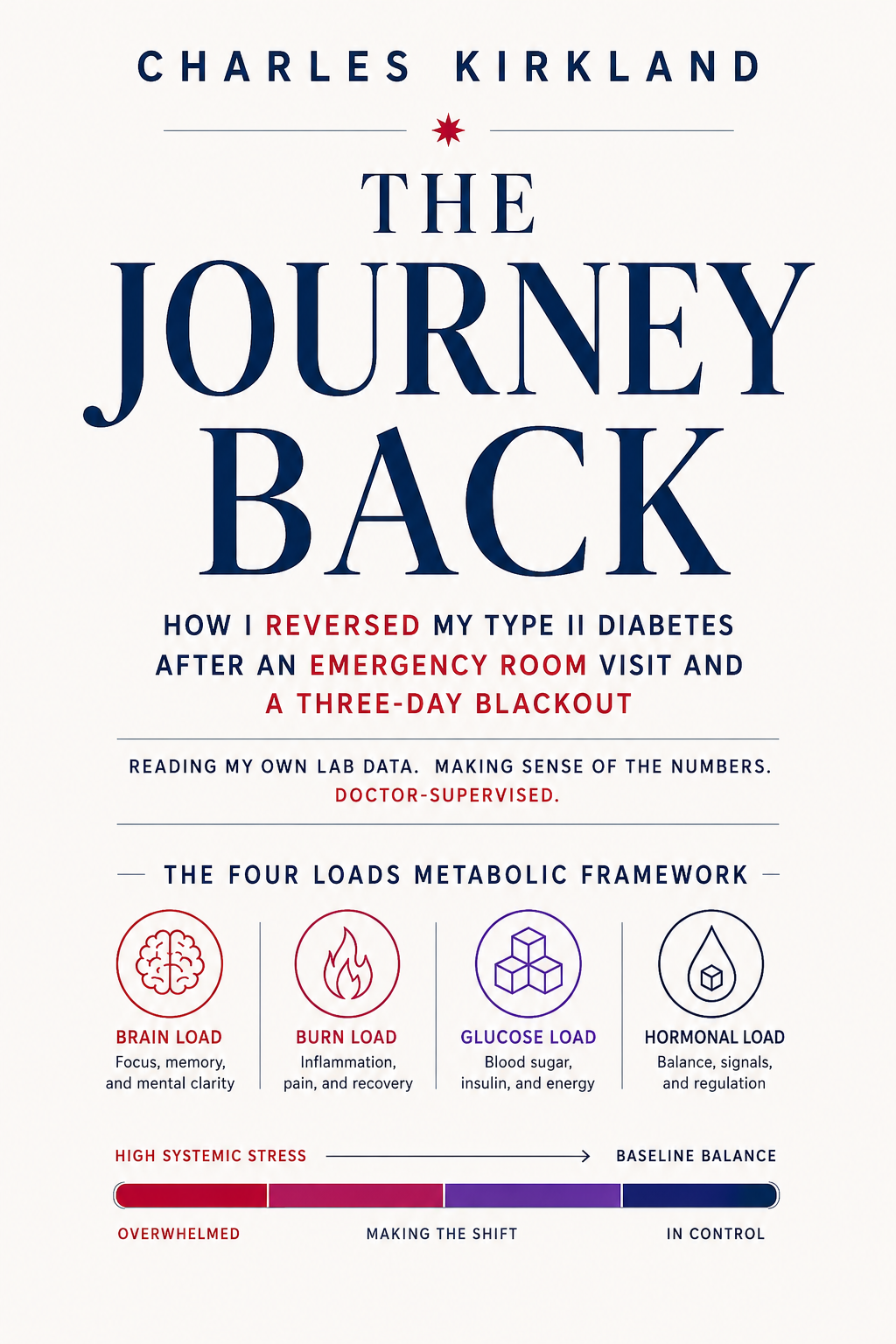
The whole framework, in one place
The Journey Back is the long-form version of this page: the four Loads, how they pull on each other, and the questions I brought to my own physician when my labs came back alarming. Written by someone who had to work it out from the inside, in plain English.
Frequently asked questions
Is the Four Loads Framework a medical diagnosis system?
No. It’s an educational framework for organizing and understanding common metabolic health markers. It does not diagnose any condition, including metabolic syndrome, prediabetes, or hypertension. Diagnosis requires a qualified healthcare professional using established clinical criteria.
Do I need to have a diagnosed condition to use this framework?
No. Many people use it simply to better understand routine lab results and home blood pressure readings, whether or not any individual number is currently flagged as abnormal.
How is this different from metabolic syndrome criteria?
Metabolic syndrome is a specific clinical diagnosis based on five defined criteria (waist circumference, triglycerides, HDL, blood pressure, and fasting glucose). The Four Loads Framework is a broader educational lens that includes those same markers, plus Inflammatory Load, organized around the mechanisms connecting them rather than a diagnostic threshold. You can check the formal criteria directly with our Metabolic Syndrome Calculator.
Can all four Loads be elevated at once?
Yes, and it’s common, precisely because the Loads influence each other. This is one of the core reasons the framework exists: to help you see that pattern instead of four disconnected numbers.
Which Load should I address first?
There’s no universal order. The right starting point depends on your specific numbers, symptoms, and history, which is why this page emphasizes gathering your actual data and discussing the full pattern with your physician rather than following a fixed sequence.
Can supplements alone address a Load?
Be skeptical of any product, including ours, that claims to single-handedly resolve a Load. Every Load discussed here is influenced by multiple factors, diet, sleep, stress, activity, medications, and genetics among them, and no single product addresses all of them.