

Quick answer: To compare berberine supplements, check the stated form and amount, serving size, finished-product testing, medication suitability, and cost per serving. This guide provides buying criteria rather than a tested brand ranking. Metabolic Clarity Labs sells berberine, so apply the same standards to our products.
Why Berberine Quality Varies So Much
FDA does not approve dietary supplements for safety and effectiveness before sale. Manufacturers are responsible for lawful products and accurate labeling, and must follow applicable manufacturing requirements. That makes verifiable product documentation useful. See FDA’s explanation of supplement oversight.
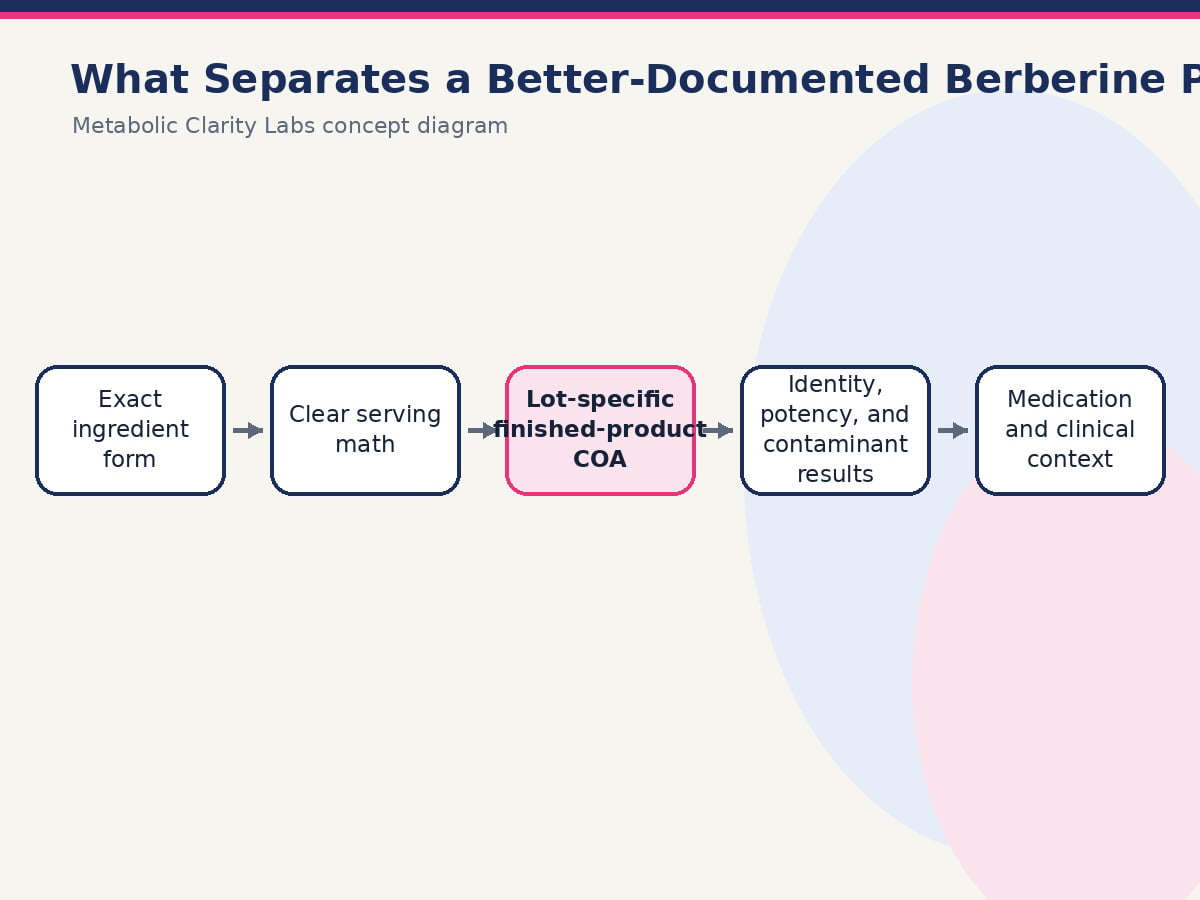
1. Third-Party Testing and a Real Certificate of Analysis
A Certificate of Analysis reports test results for a sample. It may come from an internal or independent laboratory, and may concern a raw ingredient or finished product. Check the laboratory, product identity, lot number, test methods, dates, and what was actually measured. A recent report for a different lot does not establish the quality of the bottle you are buying.
If a product has no COA, or the company can’t produce one when asked, that’s a real red flag, not a minor omission. We’ve written a full breakdown of how to actually read a berberine COA once you have one in hand, since the document itself can be confusing if you don’t know what you’re looking at.
2. Compare the formulation and evidence
HCl, phytosome formulations, and dihydroberberine are not interchangeable milligram for milligram. A study showing absorption differences does not by itself establish better long-term outcomes or fewer side effects. Read our formulation comparison and discuss tolerability concerns with a pharmacist before switching.
3. Read the amount per serving
Check whether the amount refers to one capsule, several capsules, or a proprietary blend. Research doses are not personal instructions. Use our dosage evidence guide to understand study context, and have a qualified professional assess your medicines and health history before use.
4. Manufacturing Standards: GMP Certification
Current good manufacturing practice requirements apply to dietary supplement manufacturing. A “GMP” claim alone does not prove an individual bottle’s contents or clinical benefits. Ask what organization audited the facility and what the certification covers. FDA explains the manufacturing requirements here.
5. Additional Certifications, and When They Matter
Beyond GMP and a COA, some products carry additional third-party certifications. NSF Certified for Sport specifically screens for banned athletic substances and verifies label claims; it matters most if you’re a competitive athlete subject to drug testing. Independent testing organizations that publish their own lab results (rather than relying on manufacturer-submitted data) offer another layer of verification for anyone who wants it. None of these are strictly necessary for the average person, but they’re worth knowing about if you fall into either category.
Red Flags Worth Walking Away From
- Proprietary blends that hide the actual berberine amount. If a label lists berberine as part of an unlabeled “proprietary blend” total without disclosing the specific milligram amount, you have no way to know if you’re getting a meaningful dose.
- “Nature’s Ozempic” or drug-comparison marketing. We’ve covered whether that comparison actually holds up elsewhere, but as a general rule, be skeptical of any supplement marketing itself as equivalent to a prescription medication.
- No COA available on request. A company confident in its product’s quality has no reason to make this hard to find.
- Unrealistic promises about speed or scale of results. Supplement outcomes vary by person, and anyone guaranteeing a specific result is overstating what the evidence supports.
A Note on Our Own Product
Metabolic Clarity Labs sells a berberine supplement, so it’s worth being direct about that: everything above is the same criteria we’d want you to apply to our product as much as anyone else’s. If you’re evaluating ours, ask for the COA. Check the form and dose against what’s studied. That’s the honest standard, not a sales pitch dressed up as one.
Before You Buy, One More Check
Berberine has real drug interaction considerations, particularly with certain medications metabolized through specific liver enzyme pathways, and it isn’t appropriate for everyone. Read our full rundown in Before You Buy Berberine before making a purchase, and talk to your physician first if you take any prescription medication, especially metformin.
A label comparison you can do yourself
Imagine bottle A costs $24 and contains 60 capsules, with two capsules per serving and 800 mg berberine per serving. It contains 30 servings at $0.80 each. Bottle B costs $30 and contains 60 one-capsule servings, each with 500 mg, at $0.50 per serving. These fictional products differ in amount as well as price. Neither calculation establishes which dose is suitable or which product has better quality.
Write down the form, amount per serving, capsules per serving, lot-specific testing, and cost for each actual product. Keep unanswered questions visible. Use the nine-point purchase checklist to take that comparison to a pharmacist.
Sources
Quality and testing standards referenced in this guide are based on published reporting from independent supplement testing and consumer health publications current as of 2026, including coverage from Fortune, Innerbody, and ConsumerLab’s ongoing supplement testing program.
Leave a Reply