
If you’ve ever gotten an A1C result back and wondered what that percentage actually means in the same units your glucose meter uses, there’s a real, published formula behind the conversion. This walks through exactly how it works, step by step, so you’re not just trusting a black-box calculator.
The Formula Itself
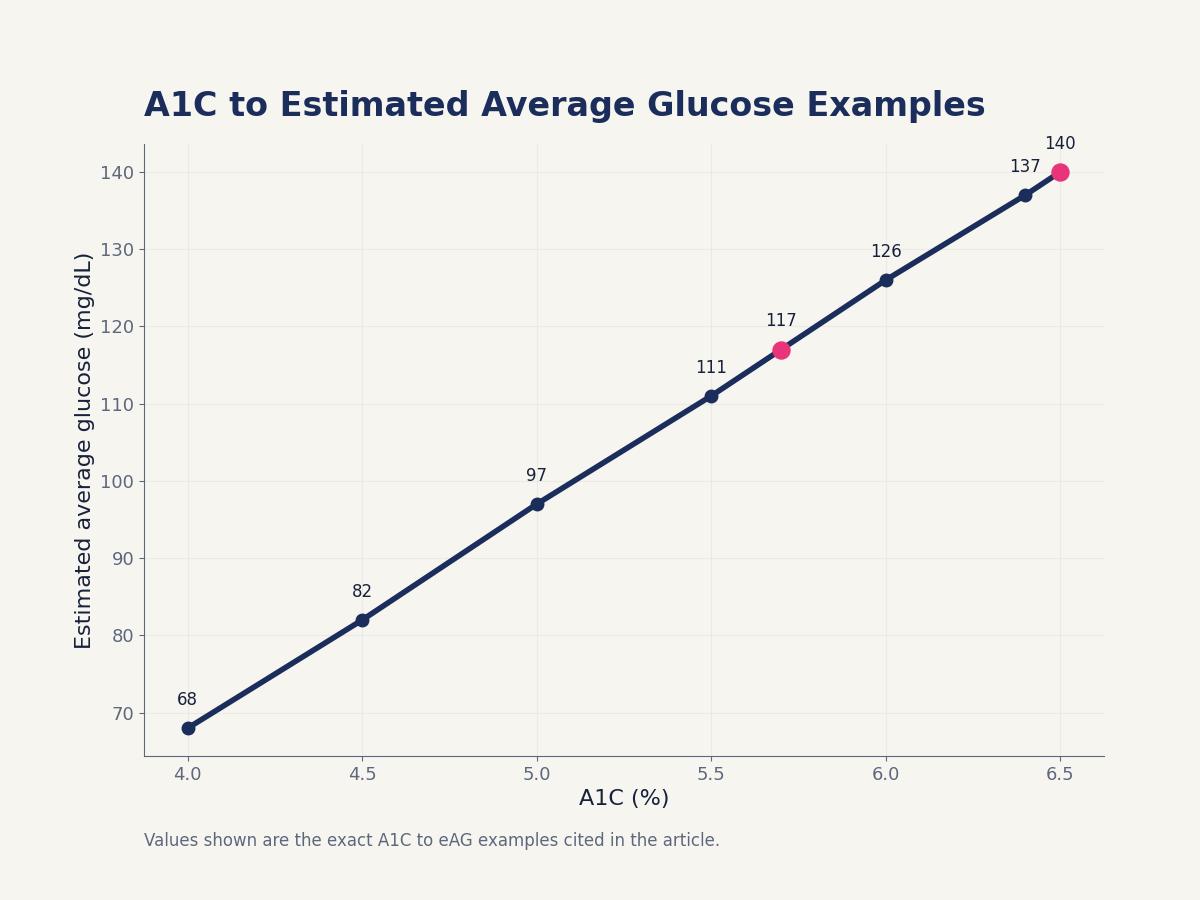
The conversion comes from a large 2008 study called the A1C-Derived Average Glucose (ADAG) Study, which tracked roughly 2,700 glucose readings per person over three months and compared them against lab-measured A1C values. The resulting formula, now used by the American Diabetes Association itself, is:
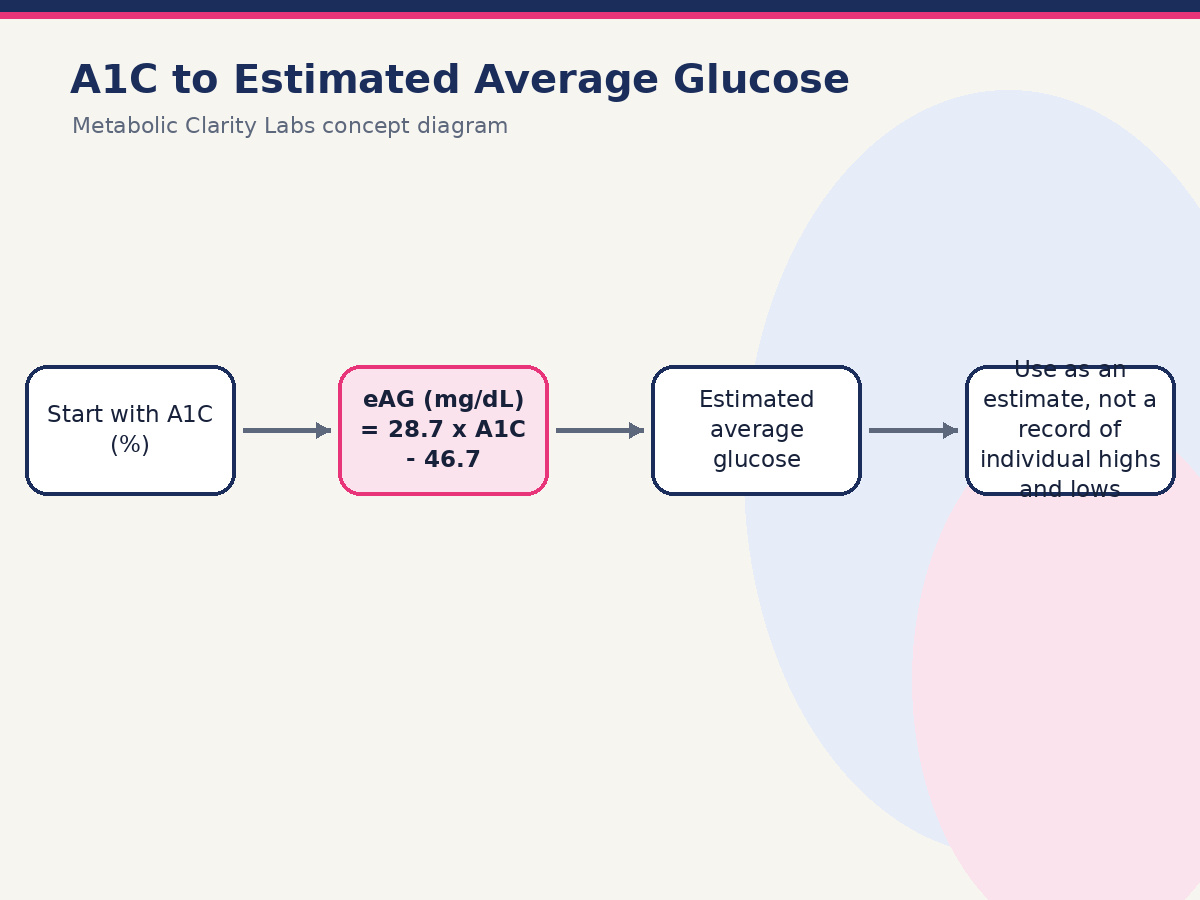
Estimated Average Glucose (mg/dL) = 28.7 × A1C − 46.7
That’s it. Two numbers, one multiplication, one subtraction.
Step-by-Step: Working Through a Real Example
Let’s say your A1C came back at 7.0%. Here’s the actual math:
- Multiply your A1C by 28.7: 7.0 × 28.7 = 200.9
- Subtract 46.7 from that result: 200.9 − 46.7 = 154.2
Your estimated average glucose is approximately 154 mg/dL.
Let’s try a second example with an A1C of 6.5%:
- 6.5 × 28.7 = 186.55
- 186.55 − 46.7 = 139.85
That rounds to an estimated average glucose of approximately 140 mg/dL.
Converting to mmol/L Instead
If your lab reports glucose in mmol/L rather than mg/dL (common outside the U.S.), there’s a parallel version of the same formula:
Estimated Average Glucose (mmol/L) = 1.59 × A1C − 2.59
Using the same 7.0% example: (1.59 × 7.0) − 2.59 = 11.13 − 2.59 = 8.54 mmol/L. That matches the mg/dL result above, since 154 mg/dL ÷ 18 also lands at roughly 8.6 mmol/L, the standard conversion factor between the two units.
Quick Reference Table
| A1C (%) | eAG (mg/dL) | eAG (mmol/L) |
|---|---|---|
| 5.7 | 117 | 6.5 |
| 6.0 | 126 | 7.0 |
| 6.5 | 140 | 7.8 |
| 7.0 | 154 | 8.6 |
| 7.5 | 168 | 9.3 |
| 8.0 | 183 | 10.1 |
| 9.0 | 212 | 11.7 |
| 10.0 | 240 | 13.3 |
Working the Formula in Reverse
If you have an average glucose reading and want to estimate what A1C that corresponds to, the formula rearranges algebraically to:
A1C (%) = (Average Glucose in mg/dL + 46.7) ÷ 28.7
For example, an average glucose of 170 mg/dL: (170 + 46.7) ÷ 28.7 = 216.7 ÷ 28.7 = approximately 7.6%.
Why This Formula Exists At All
Before the ADAG Study, A1C and day-to-day glucose meter readings were essentially two different languages. A1C is reported as a percentage reflecting the proportion of hemoglobin in your red blood cells that has glucose attached, a reflection of your average blood sugar exposure over roughly the past two to three months, weighted more heavily toward the most recent month. Your glucose meter, on the other hand, reports a direct mg/dL or mmol/L reading at a single moment. The ADAG Study’s contribution was mathematically connecting these two different ways of describing the same underlying thing, so a clinician (or you) can translate one into the language of the other.
What This Number Does and Doesn’t Tell You
Estimated average glucose is exactly what it sounds like: an estimate, based on a population-level formula, not a personalized measurement of your own glucose patterns. Two people with the identical A1C can have meaningfully different day-to-day glucose behavior, one might run steady throughout the day, another might swing widely between high post-meal spikes and low troughs, and still land on the same average. eAG also can’t tell you anything about the timing, size, or frequency of those swings, only the mathematical average.
This is also why A1C itself isn’t always perfectly reliable for everyone. Certain conditions, including some forms of anemia and other factors affecting red blood cell lifespan, can skew A1C results independent of actual glucose levels. If your A1C result seems inconsistent with your own glucose meter readings, that’s worth raising directly with your physician rather than assuming the math is wrong.
Do the Math Instantly Instead
If you’d rather not do the arithmetic by hand every time, our A1C and Average Glucose Calculator runs this exact ADAG formula in both directions, mg/dL and mmol/L, instantly. Understanding the math behind it, though, means you’re not just trusting a number a tool spits out. You know exactly where it came from.
Sources
Nathan DM, Kuenen J, Borg R, Zheng H, Schoenfeld D, Heine RJ, for the A1c-Derived Average Glucose (ADAG) Study Group. “Translating the A1C Assay Into Estimated Average Glucose Values.” Diabetes Care, 2008. American Diabetes Association, eAG/A1C Conversion Calculator.
Leave a Reply