
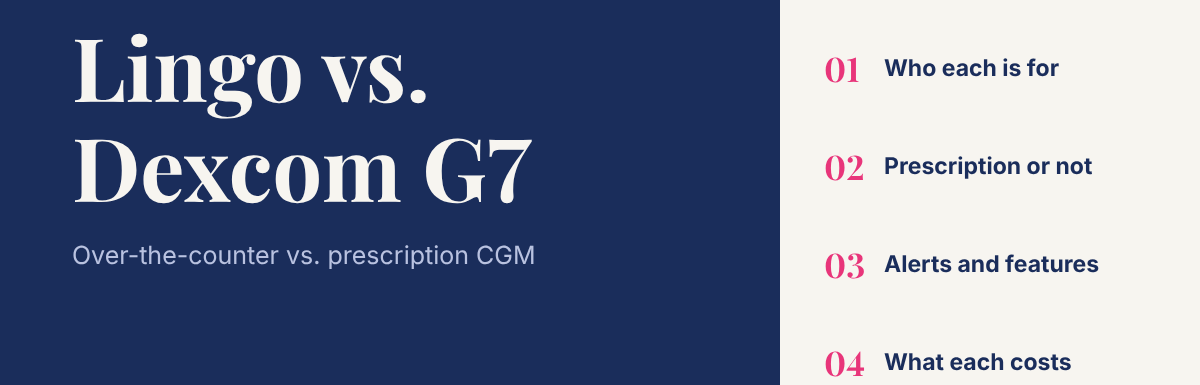
Lingo and the Dexcom G7 both put a small sensor on the back of your arm and send glucose readings to your phone. They are built for different people. One is a wellness product you can order yourself. The other is a prescription medical device with alarms. This guide compares them and shows which side of the table applies to you.
Quick answer: Lingo, made by Abbott, is an over-the-counter sensor for adults 18 and older. Abbott says it is not intended to diagnose or manage any disease, including diabetes, and it has no glucose alarms. The Dexcom G7 is a prescription CGM for people with diabetes, including people who use insulin, and it has real-time high and low alerts. If you use insulin or have had low blood sugar, the G7 side is the relevant one. This is education, not medical advice.
Lingo vs G7 at a glance
Lingo figures come from a November 2026 comparison citing the FDA record and a September 2026 price check. G7 figures come from the ADCES comparison used in our Stelo vs G7 guide. Confirm every number with Abbott and Dexcom before you buy.
| Feature | Abbott Lingo | Dexcom G7 |
|---|---|---|
| Prescription | Not required | Required |
| Who it is for | Adults 18+ tracking glucose for general wellness | People 2+ with any type of diabetes, including insulin users |
| Sensor wear | Up to 14 days | 10 days plus a 12-hour grace period (a 15-day version also exists) |
| Readings | Updates every minute | Every 5 minutes |
| Glucose range shown | 55 to 200 mg/dL | 40 to 400 mg/dL |
| High and low alerts | None | Yes, real-time and customizable |
| Insulin pump link | None | Works with some pumps and pens |
| Phones | iPhone, and Android since December 2025 | iPhone and Android |
| Insurance | Cash only; HSA or FSA funds usually allowed | Often covered with a prescription |
Who each one is cleared for
This is the difference that matters most. Abbott split its over-the-counter line in two: Lingo for people without diabetes, and a second sensor called Libre Rio for adults with type 2 diabetes who do not use insulin. Lingo carries a label statement that it is not for managing diabetes. Plenty of people with type 2 buy it anyway because insurance will not pay for a prescription sensor, but that is outside what it is cleared to do. The G7 is a medical device for diabetes, and according to ADCES it is approved from age 2.
Alerts and range
Lingo has no alarm for a high or a low, and it only displays values between 55 and 200 mg/dL. A reading above 200 simply shows as above range, so you cannot see how high you went. The G7 reads from 40 to 400 mg/dL and can wake you up when you drop. If a low could be dangerous for you, a sensor without alarms is the wrong tool. Our which CGM for which goal guide covers that decision.
One label detail for Lingo: taking more than 1,000 mg of vitamin C a day can falsely raise its readings.
What each costs
In the September 2026 price check, Lingo was $54 for one 14-day sensor, $89 for two, and $249 for six. Wearing one continuously takes about two sensors a month. The G7 has no simple cash price because most people get it through insurance. GoodRx figures from 2024, quoted in our CGM cost without insurance guide, put a month of G7 sensors at several hundred dollars at list price, and far less with coverage or coupons.
| Lingo plan | Math | Cost per sensor |
|---|---|---|
| One sensor | $54 / 1 | $54.00 |
| Two sensors | $89 / 2 | $44.50 |
| Six sensors | $249 / 6 | $41.50 |
Decision table
| If this is true | Then consider | Because |
|---|---|---|
| You use insulin | A prescription CGM such as the G7 | Lingo is not for insulin users |
| You have had low blood sugar | A prescription CGM with alerts | Lingo has no low alarm |
| You have type 2 and do not use insulin | Ask about a prescription CGM, or look at Stelo | Stelo is cleared for that group; Lingo is a wellness product |
| You have no diabetes and are curious | Lingo | Lowest cost for a two-week look |
| You are under 18 | The prescription route | Lingo is for adults |
| You want insurance to pay | Ask about the G7 | Lingo is cash-pay |
What a sensor can and cannot tell you
Either sensor shows patterns: what a meal, a walk, or a short night does to your glucose over hours. Neither one diagnoses anything. A September 2026 study of over-the-counter sensors in 39 young adults without diabetes found an average error of about 13% against fingerstick readings, and its authors warned against using them for diagnostic cutoffs. Labs ordered by your clinician remain the standard. Read how to read CGM data before your first sensor so the graph makes sense.
Day-to-day use
Both sensors go on the back of the upper arm and are applied with a one-press applicator. After that, daily life with each one feels different.
Lingo is built to teach. The app refreshes every minute, scores your glucose swings, and offers short lessons on what moved your numbers. There is nothing to respond to in the moment because it never sounds an alarm. You open the app when you are curious. A sensor lasts up to 14 days, and many people wear one or two and then stop.
The G7 is built to protect. It warms up in about 30 minutes, reads every five minutes, and will alert you if you are heading low or high, including overnight. It can connect to some insulin pumps and pens. A standard sensor lasts 10 days with a 12-hour grace period, so you change it about three times a month, and it is meant to be worn continuously.
| Everyday question | Lingo | Dexcom G7 |
|---|---|---|
| Will it wake me for a low? | No | Yes, if alerts are set |
| Can I see a reading above 200? | No, it shows above range | Yes, up to 400 mg/dL |
| Sensors per month | About two | About three (standard sensor) |
| Meant for | Short learning periods | Continuous wear |
If you have type 2 diabetes and are choosing between them
This is the most common reason people compare these two. Lingo is not the sensor designed for you, even though nothing stops you from buying it. Three paths make more sense to check first.
- Ask whether your plan covers a prescription CGM. Coverage for people with type 2 who do not use insulin has widened. Our guides on CGM coverage for type 2 without insulin and Medicare CGM coverage list what insurers ask for.
- Look at Stelo. It is Dexcom’s over-the-counter sensor and is cleared for adults with type 2 who do not use insulin. See Stelo vs G7.
- Use a meter in a structured way. Paired readings before and two hours after a meal answer many of the same questions for much less money. See CGM vs fingerstick meter.
If you take insulin or a sulfonylurea, skip the over-the-counter options entirely. The missing low alarm is the reason.
Common mistakes
- Treating Lingo as a cheaper G7. They are different categories of product with different cleared uses.
- Using Lingo as a safety net. It cannot warn you about a low.
- Reading above range as a number. Lingo stops at 200 mg/dL, so you do not know how high a spike went.
- Comparing cash price with insured price. A covered G7 can cost less out of pocket than Lingo.
- Changing medication from a sensor reading. Confirm with a meter and talk with your prescriber first.
- Taking high-dose vitamin C with Lingo. More than 1,000 mg a day can falsely raise its readings.
Questions to bring to your appointment
- Do any of my medicines put me at risk of low blood sugar?
- Would a prescription CGM be covered for me, and what documentation does my plan need?
- If I try an over-the-counter sensor first, what should I look for and when should I call you?
- Should I keep a fingerstick meter as a backup?
- Do any supplements or medicines I take interfere with sensor readings?
Accuracy: what the numbers mean
Sensor accuracy is usually reported as MARD, the mean absolute relative difference between sensor readings and a reference blood measurement. Lower is better. ADCES lists the Dexcom G7 at 8.2%. The sources checked for this guide do not agree on a single figure for Lingo, so this page does not quote one. Ask Abbott for the current number if it matters to your decision.
Three points keep MARD in perspective.
- It is an average across many people. Your own sensor on a given day can be better or worse.
- Sensors lag. They read fluid under the skin, which trails blood glucose by several minutes. The gap is widest when glucose is rising or falling quickly, such as after a meal or during exercise.
- Accuracy is not even across the range. Sensors generally perform less well at low readings, which is exactly where a mistake matters most for someone on insulin.
That last point is why the two products are regulated differently. A device that people use to make insulin decisions has to meet a higher bar and carry alarms. A wellness sensor that shows patterns does not. Our CGM vs fingerstick meter guide explains MARD in more depth.
Insurance, HSA, and FSA
| Question | Lingo | Dexcom G7 |
|---|---|---|
| Covered by commercial insurance? | No | Often, with a prescription and plan criteria |
| Covered by Medicare? | No | For people who meet Medicare’s criteria |
| HSA or FSA funds? | Usually allowed | Usually allowed for your share |
| Where you get it | Online from Abbott and retailers | Pharmacy or medical supplier |
| Paperwork | None | Prescription; sometimes prior authorization |
Coverage rules for the G7 depend on your plan and your treatment. People who use insulin or have documented low blood sugar qualify most easily. Rules for people with type 2 who do not use insulin vary. See Medicare vs private insurance for CGM coverage and Medicaid coverage by state. For Lingo, our HSA and FSA guide covers how to pay with pre-tax funds.
Scenarios by situation
These are hypothetical illustrations of how the choice tends to play out. They are not case histories and do not replace your clinician’s advice.
A healthy 45-year-old who wants to see what breakfast does. Lingo fits. One sensor for two weeks answers the question. A G7 is not intended for this person and would need a prescription.
Someone with type 2 on metformin who was told insurance will not cover a CGM. Neither product is the obvious answer. Stelo is cleared for this group, and a second look at coverage rules may be worthwhile. Lingo is a fallback, with the limits described above.
Someone with type 2 who just started basal insulin. The G7 side applies. Low alarms matter now, and insulin use usually opens the door to coverage.
A parent looking for a sensor for a child with type 1. The G7, or another prescription CGM. Lingo is for adults and has no alarms.
An endurance athlete without diabetes. Lingo, or a subscription program built around training. See exercising with a CGM.
A buying checklist
- Write down the one or two questions you want a sensor to answer.
- Confirm which product is cleared for your situation.
- Check that your phone model and operating system are supported.
- For Lingo, pick the smallest pack that answers your question. For the G7, call your plan and ask what it covers and what it needs from your prescriber.
- Ask about replacement policies for sensors that fail early.
- Keep a fingerstick meter available for readings that do not match how you feel.
- Tell your clinician before you start.
Bottom line by situation
| Situation | Bottom line |
|---|---|
| No diabetes, curious | Lingo is built for you |
| Prediabetes | Lingo or Stelo; see best CGM for prediabetes |
| Type 2, no insulin | Check coverage for a prescription CGM, then look at Stelo |
| Any insulin use | G7 or another prescription CGM |
| History of lows | A prescription CGM with alarms |
| Under 18 | Prescription route |
| Lowest cash cost for a short look | One Lingo sensor |
Frequently asked questions
Is Lingo FDA cleared?
Yes. The FDA cleared Lingo in June 2024 as an over-the-counter glucose sensor for adults. Clearance for over-the-counter wellness use is not the same as clearance to manage diabetes, and Abbott states that Lingo is not intended for diagnosing or managing any disease.
How long does each sensor last?
A Lingo sensor is labeled for up to 14 days. A standard Dexcom G7 sensor lasts 10 days plus a 12-hour grace period, and a 15-day G7 sensor also exists. Individual sensors can fail early, so ask each company about its replacement policy.
Does Lingo work with Android phones?
Yes. Lingo launched on iPhone and added Android in December 2025. Check the current list of supported phone models and operating system versions before you buy, because not every device is compatible.
Can I start with Lingo and move to a G7 later?
Yes, but they are separate systems. The G7 needs a prescription and its own app, and your Lingo history does not carry over. Screenshots of your Lingo graphs can still be useful to show your clinician when you ask about a prescription CGM.
Can I wear Lingo to find out whether I have diabetes?
No. An over-the-counter sensor is not a diagnostic test. If your readings worry you, ask for lab work such as an A1C and a fasting glucose, which are the tests used for diagnosis.
Why would someone without diabetes choose Lingo over a G7?
Access and cost. The G7 requires a prescription and is intended for people with diabetes. Lingo can be ordered directly, cost $54 for a two-week trial in the September 2026 price check, and is designed around learning how food, sleep, and activity affect glucose.
Is Lingo as accurate as the Dexcom G7?
They use different sensor platforms and have not been compared head to head in the sources checked for this guide. Lingo is built on Abbott’s FreeStyle Libre technology. Accuracy figures are averages and do not predict your own sensor.
Can I use Lingo if I have type 2 diabetes?
Abbott states that Lingo is not intended for managing diabetes. If you have type 2 and do not use insulin, Stelo is cleared for your group, and a prescription CGM may be covered. Ask your clinician.
Does Lingo have low glucose alarms?
No. Lingo has no high or low alerts. The G7 does.
Do I need a prescription for the Dexcom G7?
Yes. Dexcom’s over-the-counter product is Stelo, not the G7.
Which is cheaper?
Lingo is cheaper in cash, starting at $54 for a single sensor in the September 2026 price check. With insurance, the G7 may cost you less than Lingo. Check your plan.
About the author: Charles Kirkland is the founder of Metabolic Clarity Labs and author of The Journey Back. He is not a physician. This is general education, not a medically reviewed treatment plan.
Sources checked November 12, 2026. Prices and specifications change; confirm with the manufacturer before you buy. Do not start, stop, or change prescribed treatment based on this article.