
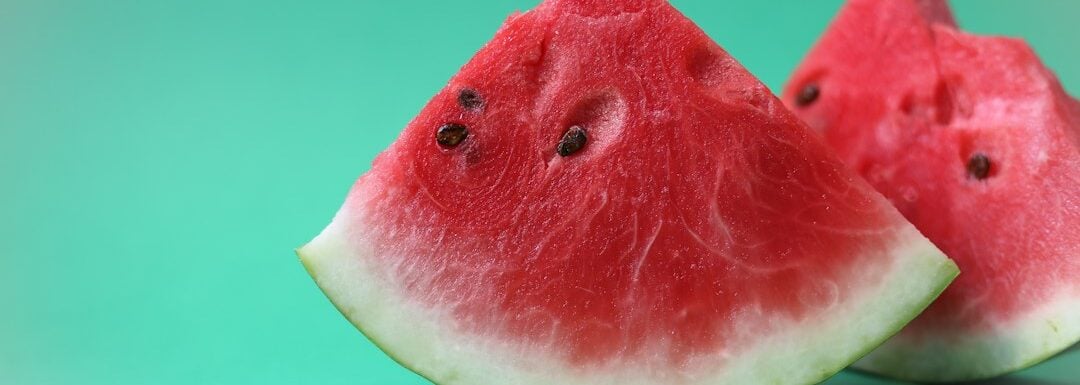
Watermelon has a reputation problem. It shows up near the top of glycemic index charts, so people with diabetes are often told to avoid it. The chart number is real, but it leaves out how little carbohydrate a normal portion holds. This guide gives you the numbers by portion, shows the glycemic index and glycemic load arithmetic, and explains where watermelon does get people into trouble.
Quick answer: One cup of diced watermelon has about 11.5 grams of carbohydrate, which is less than half of a medium banana. Its glycemic index is high, around 72 to 76, but because the fruit is about 91 percent water, the glycemic load of one cup works out to about 8, which sits in the low range. The risk with watermelon is portion size: a large wedge or a big bowl can hold two to four cups. This is general education, not medical advice. Your care team can tell you how many carbohydrate grams fit a meal or snack for you.
What is in watermelon
The figures below come from the USDA entry for raw watermelon (FoodData Central 167765), which lists 7.55 grams of carbohydrate, 0.4 grams of fiber, 6.2 grams of sugars, and 30 calories per 100 grams. We scaled those values to common portions.
| Portion | Weight | Carbs (g) | Fiber (g) | Sugars (g) | Calories |
|---|---|---|---|---|---|
| 10 melon balls | 122 g | 9.2 | 0.5 | 7.6 | 37 |
| 1 cup, diced | 152 g | 11.5 | 0.6 | 9.4 | 46 |
| 1 wedge (about 1/16 of a melon) | 286 g | 21.6 | 1.1 | 17.7 | 86 |
| 2 cups, diced | 304 g | 23.0 | 1.2 | 18.8 | 92 |
| 4 cups, diced (a large bowl) | 608 g | 45.9 | 2.4 | 37.7 | 182 |
Two things stand out. First, watermelon is one of the lowest-carbohydrate fruits by weight. Second, it has very little fiber, about half a gram per cup, so almost all of its carbohydrate is sugar that is ready to absorb.
High glycemic index, low glycemic load
The glycemic index (GI) ranks a food by how fast its carbohydrate raises glucose when people eat a test portion containing a fixed amount of carbohydrate, usually 50 grams. The 2008 international GI tables list raw watermelon at 76, plus or minus 4. Other published charts show 72. Either way it lands in the high band, which starts at 70.
Here is the catch. To get 50 grams of carbohydrate from watermelon, a person has to eat about 660 grams of it, which is more than four cups. Almost nobody eats that as a snack. Glycemic load (GL) corrects for this by multiplying the GI by the carbohydrate actually in your portion and dividing by 100. Our guide to glycemic index vs. glycemic load covers the method in full.
| Portion | Carbs minus fiber (g) | GL at GI 72 | GL at GI 76 | Band |
|---|---|---|---|---|
| 1 cup, diced | 10.9 | 7.8 | 8.3 | Low (10 or under) |
| 1 wedge | 20.5 | 14.8 | 15.6 | Medium (11 to 19) |
| 2 cups | 21.8 | 15.7 | 16.6 | Medium |
| 4 cups | 43.5 | 31.3 | 33.1 | High (20 or more) |
The arithmetic for one cup: 10.9 grams times 76, divided by 100, equals 8.3. The same fruit moves from low to high simply because the bowl got bigger. That is the whole watermelon story in one table.
Worked example: how much watermelon is 15 or 30 grams of carbohydrate?
Many diabetes meal plans count carbohydrate in 15-gram portions. The American Diabetes Association food lists put one fruit portion of watermelon at 1 1/4 cups of cubes. The USDA numbers agree: 15 divided by 7.55, times 100, equals 199 grams, which is 1.3 cups.
| Carbohydrate target | Watermelon needed | In cups |
|---|---|---|
| 15 g | 199 g | about 1.3 |
| 30 g | 397 g | about 2.6 |
| 45 g | 596 g | about 3.9 |
Those targets are illustrations, not recommendations. Your own number depends on your medicines, your goals, and your care team.
How watermelon compares with other fruit
Per cup, watermelon carries about the same carbohydrate as strawberries and roughly half that of pineapple, mango, or grapes. The figures are our arithmetic from USDA per-100-gram values.
| Fruit, 1 cup | Weight | Carbs (g) | Fiber (g) |
|---|---|---|---|
| Watermelon, diced | 152 g | 11.5 | 0.6 |
| Strawberries | 147 g | 11.3 | 2.9 |
| Pineapple, chunks | 165 g | 21.6 | 2.3 |
| Mango, pieces | 165 g | 24.8 | 2.6 |
| Grapes | 151 g | 27.3 | 1.4 |
| Banana, medium | 118 g | 26.9 | 3.1 |
Watermelon wins on total carbohydrate and loses on fiber. Strawberries give you the same carbohydrate with almost five times the fiber.
Where watermelon goes wrong
- The wedge at a cookout. A single wedge cut from a large melon is about 286 grams and 21.6 grams of carbohydrate. Two wedges is more carbohydrate than a large banana.
- Eating from the container. Pre-cut tubs often hold four cups or more. That is about 46 grams of carbohydrate with almost no fiber.
- Juice and blended drinks. One nutrition listing puts a cup of watermelon juice at about 18 grams of carbohydrate. It goes down faster than chewing the fruit, and agua fresca and smoothie recipes often add sugar. Check the label or the recipe.
- Eating it alone on an empty stomach. With so little fiber, protein, or fat, there is nothing to slow it. Some people see a quick rise and a quick fall.
Ways to fit it in
- Measure one cup into a bowl instead of cutting a wedge by eye.
- Have it at the end of a meal that already has protein and vegetables, instead of by itself.
- Pair a cup with a protein or fat food such as cottage cheese, feta, or a handful of nuts. We did not find a study that measures this pairing for watermelon in people with diabetes, so treat it as an experiment and check your readings.
- Count it. A cup is roughly three quarters of a 15-gram carbohydrate portion.
How to test your own response
- Check glucose right before you eat.
- Eat a measured cup and write down what you ate with it.
- Check again at one hour and two hours, or look at your CGM trace for that window.
- Repeat on another day with two cups, or with a pairing, and compare.
Our post-meal glucose tracker is built for this kind of comparison, and how to read your CGM data explains what the curve means.
Questions to bring to your appointment
- How many grams of carbohydrate should a snack or meal have for me?
- Does my medicine change how I should handle a fast-absorbing fruit?
- Should I pay attention to glycemic index, glycemic load, or only total carbohydrate?
Frequently asked questions
Can people with diabetes eat watermelon?
Many do. One cup of diced watermelon has about 11.5 grams of carbohydrate, which counts toward your carbohydrate for the meal or snack. The portion is what matters, because a large wedge or bowl can hold two to four times that amount.
Is watermelon high on the glycemic index?
Yes. Published values are about 72 to 76, which is in the high band. The glycemic load of one cup is only about 8, which is low, because a cup contains little carbohydrate. Both numbers are true, and the portion decides which one matters more.
How many carbs are in a cup of watermelon?
About 11.5 grams of total carbohydrate, 0.6 grams of fiber, and 9.4 grams of sugars in one cup of diced watermelon weighing 152 grams, based on USDA data.
How much watermelon is one fruit serving?
The American Diabetes Association food lists count 1 1/4 cups of cubed watermelon as one 15-gram carbohydrate portion of fruit. USDA figures give the same answer, about 199 grams of fruit.
Is watermelon better or worse than a banana for blood sugar?
A cup of watermelon has less than half the carbohydrate of a medium banana, about 11.5 grams against about 27. Watermelon has a higher glycemic index and much less fiber. For equal carbohydrate, the two may affect you differently, so test both with your meter or CGM.
About the author: Charles Kirkland is the founder of Metabolic Clarity Labs and author of The Journey Back. He is not a physician. This is general education, not a medically reviewed treatment plan.
Sources checked November 11, 2026: USDA FoodData Central (watermelon, raw, 167765), the 2008 international tables of glycemic index values, and American Diabetes Association fruit portion lists. Discuss personal decisions with a qualified clinician. Do not start, stop, or change prescribed treatment based on this article.