
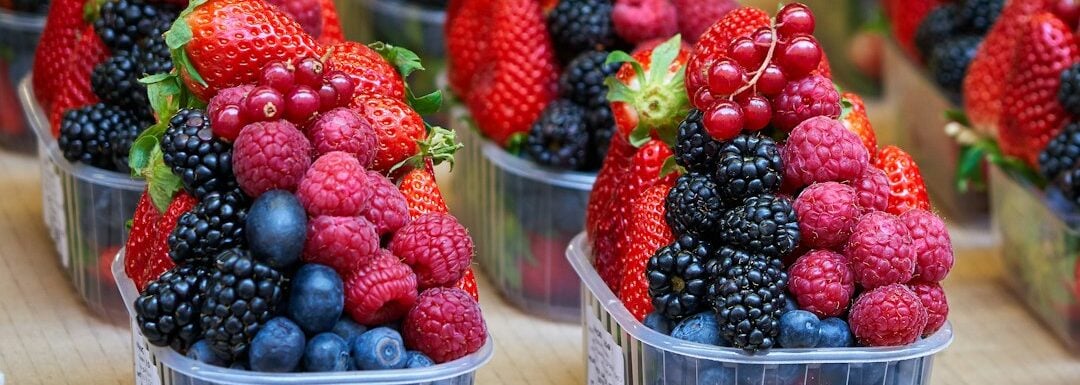
Berries are the fruit most often recommended to people with diabetes, and the numbers mostly back that up. They are not all the same, though. A cup of blueberries has almost twice the carbohydrate of a cup of strawberries, and raspberries and blackberries carry far more fiber than either. This guide compares the four side by side.
Quick answer: Per cup, strawberries have about 11 grams of carbohydrate, blackberries about 14, raspberries about 15, and blueberries about 21.5. Raspberries and blackberries have roughly 8 grams of fiber per cup, which is more than half of their carbohydrate. Fresh or unsweetened frozen berries are among the lowest-carbohydrate fruit choices by portion. Sweetened frozen berries, jam, and dried berries are different products. This is general education, not medical advice. Your care team can tell you how many carbohydrate grams fit a meal or snack for you.
The four berries side by side
All figures come from USDA FoodData Central entries for the raw fruit, scaled to the cup weights on those entries.
| Berry, 1 cup | Weight | Carbs (g) | Fiber (g) | Sugars (g) | Carbs minus fiber (g) | Calories |
|---|---|---|---|---|---|---|
| Strawberries | 147 g | 11.3 | 2.9 | 7.2 | 8.4 | 47 |
| Blackberries | 144 g | 13.8 | 7.6 | 7.0 | 6.2 | 62 |
| Raspberries | 123 g | 14.7 | 8.0 | 5.4 | 6.7 | 64 |
| Blueberries | 148 g | 21.5 | 3.6 | 14.7 | 17.9 | 84 |
Three things are worth noticing.
- Blueberries are the outlier. A cup has nearly twice the total carbohydrate of strawberries and about twice the sugar.
- Raspberries and blackberries are mostly fiber by carbohydrate. In raspberries, 8.0 of 14.7 grams is fiber. In blackberries, 7.6 of 13.8 grams.
- Strawberries are lowest in total carbohydrate but have less fiber than the two bramble berries.
The carbs-minus-fiber column is the same idea as net carbs. If you use that number, read net carbs vs. total carbs first, because the American Diabetes Association teaches counting total carbohydrate and people who dose insulin should follow their care team’s method.
Per 100 grams
If you weigh food, these are the base figures.
| Berry | Carbs (g) | Fiber (g) | Sugars (g) |
|---|---|---|---|
| Strawberries | 7.7 | 2.0 | 4.9 |
| Blackberries | 9.6 | 5.3 | 4.9 |
| Raspberries | 11.9 | 6.5 | 4.4 |
| Blueberries | 14.5 | 2.4 | 10.0 |
Worked example: how much is 15 or 30 grams of carbohydrate?
Many meal plans count carbohydrate in 15-gram portions. The arithmetic is the target divided by carbohydrate per 100 grams, times 100. The last column shows the portion the American Diabetes Association food lists give for the same 15 grams, so you can see the two agree.
| Berry | For 15 g carbs | For 30 g carbs | Diabetes food list portion (15 g) |
|---|---|---|---|
| Strawberries | 195 g (1.3 cups) | 391 g (2.7 cups) | 1 1/4 cups whole |
| Blackberries | 156 g (1.1 cups) | 313 g (2.2 cups) | 3/4 to 1 cup |
| Raspberries | 126 g (1.0 cup) | 252 g (2.0 cups) | 1 cup |
| Blueberries | 103 g (0.7 cup) | 207 g (1.4 cups) | 3/4 cup |
For the same carbohydrate, you get almost twice the volume of strawberries as blueberries. These targets are illustrations, not recommendations.
Glycemic index and glycemic load
Published glycemic index (GI) charts put strawberries at about 40 and blueberries at about 53, both in the low range. Values for raspberries and blackberries are less consistent from chart to chart, and we did not find a figure we trust enough to print. With so little digestible carbohydrate per cup, the practical effect of that gap is small.
Glycemic load (GL) is GI times the carbohydrate in the portion, divided by 100. For a cup of strawberries, 8.4 times 40, divided by 100, is 3.4. For a cup of blueberries, 17.9 times 53, divided by 100, is 9.5. Both are in the low band, which is 10 or under, but a cup of blueberries sits near the top of it and two cups would not. Our guide to glycemic index vs. glycemic load explains the method.
Fresh, frozen, dried, and jam
| Form | What changes | What to check |
|---|---|---|
| Fresh | The baseline in the tables above | Portion size |
| Frozen, unsweetened | About the same as fresh. One listing shows unsweetened frozen raspberries at 12.6 g of carbohydrate per 100 g, against 11.9 g fresh. | The ingredient list should say berries only |
| Frozen, sweetened | The same listing shows sweetened frozen raspberries at 26.2 g per 100 g, more than double | Added sugars on the label |
| Dried | Water is removed, so sugar is concentrated, and dried cranberries and blueberries are often sweetened | Two tablespoons of dried fruit is about 15 g of carbohydrate |
| Jam, syrup, pie filling | Mostly added sugar | Serving size and added sugars |
| Smoothies | Berries are rarely the main carbohydrate. Banana, juice, sweetened yogurt, and honey are. | The full recipe or label |
For reading those labels, see how to read nutrition label carbs or run the numbers through our nutrition label carb decoder.
What the research says
A 2013 analysis in the BMJ pooled three long-running U.S. studies with 187,382 adults and 12,198 new cases of type 2 diabetes. For every three servings a week of blueberries, the risk of developing type 2 diabetes was 26 percent lower (hazard ratio 0.74, 95% confidence interval 0.66 to 0.83). That was the strongest association of any fruit in the study. For strawberries, the result was 1.03 (0.96 to 1.10), which means no clear association in either direction.
Two cautions. This was an observational study of people who did not have diabetes at the start, so it shows an association with developing the condition, not a treatment effect in people who already have it. And the blueberry result does not make blueberries lower in carbohydrate than strawberries. For your glucose after a snack, the portion table above is the more useful guide.
Ways to use berries
- Add a measured half cup to plain Greek yogurt or cottage cheese. See Greek yogurt vs. regular yogurt for the carbohydrate difference between yogurts.
- Use raspberries or blackberries when you want the most fiber for the carbohydrate.
- Use berries to replace part of a higher-carbohydrate fruit. Half a banana plus half a cup of strawberries has about 19 grams of carbohydrate, against about 27 for a whole medium banana.
- Keep unsweetened frozen berries on hand. They cost less out of season and measure easily.
- Measure blueberries. They are the easiest of the four to overpour.
How to test your own response
- Check glucose right before you eat.
- Eat a measured cup of one berry and write down what you ate with it.
- Check again at one hour and two hours, or look at your CGM trace for that window.
- Repeat on another day with a different berry, and compare.
Our post-meal glucose tracker is built for this kind of comparison, and how to read your CGM data explains what the curve means.
Frequently asked questions
Which berry is lowest in carbs?
Per cup, strawberries have the least total carbohydrate at about 11.3 grams. If you subtract fiber, blackberries are lowest at about 6.2 grams per cup, with raspberries close behind at about 6.7 grams.
Are blueberries okay for people with diabetes?
Yes, as a counted carbohydrate. A cup has about 21.5 grams of carbohydrate, the most of the four common berries, so three quarters of a cup is the usual 15-gram portion. Measure them instead of pouring by eye.
How many strawberries is one serving?
Diabetes food lists count 1 1/4 cups of whole strawberries as one 15-gram carbohydrate portion of fruit. USDA data gives the same answer, about 195 grams.
Are frozen berries as good as fresh?
Unsweetened frozen berries have about the same carbohydrate as fresh. Sweetened frozen berries can have more than double. Check that the ingredient list says berries only.
Do berries lower blood sugar?
Berries contain carbohydrate, so they raise glucose, usually less than the same volume of most other fruit. One large observational study linked blueberries with a lower risk of developing type 2 diabetes, but that is not evidence that berries lower glucose in people who already have it.
About the author: Charles Kirkland is the founder of Metabolic Clarity Labs and author of The Journey Back. He is not a physician. This is general education, not a medically reviewed treatment plan.
Sources checked November 11, 2026: USDA FoodData Central (strawberries 167762, blueberries 171711, raspberries, blackberries), published glycemic index tables, American Diabetes Association fruit portion lists, and Muraki et al., BMJ 2013;347:f5001. Discuss personal decisions with a qualified clinician. Do not start, stop, or change prescribed treatment based on this article.