
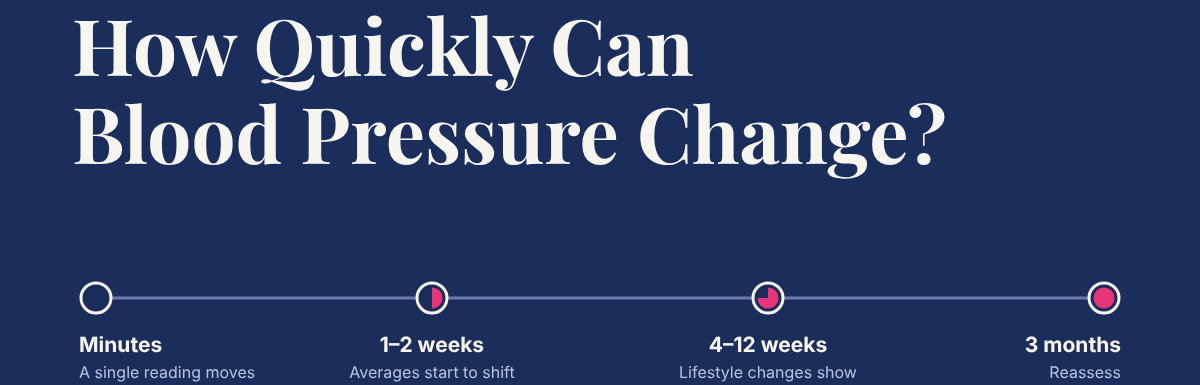
Blood pressure is the fastest-moving number on your health record. It changes when you stand up, drink coffee, or sit in a waiting room. It also responds to lasting changes, on a slower clock. Knowing both clocks keeps you from panicking over one reading or giving up on a change too early.
Quick answer: A single reading can swing within minutes. Your average, which is what matters, responds to lasting changes over weeks. In clinical trials the DASH eating pattern lowered blood pressure within about two weeks. Most blood pressure medicines begin working within hours and take about two to four weeks to reach full effect. Weight loss and exercise act over one to three months. This is education, not medical advice.
Free tools: Blood pressure chart with checker and printable blood pressure log.
Two clocks: readings and averages
Your body adjusts blood pressure constantly to match what you are doing. That is normal and healthy. Because of it, one reading says little. Clinicians diagnose and treat based on an average of several readings taken the same way on different days. When you ask how quickly blood pressure can change, you are really asking two questions: how much does a reading bounce, and how soon does the average move.
What changes a reading within minutes
| Trigger | Direction | How to avoid it when measuring |
|---|---|---|
| Caffeine, nicotine | Up | Wait about 30 minutes |
| Exercise just before | Up, then often lower afterward | Wait about 30 minutes |
| Talking, stress, pain | Up | Sit quietly for five minutes |
| Full bladder | Up | Use the bathroom first |
| Arm below heart level, legs crossed, no back support | Up | Sit supported with the cuff at heart level |
| Cuff too small | Up | Use the right cuff size |
| Standing up quickly | Down briefly | Measure seated unless told otherwise |
These effects are why technique matters so much. Our guide to measuring blood pressure at home covers the full routine, and best home blood pressure monitors covers the equipment.
What changes your average, and how fast
| Change | When the average usually starts to respond | Notes |
|---|---|---|
| DASH eating pattern | About two weeks in clinical trials | In the original trial, people with high blood pressure saw systolic pressure fall by about 11 mm Hg |
| Lower sodium | Weeks | The DASH-Sodium trial found lower sodium produced lower pressure |
| Less alcohol | Weeks | Applies if you drink regularly |
| Regular aerobic exercise | About one to two months | A single session can also lower pressure for hours afterward |
| Weight loss | One to three months | Tracks with the amount lost |
| Better sleep, treating sleep apnea | Varies | Ask about screening if you snore heavily or wake unrefreshed |
The size of the effect varies widely between people and is usually larger when your starting pressure is higher. Changes stack: eating pattern, sodium, activity, and weight each add something. See diet for high blood pressure and sodium and blood pressure.
How fast medication works
Most blood pressure medicines begin lowering pressure within hours of the first dose. The full effect of a given dose usually takes about two to four weeks to settle. That is why prescribers often wait a few weeks before deciding whether to adjust the dose or add a second medicine, and why they ask for home readings during that time.
- Take the medicine at the same time each day.
- Do not stop because your numbers look better. The medicine is why they look better.
- Report dizziness on standing, swelling, cough, or anything new.
- Tell your prescriber about pain relievers, decongestants, and supplements, since some raise blood pressure.
More in blood pressure medications: what to know and supplements and blood pressure medicines.
How to see a real change
To tell a real shift from normal bounce, compare averages, not single readings.
| Step | What to do |
|---|---|
| Baseline | Two readings morning and evening for seven days before you change anything |
| Make one change | Keep it up for at least two to four weeks |
| Repeat | Another seven-day set, same times, same arm, same monitor |
| Compare | Average of the second week against the first |
The blood pressure average calculator does the arithmetic, and the seven-day log gives you the layout. A difference of a few points between two single readings means nothing. A difference of several points between two weekly averages is real.
How quickly it can rise
The same clocks run in reverse. A salty restaurant meal, a few nights of poor sleep, a stressful week, or a new medicine such as a decongestant, a steroid, or an anti-inflammatory pain reliever can raise readings within days. Weight gain and less activity raise the average over months. Pressure also varies by time of day; see why blood pressure can be higher in the evening.
When a sudden change is urgent
Call emergency services if a very high reading comes with chest pain, shortness of breath, severe headache, confusion, weakness or numbness on one side, trouble speaking, or vision changes. If a reading is very high and you feel well, rest for five minutes and measure again, then follow the instructions your clinician has given you or call the office the same day. A sudden drop with fainting, confusion, or a racing heart also needs prompt attention.
Common mistakes
- Judging a change by one reading.
- Measuring only when you feel stressed or unwell, which biases your log upward.
- Stopping a medicine when numbers improve.
- Changing three things at once and not knowing what helped.
- Giving up after one week. Most changes need at least two.
- Comparing home readings with office readings as if they were the same.
An eight-week timeline
If you start several changes together, this is roughly the order in which they tend to show. It is a general pattern, not a prediction for any one person.
| When | What is usually happening | What to do |
|---|---|---|
| Week 0 | Baseline | Seven days of morning and evening readings |
| Weeks 1 to 2 | Lower sodium and less alcohol begin to show; a new medicine is partly working | Keep going; do not judge yet |
| Weeks 2 to 4 | An eating pattern such as DASH is showing; a medicine dose is near its full effect | Second seven-day set; share it with your prescriber |
| Weeks 4 to 8 | Regular exercise starts to show in the resting average | Stay consistent |
| Week 8 and beyond | Weight loss adds to the effect as it accumulates | Third seven-day set; review the plan |
Three sets of home readings, at the start, at about one month, and at about two months, are enough to see whether the average is moving. Record them in the seven-day log.
Scenarios by situation
These are hypothetical illustrations, not case histories.
Told at a checkup that pressure was high, with no home readings. The first job is a baseline at home. Office readings often run higher than home ones, and a week of proper home readings shows where things really stand.
Started a medicine ten days ago and numbers have barely moved. That is within the normal range. A dose usually takes two to four weeks to settle. This person keeps taking it, keeps logging, and reports at the planned review.
Cut back on salt and saw a drop within a week. Some people are more sensitive to sodium than others and respond quickly. A second week of readings confirms whether the change holds.
Readings fine all week, then one very high number. After five minutes of rest and a repeat, the reading is often lower. A single outlier without symptoms is noted and watched, not treated as a new baseline.
Lost 15 pounds and feels lightheaded on standing. Blood pressure medicine that was right before may now be too much. This is a reason to call the prescriber, not to stop the medicine alone.
Evening readings consistently higher than morning ones. The pattern is worth showing to a clinician, since it can affect when medicine is taken. See morning and night blood pressure spikes.
Questions for your clinician
- What is my target, at home and in the office?
- How long should I wait before we judge this change or this dose?
- Which readings should make me call you?
- Do any of my medicines or supplements raise blood pressure?
- Should I be screened for sleep apnea?
- If I lose weight, when should my medicine be reviewed?
Bottom line by situation
| Situation | Bottom line |
|---|---|
| One reading looks high | Rest five minutes and repeat; look at the weekly average |
| Changed eating pattern | Compare averages after two to four weeks |
| Started or changed medicine | Expect the full effect in two to four weeks |
| Started exercising | Allow one to two months for the resting average |
| Losing weight | Expect a gradual fall; have medicine reviewed |
| Very high reading with symptoms | Call emergency services |
Frequently asked questions
What is the fastest way to lower blood pressure safely?
For a lasting change, the quickest responders are medication prescribed by your clinician and lower sodium and alcohol intake, which act within days to weeks. There is no safe way to force a fast drop at home. A very high reading with symptoms is an emergency.
Can drinking water lower blood pressure quickly?
Staying hydrated supports normal blood pressure regulation, but water is not a treatment for high blood pressure and will not correct it quickly.
How long should I wait between readings?
About one minute. Take two readings each time and record both. If they differ a lot, take a third.
Why is my blood pressure lower at home than at the clinic?
Many people run higher in a clinic because of nerves or rushing. This is common and is one reason home averages are used alongside office readings.
Can blood pressure change in minutes?
Yes. Readings rise and fall with activity, stress, caffeine, posture, and even talking. That is why clinicians rely on averages taken under the same resting conditions.
How long does it take to lower blood pressure with diet?
In clinical trials of the DASH eating pattern, blood pressure began to fall within about two weeks. Individual results vary, and the effect continues only while the eating pattern does.
How long does blood pressure medication take to work?
Most medicines start working within hours, and a dose usually reaches its full effect in about two to four weeks. Your prescriber will tell you when to expect a review.
Can I lower my blood pressure in a week?
Some people see lower readings within a week of cutting sodium or alcohol, but a week is short for judging an average. Give a change two to four weeks and compare seven-day averages.
Why is my blood pressure different every time I measure?
Because blood pressure is constantly adjusting. Differences of several points between readings a minute apart are normal. Take two readings and record both.
How fast does exercise lower blood pressure?
Pressure is often lower for some hours after a session. A lasting change in your resting average typically takes a month or two of regular activity.
Does losing weight lower blood pressure right away?
The effect builds as weight comes off, so it appears over one to three months for most people. If you take blood pressure medicine, tell your prescriber as you lose weight, since doses may need review.
How quickly can blood pressure go back up?
Within days if you return to high sodium or stop medication. Benefits last only as long as the change that produced them.
About the author: Charles Kirkland is the founder of Metabolic Clarity Labs and author of The Journey Back. He is not a physician. This is general education, not a medically reviewed treatment plan.
Sources checked November 12, 2026. Do not start, stop, or change prescribed treatment based on this article.