
You changed how you eat, started walking after dinner, or began a new medicine, and you want to know when your A1C will show it. The answer is sooner than three months and later than next week. This guide explains the timeline, shows the math, and tells you when a retest is worth the money.
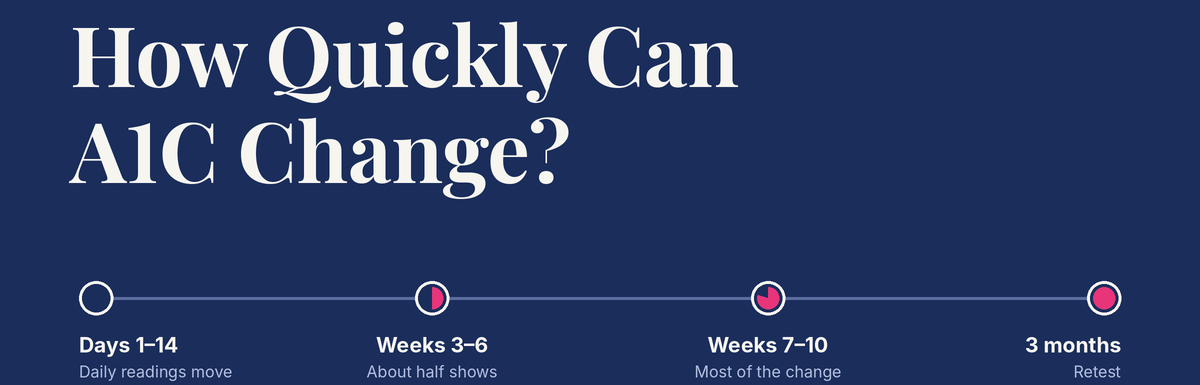
Quick answer: A1C reflects roughly the past two to three months, but it is weighted toward recent weeks. About half of the value comes from the most recent 30 days. A sustained change in your glucose starts to show within four to six weeks and is mostly reflected by three months. Daily glucose readings change within days. This is education, not medical advice.
Free tools: A1C chart with checker and printable lab results tracker. Also see the A1C goal calculator and the A1C mmol/mol converter.
Why A1C moves slowly
A1C measures the share of hemoglobin in your red blood cells that has glucose attached. Once glucose attaches, it stays for the life of the cell, and a red blood cell lives about 120 days. Your blood always holds a mix of cells from brand new to four months old, so an A1C result is an average across that whole population. It cannot drop overnight, because the older cells carrying the record of earlier glucose are still circulating.
The last month counts most
The average is not even. Younger cells outnumber older ones, so recent weeks carry more weight. A review in the Cleveland Clinic Journal of Medicine describes A1C as a weighted average with about 50% contributed by the preceding month. A commonly cited breakdown looks like this:
| Period before the test | Approximate share of the A1C value |
|---|---|
| Most recent 30 days | About 50% |
| Days 31 to 60 | About 25% |
| Days 61 to 120 | About 25% |
This is good news if you have made changes. What you did this month matters more than what you did three months ago.
A week-by-week timeline
| Time since a sustained change | What to expect |
|---|---|
| Days 1 to 14 | Meter or sensor readings change. A1C has barely moved. |
| Weeks 3 to 6 | A1C begins to shift. Roughly half the eventual change is in place by about one month. |
| Weeks 7 to 10 | Most of the change is now reflected. |
| About 3 months | The standard retest point. The result reflects your new average almost fully. |
| 4 months and beyond | Any remaining older cells are gone. The number now describes only your current pattern. |
A worked example
A1C can be converted to an estimated average glucose with the formula 28.7 x A1C – 46.7. Suppose your A1C is 8.0%, an estimated average of about 183 mg/dL, and you make changes that bring your true average down to about 154 mg/dL, which corresponds to 7.0%.
| When you test | Share of the change reflected | Approximate A1C |
|---|---|---|
| Before the change | 0% | 8.0% |
| After 1 month | About 50% | About 7.5% |
| After 2 months | About 75% | About 7.25% |
| After 3 to 4 months | Nearly all | About 7.0% |
This is a simplified model to show the shape of the curve. Real results vary with how steady the change is and with your own red blood cell turnover. You can run your own numbers in the A1C to average glucose calculator.
How much can it change in three months?
That depends mostly on where you start and what changed. A higher starting A1C has more room to fall. A new medication usually moves the number more than a single habit does, and combined changes add up. There is no honest universal figure, and anyone promising a specific drop in a specific number of weeks is guessing. Our review of lowering A1C without medication covers what studies have measured.
If you take insulin or a sulfonylurea, a fast improvement in your glucose can lead to low blood sugar unless doses are adjusted. Tell your prescriber when you change how you eat or exercise.
Signals that move faster than A1C
| Measure | How fast it responds | Good for |
|---|---|---|
| Fingerstick before and after meals | Same day | Seeing what a specific meal or walk does |
| Fasting glucose on waking | Days to weeks | A simple weekly trend |
| Continuous glucose monitor | Minutes | Patterns across the whole day |
| A1C | Weeks to months | Confirming the long-term result |
Use the fast measures to steer and A1C to confirm. See how quickly fasting blood sugar can change and CGM vs A1C.
When to retest
- After a change in treatment or habits: about three months is the usual interval.
- When you are stable and at goal: many people are tested about twice a year.
- Sooner than six weeks: rarely useful. Too few red blood cells have turned over to show a clear difference.
A home A1C kit can fill a gap between lab visits. How often to check A1C covers schedules in more detail.
When the timeline does not apply
The timeline assumes red blood cells with a normal lifespan. Anything that shortens or lengthens that lifespan changes both the number and how fast it moves. Recent blood loss, a transfusion, hemolytic anemia, and pregnancy can lower A1C. Iron deficiency can raise it. Kidney disease and some hemoglobin variants also interfere. If one of these applies to you, ask your clinician how to read your result. Why A1C can be wrong goes through each case.
Common mistakes
- Retesting after two weeks and concluding nothing worked.
- Easing off after a good result. The next test will reflect the months that follow.
- A last-week sprint before the lab. One week is a small part of the average.
- Judging by A1C alone. An average can hide highs and lows.
- Comparing a home kit with a lab result taken months apart.
- Changing medication doses yourself because numbers improved.
What moves A1C, and how soon each shows
A1C only changes when your average glucose changes, so the useful question is which actions change the average and how quickly. Daily readings respond first. A1C follows on the timeline above.
| Change | When daily glucose responds | What it mainly affects |
|---|---|---|
| Starting or adjusting a glucose-lowering medicine | Days to a few weeks, depending on the medicine | Fasting and after-meal levels |
| Replacing sweet drinks with water or unsweetened drinks | The same day | After-meal and between-meal rises |
| Smaller portions of refined starch | The same meal | After-meal peaks |
| A short walk after meals | The same meal | After-meal peaks |
| Regular exercise | Days to weeks | Insulin sensitivity across the day |
| Weight loss | Weeks to months | Fasting level and overall average |
| Better sleep | Days | Morning level and next-day responses |
Changes that act at every meal add up fastest because they happen several times a day. A change that lowers your after-meal glucose three times daily touches a large share of your 24 hours. See walking after meals and glycemic index vs glycemic load.
Scenarios by situation
These are hypothetical illustrations of how the timeline plays out. They are not case histories.
A1C 6.1%, cut out soda and started evening walks six weeks ago. A retest now would show part of the change. Waiting until about three months gives a cleaner reading and avoids paying for two tests.
A1C 8.4%, started a new medicine four weeks ago. Meter readings should already look different. Roughly half of the eventual A1C change is in place. The prescriber will usually recheck at about three months and wants to hear about any low readings before then.
A1C was 6.8%, three good months, then a difficult month before the test. Because the last month carries about half the weight, the result may be higher than the earlier effort deserved. It reflects the recent month, not a failure of the plan.
A1C unchanged after three months of real effort. Possible reasons include changes that helped fasting levels but not after-meal levels, a condition that affects red blood cells, or diabetes that is progressing and needs different treatment. That conversation belongs with a clinician.
Two weeks of steroids for another condition. Glucose often rises during the course. If it fell within the month before an A1C test, the result can be higher than usual. Mention it when the result is reviewed.
Questions for your clinician
- What A1C should I be aiming for, given my age and health?
- When should I retest after this change?
- Should I check glucose at home in the meantime, and at what times?
- Is there any reason my A1C might not reflect my true average?
- If my readings improve quickly, do any of my medicine doses need to change?
Bottom line by situation
| Situation | Bottom line |
|---|---|
| Made a change this week | Watch daily readings; A1C cannot show it yet |
| One month in | About half the change is reflected |
| Three months in | Retest; the result reflects nearly all of it |
| Stable and at goal | Testing about twice a year is common |
| Result does not match your readings | Ask about conditions that skew A1C |
| On insulin or a sulfonylurea and improving fast | Tell your prescriber so doses can be reviewed |
Frequently asked questions
What is the fastest way to lower A1C?
Nothing lowers A1C overnight, because it is a multi-month average. The changes that lower daily glucose soonest are medication prescribed by your clinician, removing sweet drinks, smaller portions of refined starch, and movement after meals. A1C then follows over weeks.
Will my A1C be lower if I eat well the week before the test?
Only slightly. One week is a small part of the average, though recent weeks do count for more than older ones. A1C is designed to resist short-term changes.
How much can A1C drop in three months?
It varies with your starting level and what changed. Higher starting values have more room to fall, and medication usually moves the number more than a single habit. Your clinician can tell you what is realistic for you.
Can A1C drop too fast?
A rapid fall is usually welcome, but in people on insulin or sulfonylureas it raises the risk of low blood sugar, and very rapid improvement from a very high level is something clinicians monitor. Keep your prescriber informed.
Can A1C change in one month?
Yes, partly. Because about half of the value reflects the most recent 30 days, a sustained change can move A1C noticeably in a month. The full effect takes about three months to appear.
Can A1C drop in two weeks?
Only slightly. Two weeks is too short for enough red blood cells to turn over. Your daily glucose readings will show the change long before A1C does.
How long does it take to lower A1C by one point?
There is no fixed time. It depends on your starting level, what you changed, and whether medication is involved. A sustained improvement in average glucose is mostly reflected in A1C by three months.
Does one bad week ruin my A1C?
No. A single week is a small share of a two to three month weighted average. A bad week just before the test counts for more than one long ago, but it will not undo months of steady readings.
Why is my A1C still high when my daily readings are good?
Older red blood cells may still be carrying earlier glucose levels, your checks may be missing after-meal rises, or a condition affecting red blood cells may be skewing the result. Bring both sets of numbers to your clinician.
Can A1C go up quickly?
Yes, by the same math. A sustained rise in glucose, such as during a course of steroids or an illness, starts to show within weeks.
Is three months the right time to retest?
For most people after a change, yes. It lets the result reflect nearly all of the new pattern. Your clinician may choose a different interval for your situation.
Do I need to fast for an A1C test?
No. A1C reflects months of glucose, so a recent meal does not affect it.
About the author: Charles Kirkland is the founder of Metabolic Clarity Labs and author of The Journey Back. He is not a physician. This is general education, not a medically reviewed treatment plan.
Sources checked November 12, 2026. Do not start, stop, or change prescribed treatment based on this article.