
A mildly raised ALT or AST on routine blood work is one of the most common lab surprises. Many people are told to come back and repeat it. That raises the obvious question: how fast can these numbers move, and what will the repeat tell you?
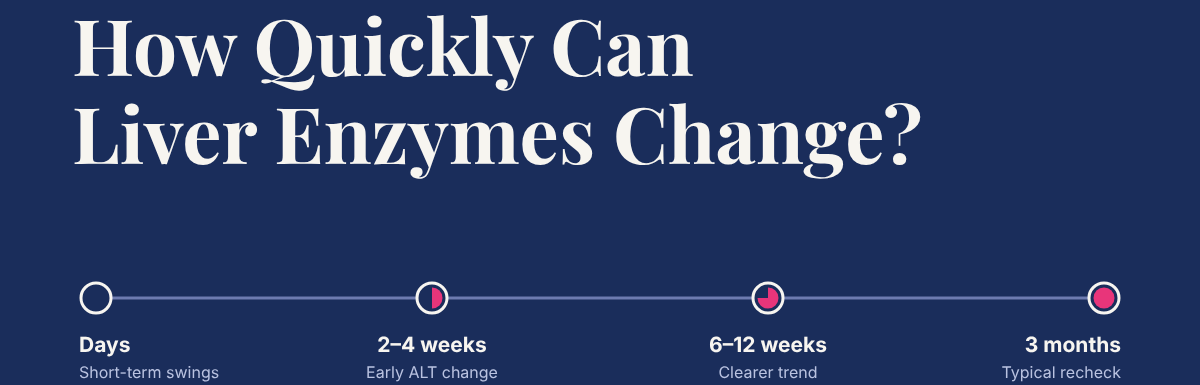
Quick answer: Liver enzymes can change within days. A hard workout, alcohol, or a new medicine can raise them briefly, and they can fall within weeks once the cause is removed. Changes tied to fatty liver and weight move over months. A single mildly raised result is usually repeated before anyone draws conclusions. Enzymes show irritation of liver cells, not how much fat or scarring is present. This is education, not medical advice.
Free tools: FIB-4 calculator and lab retest timer.
Related: what a FIB-4 score means.
What ALT and AST are
ALT and AST are enzymes that live inside cells. When cells are irritated or damaged, more of the enzyme leaks into the blood. ALT is found mainly in the liver, so it is the more liver-specific of the two. AST is also found in muscle and the heart, which is why a raised AST with a normal ALT can come from somewhere other than the liver.
Reference ranges differ between laboratories, so compare your result with the range printed on your own report. Other tests on a liver panel, such as alkaline phosphatase, GGT, bilirubin, and albumin, answer different questions.
What changes them within days
| Trigger | Usual effect | How long it tends to last |
|---|---|---|
| Strenuous exercise, especially weight training | AST up, sometimes ALT | Several days to about a week |
| Alcohol, especially a heavy episode | AST and ALT up | Days to weeks |
| Acetaminophen at high doses | ALT and AST up | Depends on dose; overdose is an emergency |
| A new prescription, supplement, or herbal product | Variable | Until it is stopped, under medical direction |
| Viral illness | Up | Weeks |
| Muscle injury | AST up more than ALT | Days to weeks |
This is why one raised result, on its own, rarely settles anything.
What changes them over weeks and months
| Lasting change | When enzymes tend to respond |
|---|---|
| Stopping alcohol | Often within weeks |
| Stopping a medicine or supplement that was the cause | Weeks, as directed by your clinician |
| Losing weight when fatty liver is present | Gradually over months, alongside the weight |
| Improving blood sugar and triglycerides | Months |
| Regular physical activity | Months |
| Treating viral hepatitis or another specific liver condition | Depends on the condition and treatment |
For fatty liver linked to metabolic health, now often called MASLD, weight loss is the best-studied approach. Enzymes usually drift down as weight comes off, though they are an imperfect guide to what is happening inside the liver. See foods for fatty liver health.
Why a repeat test is ordered, and when
Because short-term triggers are so common, clinicians often repeat a mildly raised result after a few weeks to a few months, depending on how high it was and what else is going on. The repeat answers a simple question: was this a blip, or is it persistent?
| Result on repeat | What usually follows |
|---|---|
| Back in range | Often no further testing; routine follow-up |
| Still mildly raised | A look for causes: alcohol, medicines, hepatitis tests, metabolic risk, sometimes an ultrasound |
| Higher than before | Earlier and more thorough evaluation |
Your clinician decides the timing. A markedly raised result is handled faster than a borderline one.
What enzymes cannot tell you
- They do not measure liver fat. Imaging does that.
- They do not measure scarring. Fibrosis is estimated with scores built from routine blood tests, special blood tests, or elastography.
- Normal does not always mean healthy. A person can have fatty liver, even with scarring, and normal enzymes. See fatty liver with normal liver enzymes.
- Raised does not always mean liver. Muscle is a common source of AST.
If you have type 2 diabetes, prediabetes, or carry weight around the middle, ask whether a fibrosis risk score has been calculated from your existing labs. It uses numbers you probably already have.
The metabolic connection
Fat in the liver tends to travel with a larger waist, high triglycerides, low HDL, raised blood sugar, and higher blood pressure. If your ALT is persistently raised and nothing else explains it, those numbers are worth looking at together. Useful tools: the metabolic syndrome calculator, the waist-to-height ratio calculator, and the TyG index calculator. Our article on fatty liver, belly fat, and visceral fat explains the link.
How to prepare for a repeat test
- Skip strenuous exercise for several days before the draw.
- Avoid alcohol beforehand, for as long as your clinician advises.
- Bring a list of every medicine, supplement, and herbal product you take, including pain relievers.
- Do not stop a prescribed medicine to improve the result unless your prescriber tells you to.
- Mention any recent illness, injury, or injections into muscle.
- Use the same lab if possible, so the reference range is the same.
When to seek care quickly
Get prompt medical attention for yellowing of the skin or eyes, dark urine, pale stools, pain in the upper right abdomen, swelling of the abdomen or legs, confusion, or vomiting blood. If you may have taken too much acetaminophen, treat it as an emergency even if you feel fine.
Reading the pattern on your panel
Clinicians look at which tests are raised and by how much, not at one number alone. These are common patterns and what they tend to prompt. Interpretation depends on your history, so treat this as a guide to the conversation.
| Pattern | Often associated with | Usual next step |
|---|---|---|
| ALT mildly raised, AST normal or lower than ALT | Fatty liver linked to metabolic health; medicines | Repeat; review weight, glucose, lipids, medicines |
| AST higher than ALT | Alcohol; muscle source; sometimes more advanced liver disease | Alcohol history; ask about exercise; further tests if persistent |
| AST raised alone after hard exercise | Muscle | Repeat after a rest week; a muscle enzyme test can confirm |
| Both markedly raised | Viral hepatitis, medicine or toxin injury, other acute causes | Prompt evaluation |
| Alkaline phosphatase and GGT raised more than ALT and AST | Bile duct or gallbladder issues; some medicines | Imaging and further tests |
| Enzymes normal, platelets low or albumin low | Possible long-standing liver disease despite normal enzymes | Fibrosis assessment |
The last row is a reminder that normal enzymes are not a clean bill of health for the liver, particularly in people with type 2 diabetes or long-standing metabolic risk.
Scenarios by situation
These are hypothetical illustrations, not case histories.
ALT slightly above range at an annual physical, no symptoms, waist has grown over the years. The usual path is a repeat in a few weeks to months, a review of alcohol and medicines, and a look at glucose and lipids. If it stays raised, an ultrasound or a fibrosis score may follow.
AST raised two days after a heavy leg workout. Muscle is the likely source. A repeat after several rest days often comes back normal.
Enzymes rose a month after starting a new supplement. Herbal and dietary supplements are a recognized cause of liver injury. The clinician will want the exact product and dose, and may advise stopping it and rechecking.
ALT fell from mildly raised to normal after losing weight over six months. This is the pattern expected when fatty liver improves. Enzymes alone do not prove the fat is gone, but the direction is encouraging and worth continuing.
Enzymes normal, type 2 diabetes for ten years. Normal enzymes do not exclude fatty liver or scarring. Asking whether a fibrosis risk score has been calculated is reasonable.
Drinks most evenings and ALT and AST are both raised. An honest alcohol history is the most useful thing to bring. Enzymes often improve within weeks of stopping. Anyone who drinks heavily every day should get medical advice before stopping abruptly, since withdrawal can be dangerous.
Questions for your clinician
- How far above the reference range is my result, and does that change the urgency?
- When should we repeat it?
- Could any of my medicines or supplements be responsible?
- Should I be tested for viral hepatitis?
- Has a fibrosis risk score been calculated from my labs?
- Would an ultrasound or elastography add anything?
- How much alcohol, if any, is reasonable for me?
Bottom line by situation
| Situation | Bottom line |
|---|---|
| One mildly raised result | Repeat before drawing conclusions |
| Hard exercise before the test | Rest several days and retest |
| Regular alcohol | Enzymes often improve within weeks of stopping; get advice if you drink heavily |
| New medicine or supplement | Tell your clinician; do not stop prescriptions on your own |
| Persistently raised with metabolic risk | Ask about fatty liver and fibrosis assessment |
| Normal enzymes with diabetes | Still ask about liver risk |
| Jaundice, dark urine, or abdominal pain | Seek care promptly |
Frequently asked questions
What is the fastest way to lower liver enzymes?
Removing the cause. If alcohol, a medicine, a supplement, or hard exercise raised them, they often fall within days to weeks once it is removed, under your clinician’s direction. When fatty liver is the cause, improvement follows weight and metabolic changes over months.
What is the difference between ALT and AST?
Both are enzymes released when cells are irritated. ALT comes mainly from the liver. AST also comes from muscle and the heart, so it is less specific.
Can supplements raise liver enzymes?
Yes. Some herbal and dietary supplements are known to cause liver injury. Tell your clinician everything you take, including products sold as natural.
Does coffee affect liver enzymes?
Observational studies have linked regular coffee drinking with lower liver enzyme levels, but that does not prove coffee is the cause, and it is not a treatment. Ask your clinician before making changes on that basis.
How quickly can ALT go down?
If a short-term trigger such as exercise, alcohol, or a medicine was the cause, ALT can fall within days to weeks once it is removed. When fatty liver is the cause, it usually falls gradually over months as weight and metabolic health improve.
Can exercise raise liver enzymes?
Yes. Strenuous exercise, especially lifting, releases AST and sometimes ALT from muscle. Levels typically settle within about a week. Tell your clinician if you trained hard before a blood draw.
How long after stopping alcohol do liver enzymes improve?
Often within weeks, though it depends on how much and how long a person was drinking and whether there is underlying liver disease. Your clinician can advise on timing for a repeat test.
Does one high result mean I have liver disease?
No. Mild, temporary rises are common. A repeat test and a review of medicines, alcohol, and risk factors usually come first.
Can liver enzymes be normal with fatty liver?
Yes. Many people with fatty liver have enzymes in the normal range. Enzymes are not a reliable way to rule it out.
How long should I wait to retest?
That is a decision for your clinician. Mild elevations are commonly rechecked after a few weeks to a few months. Higher results are followed up sooner.
Do statins raise liver enzymes?
They can cause small rises in some people, which are usually not harmful. Do not stop a statin on your own; ask your prescriber how your results should be interpreted.
Will losing weight lower my ALT?
When fatty liver is the cause, ALT commonly falls as weight comes off. If you take insulin or a sulfonylurea, tell your prescriber as you lose weight, since doses may need to change to avoid low blood sugar.
About the author: Charles Kirkland is the founder of Metabolic Clarity Labs and author of The Journey Back. He is not a physician. This is general education, not a medically reviewed treatment plan.
Reviewed November 12, 2026. Do not start, stop, or change prescribed treatment based on this article.