
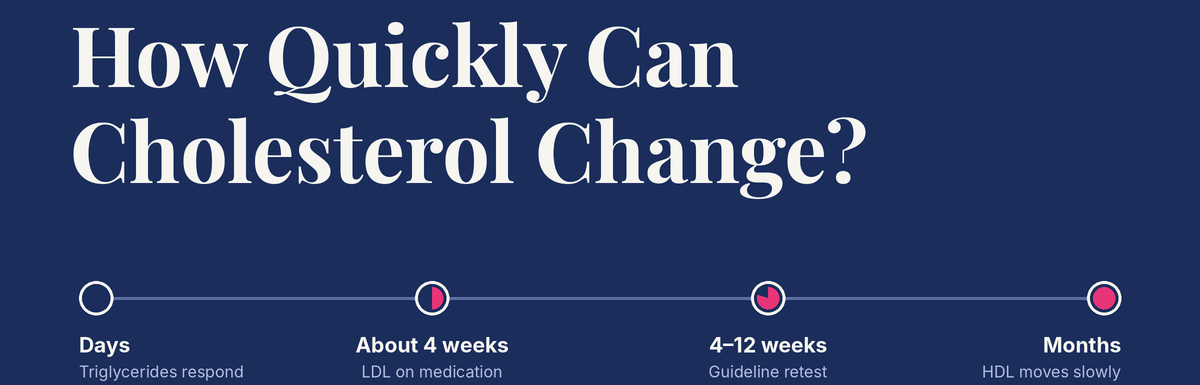
A cholesterol panel reports several numbers, and they do not move at the same speed. Triglycerides can shift within days. LDL responds over weeks. HDL barely moves for months. Knowing which is which tells you when a retest will show something and when it is too soon.
Quick answer: LDL cholesterol starts to respond to a statin within the first few weeks, and most of the effect is in place by about a month. Diet changes take a similar four to six weeks to show. HDL changes slowly and modestly. The ACC/AHA cholesterol guideline recommends repeating a lipid panel 4 to 12 weeks after starting or changing treatment, then every 3 to 12 months. This is education, not medical advice.
Free tools: Cholesterol levels chart with checker and printable lab results tracker.
Each number has its own speed
| Number | How fast it responds | What moves it most |
|---|---|---|
| Triglycerides | Days to weeks | Recent meals, alcohol, sugar and refined starch, weight, glucose control |
| LDL cholesterol | Weeks | Medication, saturated fat intake, soluble fiber, weight, thyroid function, genetics |
| Non-HDL cholesterol | Weeks | Whatever moves LDL and triglycerides |
| HDL cholesterol | Months | Activity, weight loss, stopping smoking, triglyceride level |
| Total cholesterol | Weeks | The sum of the parts |
LDL: weeks
With medication. Statins lower LDL quickly. A measurable drop appears within the first few weeks, and most of the effect of a given dose is present by about one month. That is why the first follow-up panel is scheduled a month or two after starting. If LDL has not fallen at that check, the usual reasons are missed doses, a dose that is too low for the starting level, or an interaction, and your prescriber will sort out which.
With food. Replacing saturated fat with unsaturated fat and adding soluble fiber from oats, beans, and psyllium lowers LDL over roughly four to six weeks. The size of the change varies a great deal between people. See does psyllium lower cholesterol.
With weight loss. LDL often falls as weight comes off, though it can rise temporarily during rapid loss. Retest once your weight has been stable for a few weeks.
A very high LDL, at or above 190 mg/dL, often points to an inherited cause and is unlikely to be fixed by food alone. Ask your clinician about it. See high LDL with normal triglycerides.
HDL: slow and modest
HDL is the stubborn one. Regular aerobic activity, losing excess weight, and stopping smoking can raise it, but the change is usually a few points and takes months. HDL also tends to rise when high triglycerides come down, since the two are linked. Raising HDL with medication has not been shown to prevent heart attacks, so clinicians focus on LDL and non-HDL. More in what low HDL means.
Triglycerides: fastest
Triglycerides respond within days to alcohol, sugar, refined starch, and a recent meal, and within weeks to sustained changes in eating, weight, and glucose control. Because they move so quickly, a single high result is worth repeating before drawing conclusions. Full detail in how quickly triglycerides can change and fasting vs nonfasting triglycerides.
When to retest
| Situation | Usual timing |
|---|---|
| Started or changed a cholesterol medicine | 4 to 12 weeks, per the ACC/AHA guideline |
| Stable on treatment | Every 3 to 12 months |
| Changed eating pattern | After about 6 to 12 weeks of consistent change |
| Losing weight | Once weight has been stable for a few weeks |
| Unexpected result | Repeat before acting, especially for triglycerides |
The guideline timing comes from the ACC/AHA cholesterol guideline as summarized by American Family Physician. Your clinician sets your actual schedule.
Things that temporarily skew a panel
- Recent illness, surgery, or injury. Lipids can shift for weeks. Wait until you have recovered.
- A meal or alcohol in the previous day. Mostly affects triglycerides, and through them calculated LDL.
- Pregnancy. Cholesterol and triglycerides rise naturally.
- New medicines. Steroids, some hormone treatments, and some other drugs change lipids.
- Thyroid problems. An underactive thyroid raises LDL.
- Rapid weight loss or a very low carbohydrate diet. LDL can rise in some people.
How to compare two panels fairly
- Use the same lab if you can.
- Keep fasting status the same for both tests.
- Avoid alcohol for a day or two beforehand.
- Test when you are well and your weight is steady.
- Look at LDL and non-HDL together. The complete cholesterol numbers calculator works out non-HDL, remnant cholesterol, and ratios from one panel.
Small differences between two panels can be ordinary variation. A change of a few points is not a trend. A consistent change across two or three panels is.
Common mistakes
- Retesting after two weeks of a diet change.
- Stopping a statin because the number is now good. LDL returns toward its old level within weeks of stopping.
- Chasing HDL while ignoring LDL and non-HDL.
- Comparing a fasting panel with a nonfasting one.
- Testing during or right after an illness.
- Treating one surprising result as final.
A twelve-week plan around a retest
If you and your clinician agree to try food and activity changes before the next panel, structure makes the result easier to read. This is an example of how to organize the time.
| Weeks | Focus | Number it mainly affects |
|---|---|---|
| 1 to 2 | Cut back on sweet drinks, alcohol, and refined starch | Triglycerides |
| 1 to 6 | Swap some saturated fat for olive oil, nuts, fish, and legumes | LDL |
| 1 to 6 | Add soluble fiber daily: oats, beans, or psyllium | LDL |
| 1 to 12 | Regular aerobic activity most days | Triglycerides first, HDL slowly |
| 1 to 12 | Gradual weight loss if needed | Triglycerides, LDL, and HDL |
| 10 to 12 | Hold weight steady; avoid alcohol for a few days before the draw | A cleaner comparison |
| 12 | Repeat the panel at the same lab, same fasting status | All of them |
Keep the changes going right up to the test. Triglycerides in particular return toward their old level within days if habits slip. If you take insulin or a sulfonylurea, reducing carbohydrates can cause low blood sugar, so plan food changes with your prescriber.
Scenarios by situation
These are hypothetical illustrations, not case histories.
Started a statin five weeks ago and wants to know if it is working. A panel now would show most of the effect, and the guideline window of 4 to 12 weeks has opened. The prescriber picks the date.
Changed diet two weeks ago and ordered a home lipid test. Triglycerides may already be lower. LDL has not had time to settle. A test at six to twelve weeks is more informative.
LDL fell well on medication, then crept back up a year later. Common reasons are missed doses, a change in eating or weight, a new medicine, or an underactive thyroid. It is a reason for a conversation, not for assuming the medicine stopped working.
Triglycerides came back very high on a nonfasting test after a weekend of rich food and alcohol. A fasting repeat after a few ordinary days gives a truer number.
HDL has not changed after three months of exercise. That is typical. HDL moves slowly and modestly, and other benefits of exercise do not depend on it.
Had the flu last week and a panel is due tomorrow. Illness can distort lipids for a few weeks. Rescheduling is reasonable; ask the clinic.
Questions for your clinician
- Which number matters most for me: LDL, non-HDL, or triglycerides?
- What is my target, given my overall risk?
- How long should I try food changes before we retest?
- Should the retest be fasting?
- If I start medication, when will you recheck and what result are you looking for?
- Has my thyroid been checked?
Bottom line by situation
| Situation | Bottom line |
|---|---|
| New or changed cholesterol medicine | Retest in 4 to 12 weeks |
| Diet change only | Retest after 6 to 12 consistent weeks |
| Want to raise HDL | Expect months and a small change |
| High triglycerides on one test | Repeat fasting before acting |
| Recently ill or losing weight fast | Wait until you are well and weight is stable |
| LDL 190 or higher | See a clinician; diet alone is unlikely to be enough |
Frequently asked questions
What lowers cholesterol the fastest?
For LDL, medication acts fastest, with most of the effect present by about a month. Among food changes, less saturated fat and more soluble fiber show within about six weeks. For triglycerides, cutting alcohol, sugar, and refined starch can show within days to weeks.
Can I lower my cholesterol in 30 days?
You can lower it measurably in 30 days, especially triglycerides, and LDL if you have started medication. Diet effects on LDL are often still developing at that point, so a slightly later test is usually better.
Do I need to keep taking a statin once my LDL is at goal?
The LDL is at goal because of the medicine. Stopping lets it rise again within weeks. Any change should be decided with your prescriber.
How accurate are home cholesterol tests?
They can give a reasonable estimate when instructions are followed, but results vary between devices. Use them for a rough check and rely on a laboratory panel for decisions.
How long does it take to lower cholesterol?
LDL responds within weeks. With a statin, most of the effect is present by about a month. With diet changes, allow four to six weeks or more. HDL takes months and changes less.
Can cholesterol change in a week?
Triglycerides can. LDL and HDL change little in a week, so a panel that soon will not tell you much about them.
How soon after starting a statin should cholesterol be checked?
The ACC/AHA guideline recommends a repeat lipid panel 4 to 12 weeks after starting or changing the dose, then every 3 to 12 months.
How quickly does cholesterol go back up after stopping a statin?
Within weeks. The medicine works only while you take it. Do not stop without talking with your prescriber.
How long does it take to raise HDL?
Months, and the change is usually small. Regular activity, weight loss, and not smoking help. Clinicians focus more on lowering LDL and non-HDL.
Can diet alone lower LDL?
For many people it lowers LDL somewhat within about six weeks. How much varies widely, and an inherited high LDL usually needs medication. Ask your clinician what is realistic for you.
Does what I ate yesterday affect my cholesterol test?
It affects triglycerides most. Total and HDL cholesterol change little after a single meal. If triglycerides are high on a nonfasting test, a fasting repeat is often ordered.
Why did my LDL go up when I lost weight?
LDL can rise temporarily during rapid weight loss or on a very low carbohydrate diet. Retest once your weight is stable and discuss the result with your clinician.
About the author: Charles Kirkland is the founder of Metabolic Clarity Labs and author of The Journey Back. He is not a physician. This is general education, not a medically reviewed treatment plan.
Sources checked November 12, 2026. Do not start, stop, or change prescribed treatment based on this article.