
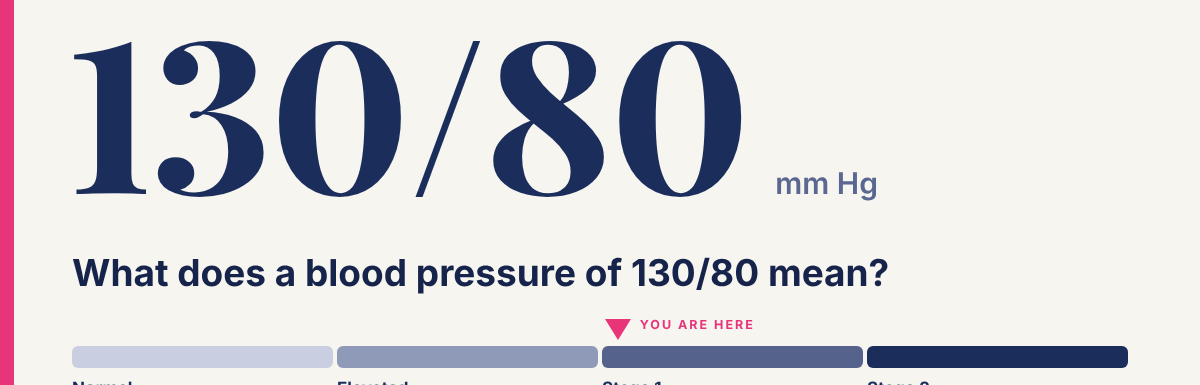
For most of the last century, a blood pressure of 130/80 was considered fine. Today the same reading is labeled stage 1 hypertension in the United States. If you have just been told your blood pressure is 130/80, or your home cuff keeps landing there, you are entitled to wonder whether you have a medical condition or a relabeled normal. This guide explains what the number means now, why the definition moved, how to find out whether it is your real blood pressure, and what current guidelines recommend at this level.
Quick answer: Under the American Heart Association and American College of Cardiology guideline, 130/80 mm Hg is the lowest reading in stage 1 hypertension. Either number qualifies on its own: a systolic of 130 to 139 or a diastolic of 80 to 89. The label requires an average of at least two careful readings on at least two occasions, ideally confirmed with home measurements. At this level, most otherwise healthy adults are advised to start with lifestyle changes for three to six months. Medication is recommended sooner for people with diabetes, chronic kidney disease, cardiovascular disease, or higher calculated risk. This is education, not medical advice.
Free tools: Blood pressure chart with checker and printable blood pressure log.
Where 130/80 fits
The categories below were set in the 2017 guideline and kept unchanged in the 2025 update. The American Heart Association publishes them for the public.
| Category | Systolic (top number) | Diastolic (bottom number) | |
|---|---|---|---|
| Normal | Below 120 | and | Below 80 |
| Elevated | 120 to 129 | and | Below 80 |
| Stage 1 hypertension | 130 to 139 | or | 80 to 89 |
| Stage 2 hypertension | 140 or higher | or | 90 or higher |
A reading of 130/80 is at the very bottom of stage 1 on both numbers. For the next category up, see what a blood pressure of 140/90 means.
Two numbers, one category
The systolic number is the pressure in your arteries when the heart contracts. The diastolic number is the pressure between beats. Notice the words and and or in the table. To be normal or elevated, both numbers have to be in range. To be stage 1 or stage 2, only one has to be. Your category is set by whichever number is higher on the scale.
- 128/82 is stage 1, because of the diastolic.
- 134/76 is stage 1, because of the systolic.
- 126/78 is elevated.
- 142/78 is stage 2, because of the systolic.
In adults over about 50, the systolic number is generally the stronger predictor of heart attack and stroke. In younger adults, a raised diastolic with a normal systolic is common and still counts. See systolic vs diastolic blood pressure and pulse pressure.
Readings near 130/80
| Reading | US category | Why |
|---|---|---|
| 118/76 | Normal | Both below 120 and 80 |
| 124/78 | Elevated | Systolic 120 to 129, diastolic below 80 |
| 128/80 | Stage 1 | Diastolic has reached 80 |
| 130/80 | Stage 1 | Both at the threshold |
| 132/84 | Stage 1 | Both in the stage 1 range |
| 130/85 | Stage 1 | Also the metabolic syndrome cut point |
| 135/85 | Stage 1 | The home-reading equivalent of 140/90 in a clinic |
| 138/88 | Stage 1 | Top of the range |
| 140/90 | Stage 2 | Either number at or above 140 or 90 |
See also what a blood pressure of 130/85 means.
Why the line moved to 130/80
Until 2017, US guidelines defined hypertension as 140/90 or higher and called 120 to 139 over 80 to 89 prehypertension. Two lines of evidence led to the change.
The first was observational. Pooled data from about a million adults showed that the risk of dying from heart disease or stroke rises steadily from a blood pressure of roughly 115/75 upward, approximately doubling with each increase of 20 points systolic or 10 points diastolic. There is no level at 140/90 where risk suddenly appears. People in the 130 to 139 over 80 to 89 range have about one and a half to two times the cardiovascular risk of people below 120/80.
The second was a large US trial called SPRINT, published in 2015. It assigned adults at increased cardiovascular risk to a systolic goal below 120 or below 140. The lower-goal group had about a quarter fewer heart attacks, strokes, heart failure events, and cardiovascular deaths, and the trial was stopped early because of the benefit.
The guideline writers concluded that calling 130/80 normal was no longer accurate. Reclassifying it was intended to prompt earlier attention, mainly through lifestyle, and not to put everyone at this level on medication.
What other guidelines call it
Not every expert body uses the same label, and it is useful to know that the disagreement is about naming, not about the underlying risk.
| Guideline | What it calls 130/80 | Where hypertension starts |
|---|---|---|
| American Heart Association and American College of Cardiology | Stage 1 hypertension | 130/80 |
| European Society of Cardiology (2024) | Elevated blood pressure | 140/90 |
| European Society of Hypertension (2023) | Normal to high-normal, depending on the exact numbers | 140/90 |
| International Society of Hypertension | High-normal | 140/90 |
If you read that 130/80 is not hypertension, the writer is probably using a European or international definition. All of these bodies agree that risk is higher at 130/80 than at 115/75, that lifestyle measures are worthwhile at this level, and that people at high cardiovascular risk may benefit from treatment.
One reading is not a diagnosis
Blood pressure changes from minute to minute. It rises when you talk, walk in from the parking lot, cross your legs, need the bathroom, or feel anxious about the result. A single reading of 130/80 in a clinic says very little. The guideline definition is based on the average of at least two careful readings taken on at least two separate occasions.
Two patterns are common enough to have names.
- White coat hypertension: readings are raised in the clinic and normal at home. This applies to a meaningful share of people with mildly raised office readings.
- Masked hypertension: readings are normal in the clinic and raised at home or at work. This is the more concerning pattern because it is easy to miss.
Both are sorted out the same way, with measurements taken outside the clinic. The guideline recommends out-of-office readings to confirm the diagnosis before treatment decisions are made. See white coat and masked hypertension.
Measuring it correctly
Small errors in technique routinely add 5 to 15 points, which is more than enough to turn 122/76 into 132/82.
| Common error | Typical effect on the reading |
|---|---|
| Cuff too small for the arm | Reads high, often by 5 to 10 points or more |
| Cuff placed over clothing | Unreliable, often high |
| Arm hanging down or unsupported | Reads high |
| Back unsupported or legs crossed | Reads high |
| Talking during the measurement | Reads high |
| Full bladder | Reads high |
| No rest before the reading | Reads high |
| Caffeine, nicotine, or exercise in the previous 30 minutes | Reads high |
The correct method: sit in a chair with your back supported and feet flat on the floor for five minutes, with the cuff on a bare upper arm supported at heart level. Do not talk. Take two readings one minute apart and record both. See how to take your blood pressure at home.
Confirming at home
Home monitoring is the practical way to find out whether 130/80 is your true blood pressure.
- Use an automatic upper-arm cuff that has been independently validated. The US Validated Device Listing is a free registry. See how to choose a validated home monitor.
- Measure twice in the morning before medicines and food, and twice in the evening, for seven days.
- Average the readings. Many clinicians discard the first day.
- Bring the average, not individual readings, to your appointment.
Home and clinic numbers line up closely at this level but drift apart higher up.
| Clinic reading | Equivalent home average | Equivalent 24-hour ambulatory average |
|---|---|---|
| 120/80 | 120/80 | 115/75 |
| 130/80 | 130/80 | 125/75 |
| 140/90 | 135/85 | 130/80 |
| 160/100 | 145/90 | 145/90 |
The blood pressure average calculator will do the arithmetic, and the seven-day blood pressure log explains the routine.
What guidelines recommend at 130/80
The 2025 guideline bases the decision on overall cardiovascular risk, estimated with a calculator called PREVENT, and on other conditions you have.
| Your situation with confirmed stage 1 readings | What the guideline recommends |
|---|---|
| No diabetes, kidney disease, or cardiovascular disease, and 10-year risk below 7.5% | Lifestyle changes for three to six months, then medication if the average is still 130/80 or higher |
| 10-year risk of 7.5% or higher | Lifestyle changes plus medication |
| Diabetes | Lifestyle changes plus medication |
| Chronic kidney disease | Lifestyle changes plus medication |
| Existing heart disease or prior stroke | Lifestyle changes plus medication |
The treatment goal for most adults is a blood pressure below 130/80, with encouragement to reach a systolic below 120 when that can be done comfortably. An important change from older guidance is the second half of the first row. Low-risk adults whose readings stay at or above 130/80 after a fair trial of lifestyle changes are now advised to begin medication instead of continuing to watch.
The guideline also advises a few baseline tests for anyone newly identified with hypertension, including a urine test for albumin to check for early kidney effects. The decision is always shared between you and your clinician. See blood pressure medications: what to know before you start.
How much each lifestyle change can do
At 130/80 you are a few points from the goal, which is why lifestyle measures are a realistic first step. The figures below are approximate average reductions in systolic pressure from clinical trials in people with raised blood pressure. Individual results vary, and the effects partly add together.
| Change | Approximate effect on systolic pressure |
|---|---|
| DASH-style eating pattern (vegetables, fruit, whole grains, low-fat dairy, less saturated fat) | Up to about 11 points |
| Weight loss, if overweight | About 1 point per kilogram (2.2 lb) lost |
| Reducing sodium toward 1,500 mg a day | About 5 to 6 points |
| More potassium from food, unless you have kidney disease or take medicines that raise potassium | About 4 to 5 points |
| Aerobic exercise, 90 to 150 minutes a week | About 5 to 8 points |
| Resistance training | About 4 points |
| Reducing alcohol | About 4 points in regular drinkers |
Any one of these could, on average, move 130 into the 120s. Sleep matters as well: untreated sleep apnea is one of the most common reasons blood pressure stays up. See diet for high blood pressure, sodium and blood pressure, stress and blood pressure, and how quickly blood pressure can change.
If you are on medication and reading 130/80
If you are being treated for high blood pressure, 130/80 means you are right at the goal line. The target is below 130/80, so a steady average of 130/80 is close, and a clinician may suggest a small adjustment or more work on sodium, weight, or activity to get clearly under it. If you came down from 150/95, you have already captured most of the benefit.
Do not change or stop a blood pressure medicine on your own. If you feel lightheaded when you stand, mention it, because that can be a sign that pressure is dropping too far at certain times of day.
Blood pressure and your other metabolic numbers
Blood pressure in this range frequently appears alongside a larger waist, raised triglycerides, lower HDL cholesterol, and a fasting glucose of 100 or more. The five together define metabolic syndrome, and insulin resistance is thought to be a common thread. The blood pressure cut point used in that definition is 130/85. See blood pressure and insulin resistance, blood pressure and belly fat, and the metabolic syndrome calculator.
Having diabetes changes the recommendation at 130/80, as the table above shows. If your glucose numbers are also borderline, see a fasting blood sugar of 100 to 110 and an A1C of 6.0. Cholesterol is assessed with the same risk calculator: see LDL of 130.
Pregnancy, older age, and other special cases
- Pregnancy. Blood pressure in pregnancy is managed by different rules, and readings that would be minor otherwise can matter. Report any reading of 140/90 or above, or symptoms such as severe headache, vision changes, or upper abdominal pain, to your obstetric team right away.
- Older adults. The categories do not change with age. For healthy older adults living independently, the goal is generally the same. For people who are frail, have limited life expectancy, or get dizzy on standing, targets are individualized. See blood pressure by age.
- Young adults. A reading of 130/80 in your twenties or thirties carries low short-term risk and more years of exposure, which is the argument for acting on habits early.
- Athletes and very active people. A reading taken soon after training is not a resting reading.
When blood pressure is an emergency
A reading of 130/80 is never an emergency. A reading above 180/120 needs prompt attention. If it comes with chest pain, shortness of breath, back pain, numbness or weakness, a change in vision, or difficulty speaking, call 911. Without symptoms, rest for a few minutes, measure again, and contact your clinician the same day if it remains that high.
Scenarios by situation
These are hypothetical illustrations, not case histories.
Age 38, one clinic reading of 130/80 after rushing in late. Not a diagnosis. A week of home readings will show the real average, which may well be in the low 120s.
Age 47, home average 132/82 over seven days, no other conditions, low calculated risk. Confirmed stage 1. The recommendation is three to six months of lifestyle changes with home monitoring, then reassess.
Age 58, type 2 diabetes, home average 131/81. With diabetes, the guideline recommends medication along with lifestyle changes at this level.
Age 52, clinic 138/86, home average 121/76. White coat pattern. Usually monitored without medication, with periodic home checks.
Age 64, on two medicines, down from 156/94 to 130/80. At the goal line after a large improvement. A small further step may be discussed.
Questions for your clinician
- Was my reading taken with the right cuff size, after resting, with my arm supported?
- Should I do a week of home readings before we decide anything?
- Is my home monitor validated, and can we compare it with the office device?
- What is my 10-year cardiovascular risk?
- Given my other conditions, do you recommend lifestyle changes first or medication now?
- When should we reassess, and what average are we aiming for?
- Should I have urine and blood tests for kidney function?
- Could sleep apnea, a medicine, or a supplement be raising my blood pressure?
Bottom line by situation
| Situation | Bottom line |
|---|---|
| One reading of 130/80 | Not a diagnosis; measure at home for a week |
| Confirmed average of 130/80, low risk, no other conditions | Stage 1; lifestyle changes for three to six months, then reassess |
| Confirmed 130/80 with diabetes, kidney disease, heart disease, or higher risk | Medication plus lifestyle changes is recommended |
| High in the clinic, normal at home | White coat pattern; keep monitoring |
| On treatment and averaging 130/80 | At the goal line; a little lower is the target |
| Pregnant | Follow your obstetric team’s thresholds |
Frequently asked questions
Is a blood pressure of 130/80 high?
Under US guidelines it is the lowest reading classified as stage 1 hypertension. European guidelines call the same reading elevated or high-normal. It is higher than ideal and not dangerous in the short term.
Is 130/80 normal?
Not under current US categories, where normal is below 120/80. It was considered acceptable under older definitions.
Do I need medication for 130/80?
Many people do not at first. Low-risk adults are advised to try lifestyle changes for three to six months. Medication is recommended sooner with diabetes, kidney disease, cardiovascular disease, or a 10-year risk of 7.5% or higher.
Is 130/80 OK for my age?
The categories are the same for all adults. Risk at a given blood pressure rises with age, so the reading matters more, not less, as you get older, though goals are individualized for frail adults.
What if only my bottom number is 80?
A diastolic of 80 to 89 is stage 1 even when the systolic is below 130. Isolated diastolic elevation is common in younger adults.
What if my top number is 130 and my bottom number is 70?
A systolic of 130 to 139 is stage 1 regardless of the diastolic.
Can 130/80 come down without medication?
Often. Weight loss, a DASH-style eating pattern, less sodium, regular exercise, and less alcohol each lower systolic pressure by several points on average.
How do I know if 130/80 is my real blood pressure?
Measure at home with a validated upper-arm cuff, twice each morning and evening for seven days, and average the results.
Is 130/80 dangerous?
Not in the short term. Over many years, blood pressure at this level carries a higher risk of heart disease and stroke than readings below 120/80.
What is the blood pressure goal on treatment?
Below 130/80 for most adults, with a systolic below 120 encouraged when it is well tolerated.
Does anxiety cause a reading of 130/80?
Anxiety can raise a single reading by 10 points or more. That is why the diagnosis is based on averages and home readings.
Is 130/80 high during pregnancy?
Pregnancy uses its own thresholds, and your obstetric team should interpret any reading. Report 140/90 or higher, or warning symptoms, immediately.
How often should I check my blood pressure at 130/80?
Do a seven-day home series to establish your average, then recheck periodically as your clinician advises, and again after any change in treatment or habits.
Why did 130/80 become high blood pressure?
The 2017 US guideline lowered the definition from 140/90 after evidence showed cardiovascular risk rising well below 140/90 and a major trial showed benefit from lower targets. The 2025 guideline kept it.
About the author: Charles Kirkland is the founder of Metabolic Clarity Labs and author of The Journey Back. He is not a physician. This is general education, not a medically reviewed treatment plan.
Sources checked November 12, 2026: the 2025 AHA/ACC high blood pressure guideline, the American Heart Association, the European Society of Cardiology, and the SPRINT trial. Do not start, stop, or change prescribed treatment based on this article.