
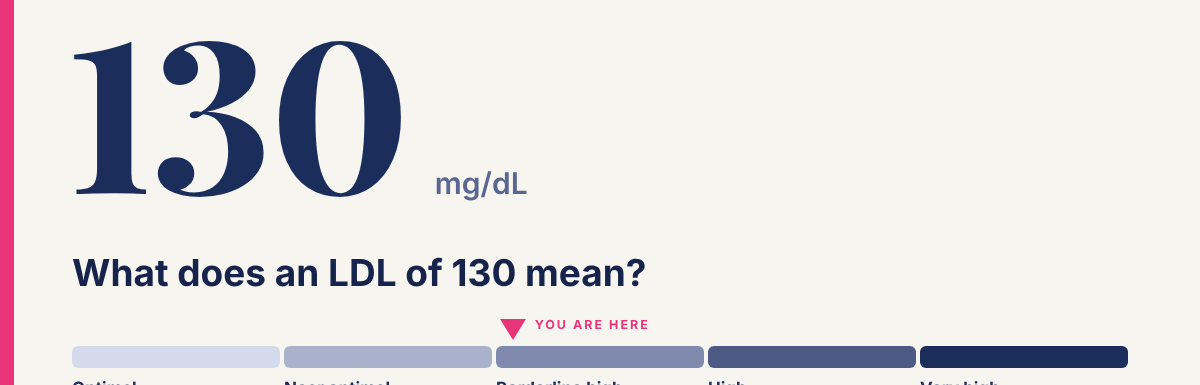
An LDL cholesterol of 130 mg/dL is one of the most ambiguous results on a lipid panel. Many lab reports flag it. Some clinicians say it is fine and others bring up a statin. Both responses can be correct, because the meaning of an LDL of 130 depends less on the number than on the person it belongs to. This guide explains how the number is categorized, how the current guideline uses it, and what determines whether it needs more than attention to food and activity.
Quick answer: An LDL cholesterol of 130 mg/dL (3.4 mmol/L) is the lowest value in the range traditionally labeled borderline high, which runs from 130 to 159. The 2026 American College of Cardiology and American Heart Association guideline sets an LDL goal below 100 mg/dL for most adults without cardiovascular disease, and below 70 or 55 for people at higher risk. So 130 is above goal for nearly everyone. Whether it calls for medication depends on your estimated 10-year and 30-year cardiovascular risk, other conditions such as diabetes, family history, and sometimes further tests. It is not urgent. This is education, not medical advice.
Free tools: Cholesterol levels chart with checker and LDL cholesterol calculator.
Where 130 fits
The descriptive categories printed on most lab reports date from earlier national cholesterol guidelines and are still published by the National Library of Medicine.
| LDL cholesterol (mg/dL) | In mmol/L | Traditional label |
|---|---|---|
| Below 100 | Below 2.6 | Optimal |
| 100 to 129 | 2.6 to 3.3 | Near optimal |
| 130 to 159 | 3.4 to 4.1 | Borderline high |
| 160 to 189 | 4.1 to 4.9 | High |
| 190 or higher | 4.9 or higher | Very high |
These labels describe where a number falls in the population. They do not tell you what to do, which is why guidelines moved toward goals based on individual risk. For the next band up, see what an LDL of 160 means.
How the current guideline reads 130
In March 2026 the American College of Cardiology, the American Heart Association, and nine other societies released a new guideline on dyslipidemia that replaced the 2018 cholesterol guideline. Two of its changes matter for reading a result of 130.
First, numeric LDL goals are back. The previous guideline focused on percentage reductions. The new one pairs those with specific targets set by risk.
| Who | LDL goal | Non-HDL goal | Is 130 at goal? |
|---|---|---|---|
| No cardiovascular disease, low, borderline, or intermediate 10-year risk | Below 100 mg/dL | Below 130 mg/dL | No, 30 points above |
| No cardiovascular disease, high 10-year risk | Below 70 mg/dL | Below 100 mg/dL | No, 60 points above |
| Established cardiovascular disease | Below 70 mg/dL | Below 100 mg/dL | No, 60 points above |
| Established cardiovascular disease at very high risk | Below 55 mg/dL | Below 85 mg/dL | No, 75 points above |
Second, risk is estimated with a newer calculator called PREVENT, which sorts 10-year risk of heart attack and stroke into four bands and also estimates 30-year risk.
| 10-year risk | Category |
|---|---|
| Below 3% | Low |
| 3% to under 5% | Borderline |
| 5% to under 10% | Intermediate |
| 10% or higher | High |
The guideline also emphasizes lifetime exposure. Arterial plaque builds in proportion to how high LDL is and for how many years, so an LDL of 130 at age 35 that stays at 130 for three decades matters more than the same number first appearing at 70.
The gap between 130 and your goal
| Your goal | Points to lose from 130 | Percent reduction needed | What typically achieves that |
|---|---|---|---|
| Below 100 | More than 30 | About 23% | Sometimes diet and lifestyle alone; reliably a low to moderate statin dose |
| Below 70 | More than 60 | About 46% | Moderate to high-intensity statin, often with lifestyle changes |
| Below 55 | More than 75 | About 58% | High-intensity statin, usually with a second medicine |
This is the practical value of having a target. For a person whose goal is below 100, 130 is within reach of sustained dietary change. For a person whose goal is below 70, it is not, and the conversation is about medication.
Why the same 130 means different things
Consider two people with an identical LDL of 130.
| Person A | Person B | |
|---|---|---|
| Age and sex | Woman, 38 | Man, 61 |
| Blood pressure | 114/72 | 144/88 on treatment |
| Smoking | Never | Current |
| Diabetes | No | Type 2 diabetes |
| HDL cholesterol | 62 mg/dL | 38 mg/dL |
| Likely risk category | Low | High |
| LDL goal | Below 100 | Below 70 |
| Usual approach | Food and activity, recheck | Statin therapy recommended |
LDL is the fuel for plaque. Blood pressure, smoking, diabetes, age, and kidney function determine how quickly the artery wall is damaged in the presence of that fuel. That is why a risk estimate comes before a treatment decision. Ask your clinician to calculate yours with the PREVENT calculator.
How LDL is measured, and how exact it is
On most lipid panels, LDL is calculated, not measured directly. The traditional Friedewald equation is LDL = total cholesterol – HDL – (triglycerides / 5). It works well when triglycerides are normal and becomes less accurate as triglycerides rise, and it is not valid at all when triglycerides are 400 mg/dL or higher. Many laboratories now use newer equations that hold up better with raised triglycerides, or measure LDL directly when needed.
- Fasting is usually optional. Guidelines accept non-fasting lipid panels for routine screening. Fasting mainly affects triglycerides, and a repeat fasting test is requested if they are high.
- LDL varies. Day-to-day biological variation is around 8 percent, so a true LDL of 130 can report anywhere from roughly 120 to 140. Treat changes smaller than 10 points with caution.
- Illness lowers it temporarily. LDL can fall for weeks after a serious infection, surgery, or heart attack. Test when you are well.
- Pregnancy raises it. Lipid panels are generally deferred until after pregnancy and breastfeeding.
Enter your panel in the complete cholesterol numbers calculator to see LDL, non-HDL, and ratios together.
The numbers to read with it
| Number | What it adds | Read more |
|---|---|---|
| Non-HDL cholesterol | Total cholesterol minus HDL. Captures all plaque-forming particles, not only LDL. The goal is 30 points above your LDL goal. | Non-HDL cholesterol explained |
| Triglycerides | When raised, LDL alone understates risk. | Triglyceride levels explained |
| HDL cholesterol | Low HDL raises estimated risk. A high HDL does not cancel a high LDL. | Low HDL explained |
| Apolipoprotein B | Counts plaque-forming particles directly. Most useful with raised triglycerides, diabetes, or metabolic syndrome. | Remnant cholesterol |
| Lipoprotein(a) | An inherited particle that raises risk independently. The 2026 guideline recommends testing once in adulthood. | How to read lab results |
LDL of 130 with insulin resistance or metabolic syndrome
LDL cholesterol is not one of the five criteria for metabolic syndrome. The lipid criteria are raised triglycerides and low HDL. That creates a blind spot. In people with insulin resistance, LDL cholesterol often looks ordinary, around 110 to 140, while the number of LDL particles is high, because each particle is smaller and carries less cholesterol. The standard LDL figure measures the cholesterol cargo, not the particle count, and it is the particles that enter the artery wall.
If your triglycerides are above 150, your HDL is low, your waist is over the cut point, or your glucose is in the prediabetes range, an LDL of 130 may understate your risk. This is the situation where non-HDL cholesterol or apolipoprotein B gives a truer reading. See high LDL with normal triglycerides for the opposite pattern, the triglyceride-to-HDL ratio calculator, and the metabolic syndrome calculator. For the related cut points, see blood pressure of 130/85 and fasting blood sugar of 100 to 110.
Factors that raise the stakes
When a risk estimate falls in the borderline or intermediate band, clinicians look at additional factors that the calculator does not fully capture. These include:
- A parent or sibling with heart attack or stroke at a young age (before 55 in men, before 65 in women)
- Metabolic syndrome
- Chronic kidney disease
- Chronic inflammatory conditions such as rheumatoid arthritis, psoriasis, lupus, or HIV
- A history of preeclampsia or early menopause
- South Asian ancestry
- A high lipoprotein(a) or apolipoprotein B
- Persistently raised triglycerides
The more of these apply, the more reason there is to treat an LDL of 130 actively.
Where a calcium score fits
A coronary artery calcium scan is a quick, low-dose CT scan that detects calcified plaque in the heart’s arteries. It is used selectively, mainly when a person’s risk is borderline or intermediate and the decision about a statin is uncertain. A score of zero in such a person suggests low near-term risk and can support waiting. Any detectable calcium is evidence that plaque is already present, and under the 2026 guideline it supports an LDL goal below 100, with lower goals as the score rises. It is not useful for people already known to be at high risk, or for people who have already decided to start or decline treatment.
What lowers LDL, and by how much
The figures below are approximate average reductions from clinical studies. Individual responses vary widely, partly for genetic reasons.
| Approach | Typical LDL reduction | What 130 might become |
|---|---|---|
| Replacing saturated fat with unsaturated fat | About 5% to 10% or more | About 117 to 124 |
| Soluble fiber, 5 to 10 g a day from oats, barley, beans, psyllium | About 5% to 10% | About 117 to 124 |
| Plant sterols or stanols, about 2 g a day | About 5% to 10% | About 117 to 124 |
| Weight loss of 5% to 10%, if overweight | A few percent; larger effect on triglycerides | About 122 to 127 |
| Combined dietary approach | About 15% to 25% in motivated people | About 98 to 110 |
| Moderate-intensity statin | 30% to 49% | About 66 to 91 |
| High-intensity statin | 50% or more | 65 or lower |
| Ezetimibe, usually added to a statin | About 15% to 25% further | Depends on starting point |
Exercise has a small effect on LDL itself and larger effects on triglycerides, HDL, blood pressure, and glucose, so it lowers risk more than the LDL change suggests. See psyllium and cholesterol, beta-glucan from oats and barley, the evidence on supplements for cholesterol, and how quickly cholesterol can change.
Does 130 call for a statin?
Statins have the largest body of evidence of any cholesterol treatment. Across trials, each reduction of about 39 mg/dL in LDL lowers major cardiovascular events by roughly a fifth, and the benefit grows with the years of treatment. Whether that benefit is worth pursuing at an LDL of 130 depends on your starting risk.
| Your situation | General direction of guidelines |
|---|---|
| Low 10-year risk, no enhancing factors | Food, activity, and weight; recheck. Thirty-year risk may be discussed in younger adults. |
| Borderline or intermediate risk | A shared decision, weighing enhancing factors and sometimes a calcium score; statin therapy is often reasonable. |
| High 10-year risk | Statin therapy recommended, aiming below 70. |
| Diabetes, age 40 or older | Statin therapy is recommended for most. |
| Established cardiovascular disease | Statin therapy recommended, aiming below 70 or 55. |
This table is a general summary. The decision is individual and is made with your clinician. If you are weighing a statin, see supplements and statins and CoQ10 and statin muscle symptoms. Do not substitute a supplement for a prescribed medicine without discussing it. Red yeast rice, for example, contains a statin-like compound in unpredictable amounts. See red yeast rice and quality.
Things that can raise LDL
- Diet high in saturated fat, including butter, fatty meats, full-fat dairy, and coconut and palm oils
- Very low-carbohydrate diets that are high in saturated fat, which raise LDL substantially in some people
- Unfiltered coffee such as French press or boiled coffee, in large amounts
- Underactive thyroid, which is why a thyroid test is often ordered with a raised LDL
- Kidney disease with protein loss, and some liver conditions
- Menopause, after which LDL commonly rises
- Medicines including some diuretics, steroids, retinoids, and certain transplant and HIV medicines
- Inherited tendency, which accounts for a large share of the variation between people
When to retest
- After a dietary change: LDL responds within four to six weeks, so a recheck at six to twelve weeks shows the effect.
- After starting or changing a medicine: four to twelve weeks, then every few months until at goal, then yearly.
- Routine screening: the 2026 guideline advises a lipid panel about every five years from early adulthood, more often when results are abnormal or risk is higher.
Scenarios by situation
These are hypothetical illustrations, not case histories.
Age 34, LDL 130, no other risk factors, no family history. Low risk, goal below 100. A fair trial of dietary change with a recheck in three months is the usual plan. Because the number may be present for decades, it is worth getting down.
Age 52, LDL 130, triglycerides 240, HDL 37, waist 42 inches. The LDL looks borderline, and the pattern suggests many small particles. Non-HDL here is far above goal. This person is at higher risk than the LDL implies.
Age 58, type 2 diabetes, LDL 130. Statin therapy is recommended for most adults in this group regardless of the starting LDL.
Age 47, LDL 130, father had a heart attack at 49. Family history is a strong enhancing factor. A lipoprotein(a) test and possibly a calcium score would inform the decision.
Age 66, prior stent, LDL 130 on no treatment. Well above the goal of below 70 or 55. Treatment is clearly indicated.
Questions for your clinician
- What is my 10-year and 30-year cardiovascular risk?
- What LDL goal applies to me?
- What is my non-HDL cholesterol, and is it at goal?
- Have I ever had lipoprotein(a) measured? Would apolipoprotein B help?
- Do my triglycerides and HDL suggest my LDL understates my risk?
- Would a coronary calcium score change the decision?
- Should my thyroid be checked?
- If we try lifestyle changes first, when do we recheck and what result would lead to medication?
Bottom line by situation
| Situation | Bottom line |
|---|---|
| LDL 130, low risk, nothing else abnormal | Above the goal of 100; diet and activity first, recheck in about three months |
| LDL 130 with high triglycerides and low HDL | Risk is probably higher than the LDL suggests; look at non-HDL or apoB |
| LDL 130 with diabetes or high calculated risk | Statin therapy is generally recommended |
| LDL 130 with existing heart disease | Far above goal; treatment is indicated |
| LDL 130 with strong family history | Ask about lipoprotein(a) and a calcium score |
| Borderline or intermediate risk, undecided | A calcium score can help settle it |
Frequently asked questions
Is an LDL of 130 bad?
It is labeled borderline high and is above the goal of below 100 mg/dL that current guidelines set for most adults. How much it matters depends on your overall cardiovascular risk.
Is an LDL of 130 normal?
It is close to the average for adults, but average is not the same as optimal. Guidelines consider below 100 the target for most people.
Do I need a statin for an LDL of 130?
Not necessarily. At low risk, diet and lifestyle are usually tried first. With diabetes, high calculated risk, or cardiovascular disease, a statin is generally recommended.
What is 130 mg/dL in mmol/L?
About 3.4 mmol/L. Divide mg/dL by 38.67 to convert LDL cholesterol.
Can I lower an LDL of 130 with diet?
Often. Replacing saturated fat with unsaturated fat, adding soluble fiber, and using plant sterols can together lower LDL by about 15% to 25% in people who stick with them.
How long does it take to lower LDL?
Dietary changes show up in four to six weeks. Statins reach most of their effect in about four weeks.
Is 130 OK if my HDL is high?
A high HDL lowers the calculated risk somewhat, but it does not cancel out LDL. Treatment decisions are based on LDL and overall risk.
Is LDL of 130 OK for my age?
The goal does not rise with age. In younger adults the concern is decades of exposure, and in older adults the concern is higher near-term risk.
What should my LDL be?
Below 100 mg/dL for most adults without cardiovascular disease, below 70 at high risk or with cardiovascular disease, and below 55 at very high risk.
Does LDL count toward metabolic syndrome?
No. The lipid criteria are triglycerides of 150 or higher and low HDL. LDL is assessed separately.
Do I need to fast for an LDL test?
Usually not for routine screening. A fasting test may be requested if triglycerides are high.
What is non-HDL cholesterol, and what should it be?
It is total cholesterol minus HDL. The goal is 30 points above your LDL goal, so below 130 for most adults.
Can thyroid problems raise LDL?
Yes. An underactive thyroid is a common, treatable cause of raised LDL.
Should I get a calcium score with an LDL of 130?
It can be useful when your risk is borderline or intermediate and you are unsure about a statin. It adds little if you are clearly low or clearly high risk.
About the author: Charles Kirkland is the founder of Metabolic Clarity Labs and author of The Journey Back. He is not a physician. This is general education, not a medically reviewed treatment plan.
Sources checked November 12, 2026: the 2026 ACC/AHA guideline on the management of dyslipidemia, the American College of Cardiology, and the National Library of Medicine. Do not start, stop, or change prescribed treatment based on this article.