
Quick answer: Yes, Aetna covers continuous glucose monitors, but its medical policy is one of the stricter ones among large insurers. Clinical Policy Bulletin 0070 calls long-term CGM medically necessary for people with type 1 or type 2 diabetes who use an intensive insulin regimen, meaning three or more injections a day or an insulin pump, and who also are under 18, are not meeting glycemic targets, or are having hypoglycemia. The same bulletin lists CGM for type 2 diabetes without intensive insulin as experimental. Plans that fill sensors through the pharmacy may apply different, broader criteria, so the benefit your plan uses matters.
This page explains what the Aetna policy says in plain language, where people with type 2 diabetes tend to get stuck, and what to ask before your prescriber sends the request. It is general education. It is not insurance, legal, or medical advice, and your own plan documents decide what is covered.
Policy last checked: November 13, 2026, against Aetna Clinical Policy Bulletin 0070 (reviewed February 20, 2026).
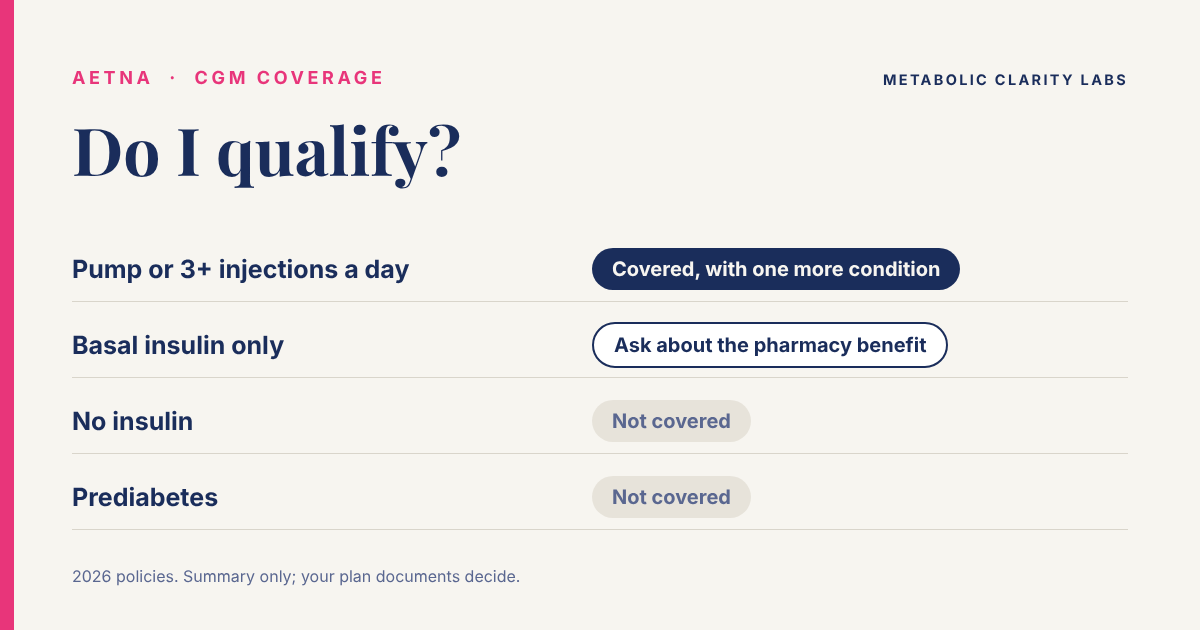
Do I qualify? A quick table
| Your treatment | Aetna medical policy | What to document |
|---|---|---|
| Type 1, pump or 3+ injections a day | Covered with one more condition | A1C above your target, or lows, or age under 18 |
| Type 2, pump or 3+ injections a day | Covered with one more condition | Number of daily injections, A1C against target, any lows |
| Type 2, basal insulin only | Not covered under the medical policy | Ask whether your pharmacy benefit uses different criteria |
| Type 2, sulfonylurea or meglitinide, no insulin | Not covered under the medical policy | Lows and risk factors, for a pharmacy-benefit request |
| Type 2, metformin or GLP-1 only | Not covered | Consider an over-the-counter sensor |
| Prediabetes | Not covered | Consider an over-the-counter sensor |
Free tools: time in range calculator, GMI calculator and printable meal and CGM log.
What the Aetna policy says
Aetna publishes its rules in Clinical Policy Bulletin 0070, Diabetes Tests, Programs and Supplies. The version we read was last reviewed on February 20, 2026, with the next review expected in January 2027. For long-term personal CGM, the bulletin sets a two-part test.
| Requirement | What the bulletin asks for |
|---|---|
| Diagnosis | Type 1 or type 2 diabetes |
| Part 1: insulin regimen | An intensive regimen: multiple daily injections (three or more a day) or an insulin pump |
| Part 2: at least one of these | Younger than 18; not meeting glycemic targets; or experiencing hypoglycemia, including hypoglycemia unawareness |
| Separate pathway | Glycogen storage disease qualifies on diagnosis |
Both parts have to be met. Intensive insulin alone is not enough on paper, although the second part is broad: an A1C above the goal your clinician set counts as not meeting targets.
Type 2 diabetes: who qualifies and who does not
The bulletin does not treat type 1 and type 2 differently. What it looks at is the insulin regimen. That produces three groups.
| Your situation | Under Clinical Policy Bulletin 0070 |
|---|---|
| Type 2, three or more insulin injections a day or a pump | Can qualify, with one item from part 2 |
| Type 2, basal insulin only (one or two injections a day) | Does not meet the intensive-insulin test |
| Type 2, pills or a GLP-1 medicine, no insulin | Listed as experimental, investigational, or unproven |
| Gestational diabetes | Listed as experimental, investigational, or unproven |
| Prediabetes or no diabetes | Not covered |
The bulletin names type 2 diabetes in members not using intensive insulin regimens as an example of a use it considers unproven. If that describes you, the medical policy is not on your side, and the realistic routes are the pharmacy benefit described next, an appeal with strong documentation, or paying for an over-the-counter sensor yourself. Our guide to CGM coverage for type 2 when you are not on insulin covers that situation across insurers.
Pharmacy benefit vs. medical benefit
A CGM can be paid for in two ways: as durable medical equipment under the medical benefit, or as a prescription filled at a pharmacy. Clinical Policy Bulletin 0070 is a medical policy. Aetna is part of CVS Health, and CVS Caremark manages the pharmacy benefit for many Aetna plans.
A CVS Caremark prior authorization document for continuous glucose monitors (reference 3888-A, 2025 version) uses different criteria from the medical bulletin. It allows approval for a person with diabetes who is using insulin therapy, without stating a number of daily injections. It also allows approval for someone taking a sulfonylurea (glyburide, glipizide, glimepiride) or a meglitinide (repaglinide, nateglinide) who has a major risk factor for hypoglycemia, such as a history of level 2 or level 3 lows, impaired awareness of lows, cognitive impairment, or end-stage kidney disease, or several lesser risk factors, such as age 75 or older or chronic kidney disease. Approvals under that document run 12 months.
We cannot tell you which criteria your plan applies. Employers choose their own pharmacy rules, and some plans send CGMs only through a medical supplier. That is why the first question to ask Aetna is which benefit covers a CGM on your plan and which criteria go with it. If you take basal insulin only, the answer can decide whether you are approved.
Keeping coverage after the first approval
For continued coverage under the medical bulletin, a member with diabetes has to still be on an intensive insulin regimen and meet at least one of two conditions: glycemic control has improved or lows have decreased while using the CGM, or the prescriber is assessing adherence to the CGM and the treatment plan at least every six months. In practice, keep your follow-up visits and make sure the note mentions the CGM data.
Which devices Aetna treats as equivalent
The bulletin names Dexcom, Eversense, FreeStyle Libre, and Guardian as examples of long-term CGM devices. It says FreeStyle Libre is an equally acceptable alternative to other CGM systems for medically necessary uses, and it says the same about CGMs with an implantable sensor such as Eversense. Which brand is preferred on your plan, and what you pay for it, comes from the plan formulary or supplier list, not from the bulletin. For how the devices differ, see Dexcom G7 vs. FreeStyle Libre 3 Plus and Eversense 365 vs. Dexcom G7.
Short-term diagnostic CGM
Separately from personal long-term use, the bulletin covers short-term diagnostic monitoring, from 72 hours to one week, for people with diabetes who have hypoglycemia unawareness or repeated lows below 50 mg/dL and highs above 150 mg/dL at the same time each day that have not responded to conventional insulin dose adjustment. It allows no more than two such monitoring periods in 12 months. This is the clinic-owned sensor some practices call a professional CGM.
Over-the-counter sensors
The parts of the Aetna bulletin we read do not address over-the-counter sensors such as Stelo and Lingo, and the CVS Caremark document says over-the-counter products are not included unless stated. If you do not meet the insulin criteria, an over-the-counter sensor paid for out of pocket, or with HSA or FSA dollars where eligible, is the route many people use. See the best CGM without a prescription, CGM cost without insurance, and Stelo HSA, FSA, and insurance coverage.
How to ask for approval
- Call the number on your card and ask whether a CGM is covered under the pharmacy benefit, the medical benefit, or both, and which one costs you less.
- Ask which criteria apply and whether precertification is required. For the medical benefit, Aetna points prescribers to its precertification forms.
- Ask for the preferred brand and the preferred pharmacy or supplier.
- Give your prescriber the specifics the policy looks for: your insulin regimen with the number of daily injections, your recent A1C against your target, and any lows, including dates and readings.
- Keep a copy of what was sent and the date.
If Aetna says no
Ask for the denial in writing with the specific criterion that was not met. Many denials come down to a missing detail, such as the chart note not stating three or more injections a day. Your prescriber can resubmit with that detail or request a peer-to-peer review. You have the right to an internal appeal and, for most plans, an external review by an independent organization. The denial letter gives the deadlines. If the denial stands, compare the cash price of a prescription sensor with a manufacturer savings offer against an over-the-counter sensor.
How this compares with current guidelines
The American Diabetes Association’s Standards of Care in Diabetes 2026 recommends CGM for adults with diabetes on insulin therapy, for those on non-insulin medicines that can cause hypoglycemia, and for those on any diabetes treatment where CGM helps management. That is broader than Aetna’s medical bulletin. In June 2026, the CONNECT randomized trial reported lower A1C with CGM in 283 adults with type 2 diabetes who were not on insulin. A May 2026 report from Georgetown University’s Center on Health Insurance Reforms found that plan criteria for CGMs often do not match the ADA standards. Insurers revise policies on their own schedule, so the criteria above may change. A guideline recommendation is not the same as coverage.
Questions to ask Aetna before you start
- Is a CGM covered under my pharmacy benefit, my medical benefit, or both?
- Which criteria does my plan use, and do I need precertification?
- Which brand is preferred, and what will I pay per month?
- Does my deductible apply?
- If I use basal insulin only, is there a path to approval on my plan?
What you will pay
Approval and cost are separate questions. Once a CGM is approved, what you pay depends on which benefit it runs through and where you are in your plan year.
- Pharmacy benefit. Sensors are usually on a drug-list tier with a flat copay or a percentage. On many plans the copay applies from the first fill. On high-deductible plans you may pay the full negotiated price until the deductible is met.
- Medical benefit. Sensors are billed as durable medical equipment by a supplier. You typically pay the deductible first and then coinsurance, often 20 percent, until you reach the out-of-pocket maximum.
- The reader or receiver. Most people use a phone, so ask whether you need the separate reader at all before paying for one.
Here is how the two routes can differ over a year. The plan terms and prices are invented for illustration and are not Aetna figures.
| Illustration | How it is charged | Cost for 12 months |
|---|---|---|
| Pharmacy benefit, $40 copay per month, deductible does not apply | 12 fills at $40 | $480 |
| Medical benefit, $1,500 deductible not yet met, then 20% coinsurance, plan price $300 per month | 5 months at $300, then 7 months at $60 | $1,920 |
| Same medical benefit, deductible already met by other care | 12 months at $60 | $720 |
The same device can cost four times as much through one benefit as the other, which is why it is worth asking Aetna to price both. If the insured cost comes out higher than a cash price, you are allowed to pay cash instead, although that spending usually will not count toward your deductible. Pharmacy discount cards brought FreeStyle Libre 3 Plus to about $162 a month in one example we recorded. See CGM cost without insurance for the dated price list.
Dexcom G7, Libre 3 Plus, Eversense, and Stelo
Does Aetna cover the Dexcom G7?
The medical bulletin lists Dexcom as a long-term CGM that is covered when the criteria are met. It does not rank Dexcom above or below other brands. Whether the G7 or the 15-day G7 sensor is preferred on your plan is a formulary question, so ask for the tier and whether a quantity limit applies.
Does Aetna cover FreeStyle Libre 3 Plus?
The bulletin says FreeStyle Libre is an equally acceptable alternative to other CGM systems for medically necessary uses. That statement matters if a reviewer suggests Libre is a lesser device or pushes you toward a different brand without a plan reason. Check which Libre model your plan lists, since older and newer sensors can sit on different tiers.
Does Aetna cover Eversense 365?
The bulletin treats a CGM with an implantable sensor as an equally acceptable alternative for medically necessary uses, so the same intensive-insulin criteria apply. The sensor is placed and removed in a clinic, so there are procedure charges under the medical benefit as well as the device. See Eversense 365 vs. Dexcom G7.
Does Aetna cover Stelo or Lingo?
We found nothing in the Aetna or CVS Caremark documents that covers over-the-counter sensors. Stelo was listed at $89 to $99 a month and Lingo at $89 for four weeks when we checked in November 2026. Both are sold directly to adults, and both makers describe them as eligible for HSA or FSA spending. See Stelo vs. Lingo.
Employer, marketplace, Medicare, and Medicaid plans
Clinical Policy Bulletin 0070 is Aetna’s standard commercial policy. How closely your plan follows it depends on the plan type.
- Fully insured employer plans and individual plans generally follow the bulletin, plus any state law that requires diabetes supply coverage.
- Self-funded employer plans. Many large employers pay claims themselves and hire Aetna to administer the plan. The employer can adopt the standard policy or write its own rule. Your benefits office or summary plan description will say which.
- Aetna Medicare Advantage. These plans follow Medicare’s coverage rules, which cover a CGM for a person with diabetes who is treated with insulin, with no minimum number of injections, or who has documented problematic hypoglycemia. Medicare also requires a visit within six months before the order and follow-up visits about every six months. That is broader than the commercial bulletin for people on basal insulin. See Medicare CGM coverage for type 2.
- Aetna Better Health (Medicaid). Medicaid plans follow each state’s rules, and many states now cover CGMs for anyone using insulin. See Medicaid CGM coverage by state.
Prior authorization checklist
Reviewers check the request against the policy line by line. A request that states each item in the policy’s own terms is less likely to bounce. Ask your prescriber’s office to confirm the note includes:
- The diagnosis, type 1 or type 2 diabetes, with the diagnosis code.
- The insulin regimen in plain numbers: which insulins, and that you inject three or more times a day or use a pump.
- Your most recent A1C with the date, and the target your clinician has set, so that not meeting glycemic targets is explicit.
- Any hypoglycemia: dates, readings, whether you felt symptoms, and whether you needed help.
- For a child or teen, the date of birth, since being under 18 satisfies the second part of the test.
- The specific device and the quantity per month.
- For renewals, a sentence on benefit, such as a lower A1C or fewer lows, or the date of the six-month adherence review.
Sample appeal letter
If a request is denied, a short letter that quotes the criterion and shows how you meet it is more effective than a long one. This template is a starting point. Replace the bracketed parts, attach records, and ask your prescriber to send a letter of medical necessity alongside it.
[Date]
Aetna Appeals
[Address from your denial letter]
Re: Appeal of denial for continuous glucose monitor
Member: [Name], ID [number], Claim or reference [number]
I am appealing the denial dated [date] of coverage for [device name]. The denial letter states that [reason given].
Aetna Clinical Policy Bulletin 0070 considers a long-term CGM medically necessary for a member with diabetes who is on an intensive insulin regimen and who is not meeting glycemic targets or is experiencing hypoglycemia. I meet these criteria:
- I have [type 1 / type 2] diabetes, diagnosed [year].
- I take insulin [number] times a day: [list insulins and timing]. [Or: I use an insulin pump.]
- My A1C on [date] was [value]. My clinician’s target for me is [value].
- [If applicable] I had low glucose readings on [dates and values], including [describe any severe low or low without symptoms].
Enclosed are my clinic notes from [dates], lab results, and glucose logs. My prescriber, [name], has also submitted a letter of medical necessity. Please reverse the denial and approve the device and supplies.
Sincerely,
[Name, phone, address]
Send it by a method that gives you a delivery record, keep a copy, and note the deadline in the denial letter. If you are appealing for basal-insulin use that the medical bulletin does not cover, say so directly and ask for an exception based on your clinician’s reasoning and the current American Diabetes Association recommendation.
Frequently asked questions
Does Aetna cover the Dexcom G7?
Aetna’s medical bulletin lists Dexcom among covered long-term CGM devices when the medical necessity criteria are met. Whether the G7 is the preferred brand on your plan, and your cost, depends on your plan formulary or supplier list.
Does Aetna cover FreeStyle Libre?
Yes, when criteria are met. The bulletin calls FreeStyle Libre an equally acceptable alternative to other CGM systems for medically necessary uses.
Does Aetna cover a CGM for type 2 diabetes?
Under Clinical Policy Bulletin 0070, yes if you use three or more insulin injections a day or an insulin pump and also are not meeting glycemic targets or are having hypoglycemia. Type 2 diabetes without an intensive insulin regimen is listed as unproven.
Does Aetna cover a CGM if I only take basal insulin?
The medical bulletin requires an intensive regimen, so basal insulin alone does not meet it. A CVS Caremark pharmacy document used by some plans allows approval for people using insulin therapy without a set number of injections. Ask Aetna which criteria your plan applies.
Does Aetna cover a CGM for prediabetes?
No. The criteria require a diabetes diagnosis, with the exception of glycogen storage disease.
Does Aetna cover a CGM for gestational diabetes?
The medical bulletin lists gestational diabetes among uses it considers experimental or unproven for long-term CGM. Ask your plan and your obstetric team, because plan rules can differ.
Do I need prior authorization for a CGM with Aetna?
Often, yes. Aetna calls it precertification. Requirements depend on the plan and on whether the CGM goes through the pharmacy or a medical supplier, so confirm before your prescriber sends the order.
How often does Aetna re-review CGM coverage?
The medical bulletin ties continued coverage to staying on an intensive insulin regimen and either showing benefit or having your prescriber assess adherence at least every six months. Pharmacy approvals under the CVS Caremark document last 12 months.
Does Aetna Medicare Advantage follow the same rules?
Medicare Advantage plans must cover what Original Medicare covers and follow Medicare coverage rules, which differ from the commercial bulletin. See our Medicare CGM guide.
Does Aetna cover Stelo or Lingo?
The sources we read do not show coverage for over-the-counter sensors. Most people pay for them directly. HSA or FSA funds may be usable.
How much does a CGM cost with Aetna?
It depends on your plan and the benefit used. Under a pharmacy benefit you usually pay a copay per fill. Under the medical benefit you usually pay the deductible first and then coinsurance. Ask Aetna to price both routes for your plan.
How long does Aetna take to decide a CGM request?
Timelines vary by plan and state. Standard precertification decisions commonly take several business days once Aetna has complete records, and urgent requests are faster. Ask for the expected date when the request is submitted.
Can I pay cash if Aetna denies my CGM?
Yes. You can fill a prescription sensor at a pharmacy cash price, often with a discount card, or buy an over-the-counter sensor. Cash purchases usually do not count toward your deductible.
Does Aetna cover a CGM if I take a sulfonylurea?
Not under the medical bulletin. A CVS Caremark pharmacy document used by some plans allows approval for people on a sulfonylurea or meglitinide who have specified hypoglycemia risk factors.
Do I need a new approval every year with Aetna?
Coverage is re-reviewed. The medical bulletin ties continuation to staying on an intensive insulin regimen and either documented benefit or a prescriber adherence review at least every six months.
Does a self-funded employer plan follow Aetna’s CGM policy?
Not always. A self-funded employer can adopt Aetna’s standard policy or set its own rule. Check your summary plan description or ask your benefits office.
Not insurance, legal or medical advice. Coverage rules change and are set by Aetna and your plan. Metabolic Clarity Labs has no relationship with Aetna or CVS Health.
Sources
Read the documents: Aetna Clinical Policy Bulletin 0070, CVS Caremark CGM criteria 3888-A, ADA Standards of Care 2026, and the Georgetown CHIR report.
- Aetna Clinical Policy Bulletin 0070, Diabetes Tests, Programs and Supplies (last reviewed February 20, 2026)
- CVS Caremark, Continuous Glucose Monitors initial prior authorization criteria, reference 3888-A (2025)
- American Diabetes Association, Standards of Care in Diabetes 2026, diabetes technology section and summary of revisions
- CONNECT randomized controlled trial, presented at the ADA Scientific Sessions, June 6, 2026
- Georgetown University Center on Health Insurance Reforms, report on CGM coverage criteria and prior authorization (May 2026)
About the author: Charles Kirkland is the founder of Metabolic Clarity Labs and author of The Journey Back. He is not a physician. This is general education, not a medically reviewed treatment plan.
Sources checked November 13, 2026. Discuss personal decisions with a qualified clinician. Do not start, stop, or change prescribed treatment based on this article.