
Quick answer: Yes, and Cigna’s published criteria are broader than several other large insurers. Its medical coverage policy covers continuous glucose monitors for type 1 or type 2 diabetes when you are on multiple daily injections, long-acting basal insulin, or an insulin pump. Basal insulin alone is enough. Its pharmacy prior authorization policy goes further: it approves a CGM for one year for a person with diabetes on any insulin regimen, or on non-insulin medicine with a qualifying low in the past six months, and for nine months during pregnancy, including gestational diabetes.
This page explains both Cigna policies, the device and quantity limits, and how to get a request approved. It is general education. It is not insurance, legal, or medical advice, and your plan documents decide what is covered.
Policy last checked: November 13, 2026, against Cigna Medical Coverage Policy 0106 and the Cigna National Formulary CGM prior authorization policy (revised January 21, 2026).
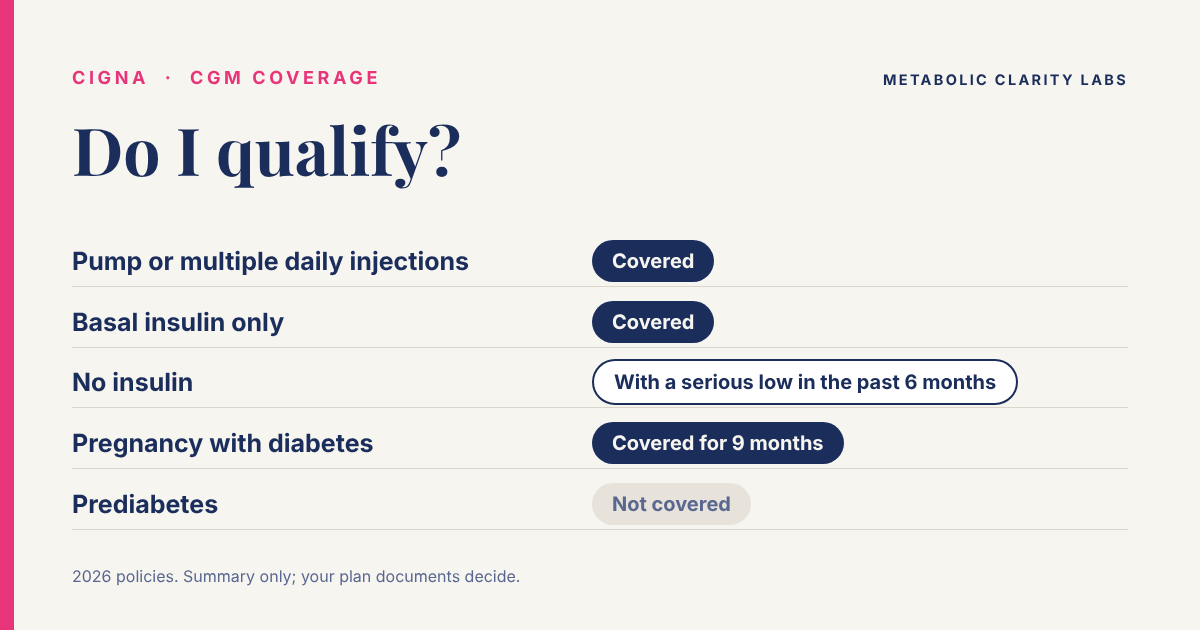
Do I qualify? A quick table
| Your treatment | Cigna policies | What to document |
|---|---|---|
| Type 1 or type 2, pump or multiple daily injections | Covered | The insulin regimen |
| Type 2, basal insulin only | Covered | The basal insulin, by name |
| Type 2, pills or GLP-1, with a recent serious low | Covered under the pharmacy policy | A reading under 54 mg/dL or a severe low in the past 6 months |
| Type 2, pills or GLP-1, no lows | Not covered | Consider an over-the-counter sensor |
| Pregnant with type 1, type 2, or gestational diabetes | Covered under the pharmacy policy for 9 months | The pregnancy and the diabetes diagnosis |
| Prediabetes | Not covered | Consider an over-the-counter sensor |
Free tools: time in range calculator, GMI calculator and printable meal and CGM log.
Two Cigna policies, two benefits
Cigna says coverage for CGMs varies across plans and may sit under the medical benefit or the pharmacy benefit. Each has its own document:
- Medical Coverage Policy 0106, Diabetes Equipment and Supplies. This applies when a CGM is supplied as medical equipment. It was updated in February 2026 to add the Dexcom G7 15-day sensor and the MiniMed Instinct sensor, and its next scheduled review is February 2027.
- Cigna National Formulary prior authorization policy, Diabetes: Continuous Glucose Monitoring Systems. This applies when sensors are filled as a prescription. Its most recent annual revision was January 21, 2026.
Your plan document decides which one applies to you, so the first call is to ask.
The medical policy: insulin, including basal
Under policy 0106, a therapeutic CGM is medically necessary for managing type 1 or type 2 diabetes when the person is on any one of these insulin regimens:
- multiple daily injections,
- long-acting basal insulin, such as glargine, detemir, degludec, or NPH, or
- a continuous subcutaneous insulin pump.
The policy does not ask for a number of fingersticks a day, an A1C above a threshold, or a history of lows. That makes it more generous than policies that require three or more injections a day. If you are comparing, see Aetna and UnitedHealthcare.
The pharmacy policy: insulin, lows, or pregnancy
The pharmacy prior authorization policy approves a CGM in these situations:
| Situation | What the policy requires | Approval length |
|---|---|---|
| Diabetes, on insulin | Basal insulin, basal plus mealtime insulin, mealtime insulin, or an insulin pump | 1 year |
| Diabetes, on non-insulin glucose-lowering medicine, starting a CGM | A level 2 low (below 54 mg/dL) or a level 3 low (severe, needing another person’s help) in the past 6 months | 1 year |
| Diabetes, on non-insulin medicine, already using a CGM | A level 2 or level 3 low in the 6 months before the CGM was first prescribed | 1 year |
| Diabetes during pregnancy | Type 1, type 2, or gestational diabetes | 9 months |
Any use not on that list is treated as not medically necessary. The products the policy names include Dexcom G6 and G7, Eversense 365, the FreeStyle Libre family, Guardian 3 and 4, MiniMed Instinct, and Simplera.
Type 2 not on insulin
If you manage type 2 diabetes with pills or a GLP-1 medicine, the medical policy does not give you a path, because every route in it involves insulin. The pharmacy policy does, but only with a documented low: one reading below 54 mg/dL, or one severe event, within the past six months. A single qualifying event is enough, which is a lower bar than policies that ask for repeated lows after several treatment changes. Lows are most likely with sulfonylureas such as glipizide, glimepiride, and glyburide. If you have none on record, coverage is unlikely, and an over-the-counter sensor is the usual alternative. See CGM coverage for type 2 when you are not on insulin.
Covered devices and age limits
Policy 0106 ties each device to the minimum age on its FDA labeling:
| Device | Minimum age in the policy |
|---|---|
| Dexcom G6, Dexcom G7, FreeStyle Libre 2 Plus, FreeStyle Libre 3 Plus | 2 years |
| FreeStyle Libre 2, FreeStyle Libre 3 | 4 years |
| Dexcom G7 15-day, FreeStyle Libre 14 day, Simplera | 18 years |
| MiniMed Instinct sensor | 7 years, type 1 only |
| Eversense implantable sensor | 18 years, on multiple daily injections, basal insulin, or a pump |
Which brand is preferred on your plan comes from the formulary. For how they differ in daily use, see Dexcom G7 vs. FreeStyle Libre 3 Plus and which CGM fits which goal.
Quantity limits
| Item | Limit in policy 0106 |
|---|---|
| FreeStyle Libre 14 day, Libre 2, Libre 3, Libre 2 Plus, Libre 3 Plus sensors | 2 every 28 days |
| Dexcom G6 and G7 sensors | 3 every 30 days |
| Dexcom G7 15-day sensors | 2 every 30 days |
| Simplera sensors | 5 every 30 days |
| Dexcom G6 transmitter | 1 every 90 days |
| FreeStyle Libre reader | 1 every 720 days |
| Dexcom receiver | 1 every 365 days |
These limits match normal wear time, so there is no spare built in. If a sensor fails early, contact the manufacturer for a replacement before asking the plan for an extra fill.
Replacing a device
Cigna covers replacement of a CGM or component when two things are documented: the device is malfunctioning, out of warranty, and cannot be repaired, and the provider managing your diabetes has evaluated you within the last six months and recommends continued use.
Over-the-counter sensors
Neither Cigna policy lists over-the-counter sensors such as Stelo or Lingo among covered products, and the pharmacy policy targets prescription systems. Expect to pay for those yourself, possibly with HSA or FSA funds. See the best CGM without a prescription, Stelo vs. Lingo, and CGM cost without insurance.
How to ask for approval
- Call the number on your Cigna card and ask whether a CGM is covered under your pharmacy benefit, your medical benefit, or both.
- Ask which brand is preferred and whether prior authorization is required for it.
- Make sure the prescription record shows your insulin. If you take basal insulin, the request should name it. This is the detail that qualifies most people with type 2.
- If you are not on insulin, give your prescriber the date and reading of any low below 54 mg/dL in the past six months, or the record of a severe low.
- If you are pregnant, ask your obstetric or diabetes team to note the pregnancy on the request, since it is its own approval category.
- Set a reminder before the approval ends. Insulin and hypoglycemia approvals last one year.
If Cigna says no
Ask for the written reason. Common causes are a request sent under the wrong benefit, a missing note about basal insulin, or a non-preferred brand. Your prescriber can resubmit or request a peer-to-peer review. You can file an internal appeal and, for most plans, ask for an independent external review. The denial letter lists the deadlines.
How this compares with current guidelines
The American Diabetes Association’s Standards of Care in Diabetes 2026 recommends CGM for adults on insulin therapy, for those on non-insulin medicines that can cause hypoglycemia, and for those on any diabetes treatment where CGM helps management. Cigna’s criteria line up with the first group and partly with the second, since the pharmacy policy asks for a low that has already happened. They do not reach people with type 2 diabetes on non-insulin treatment who have had no lows, the group studied in the CONNECT trial reported in June 2026.
What you will pay
Because Cigna’s criteria are comparatively easy to meet for anyone on insulin, cost is often the bigger question. It turns on three things.
- Which benefit. A pharmacy fill is charged at your drug-list tier. A medical-equipment order is charged against the deductible and then coinsurance.
- Which brand. A preferred brand sits on a lower tier. A non-preferred brand can cost more or need an exception request.
- Where you are in the plan year. On a high-deductible plan, January fills can cost the full negotiated price and December fills very little.
An illustration with invented numbers, which are not Cigna figures:
| Illustration | How it is charged | Cost for 12 months |
|---|---|---|
| Preferred brand, pharmacy tier copay of $30 | 12 fills at $30 | $360 |
| Non-preferred brand, pharmacy tier copay of $75 | 12 fills at $75 | $900 |
| Medical equipment, $1,000 deductible not yet met, then 20% coinsurance, plan price $280 per month | About 3.5 months at full price, then 20% | about $1,472 |
The preferred-brand difference in that example is $540 a year for sensors that do the same job, so ask which brand is preferred before you choose. If your insured price is above a cash price, compare it with the dated cash and discount-card prices in CGM cost without insurance.
Dexcom G7, Libre 3 Plus, Eversense, and Stelo
Does Cigna cover the Dexcom G7?
Yes, when the insulin criteria are met. Policy 0106 lists the Dexcom G7 for ages 2 and up at three sensors every 30 days, and the G7 15-day sensor for adults at two every 30 days. The G7 has no separate transmitter, so the only other item is the optional receiver, limited to one every 365 days.
Does Cigna cover FreeStyle Libre 3 Plus?
Yes, when criteria are met. The policy lists Libre 3 Plus and Libre 2 Plus for ages 2 and up, at two sensors every 28 days. The reader is limited to one every 720 days, and most people use the phone app instead.
Does Cigna cover Eversense 365?
Yes for adults 18 and older with type 1 or type 2 diabetes on multiple daily injections, long-acting basal insulin, or a pump. The pharmacy policy names Eversense 365 among its target products. Insertion and removal are billed as clinic procedures. See Eversense 365 vs. Dexcom G7.
Does Cigna cover Stelo or Lingo?
Neither policy lists over-the-counter sensors. If you have type 2 diabetes, take no insulin, and have had no lows, these are the practical option. Stelo was listed at $89 to $99 a month and Lingo at $89 for four weeks when we checked in November 2026. See Stelo vs. Lingo.
Employer, marketplace, Medicare, and Medicaid plans
- Employer plans administered by Cigna Healthcare. Most Cigna members are in employer plans, and many of those are self-funded. The employer can use Cigna’s standard policies or its own. The policies themselves say coverage varies across plans and that the plan document controls.
- Individual and family plans. Cigna sells marketplace plans in some states. They follow the standard policies and state diabetes-supply laws.
- Pharmacy benefit managed by Express Scripts. Cigna’s pharmacy benefits run through its Evernorth and Express Scripts businesses. If your employer uses a different pharmacy manager, different CGM criteria may apply.
- Medicare. Cigna completed the sale of its Medicare Advantage and Part D plans to Health Care Service Corporation in March 2025, and those plans now use the HealthSpring name. Whatever name is on your card, Medicare Advantage plans follow Medicare’s CGM rules: diabetes treated with insulin, or documented problematic hypoglycemia, with a visit in the six months before the order. See Medicare CGM coverage for type 2.
- Medicaid. State rules apply. See Medicaid CGM coverage by state.
Prior authorization checklist
The Cigna criteria are short, so most problems are paperwork. Ask your prescriber’s office to confirm the request states:
- The diagnosis: type 1, type 2, or gestational diabetes.
- The insulin you take, by name, and whether it is basal, mealtime, both, or pump therapy.
- If you take no insulin: the non-insulin medicine you take, and the date and value of a reading below 54 mg/dL, or the details of a severe low, within the past six months.
- If you are pregnant: that you are pregnant, since the approval length is different.
- The device, checked against the age limit for that model.
- The quantity, within the policy limit for that sensor.
- For a replacement device: that the old one is malfunctioning, out of warranty, and cannot be repaired, and the date of your last visit within six months.
Sample appeal letter
Fill in the brackets, attach records, and ask your prescriber to add a letter of medical necessity.
[Date]
Cigna Healthcare Appeals
[Address from your denial letter]
Re: Appeal of denial for continuous glucose monitor
Member: [Name], ID [number], Reference [number]
I am appealing the denial dated [date] of coverage for [device name]. The stated reason was [reason given].
Cigna Medical Coverage Policy 0106 considers a therapeutic CGM medically necessary for type 1 or type 2 diabetes when the individual is on multiple daily injections, long-acting basal insulin, or an insulin pump. Cigna’s CGM prior authorization policy also approves a CGM for a patient with diabetes who is on insulin. I meet these criteria:
- I have [type 1 / type 2] diabetes.
- I take [insulin name] [dose and frequency], prescribed by [prescriber] since [date]. My pharmacy fill history confirms this.
- [If not on insulin] I take [medicine]. On [date], my glucose was [value] mg/dL, which is below 54 mg/dL. [Or describe the severe low.]
The device requested, [model], is within the age and quantity limits in the policy. My records are enclosed. Please reverse the denial.
Sincerely,
[Name, phone, address]
If the denial was for a non-preferred brand, ask your prescriber to explain why the preferred brand is not suitable, for example a skin reaction to its adhesive or a need for a feature only the other device has, or consider switching to the preferred brand.
From request to first sensor
- Confirm the benefit. Ask Cigna whether your plan fills CGMs at the pharmacy, through a medical supplier, or either. This decides which policy and which form apply.
- Pick the device with the tier in mind. Ask which brand is preferred before your prescriber writes the order.
- The prescription and the request. For a pharmacy fill, the pharmacy runs the claim and the system may approve it without paperwork if your record already shows insulin. If it asks for prior authorization, your prescriber’s office submits the diagnosis and insulin details.
- The decision. Approvals for the insulin and hypoglycemia categories run one year, and nine months for pregnancy.
- The fill. Sensors are dispensed within the quantity limits: two Libre sensors per 28 days, or three Dexcom sensors per 30 days.
- The renewal. Put a reminder on your calendar a month before the approval ends, and keep a diabetes visit within the prior six months in case a replacement device is ever needed.
Why requests get denied, and the fix
| Reason on the letter | What it usually means | What to do |
|---|---|---|
| Criteria not met: insulin use not documented | The request did not name your insulin, or your insulin is filled somewhere the plan cannot see | Have the prescriber name the insulin and regimen on the request |
| Criteria not met: no qualifying hypoglycemia | You take no insulin and the request showed no low under 54 mg/dL in the past 6 months | Supply the date and reading, or the record of a severe low, if you have one |
| Non-formulary or non-preferred product | The brand requested is not the plan’s preferred one | Switch to the preferred brand, or have the prescriber explain why it will not work for you |
| Quantity exceeds limit | More sensors were requested than the policy allows | Request the policy quantity. For a failed sensor, ask the manufacturer to replace it |
| Age restriction | The device is not labeled for the patient’s age | Choose a model the policy lists for that age |
| Not a covered benefit | Your plan covers CGMs under the other benefit, or your employer’s plan excludes them | Resubmit under the right benefit, or check the plan document |
Already using a CGM, or about to start insulin
If you already use a CGM and are new to Cigna. People on insulin simply need the new plan to see the insulin, so a current prescription is usually enough. The pharmacy policy has a separate line for people on non-insulin medicine who are already using a CGM: it asks for a level 2 or level 3 low in the six months before the CGM was first prescribed. That means the record you need is the one from before you started, so ask your previous prescriber or insurer for it.
If your clinician is about to start you on basal insulin. Under both Cigna policies, basal insulin is a qualifying regimen. If a CGM is part of the plan for starting insulin safely, your prescriber can request it at the same visit, noting the insulin that was prescribed.
If you stop insulin later. Coverage is tied to the criteria at each review. If you come off insulin and have had no qualifying lows, expect the next renewal to be questioned, and talk with your clinician ahead of time about whether an over-the-counter sensor would meet your needs.
How Cigna compares
| Insurer | Basal insulin only | No insulin | Gestational diabetes |
|---|---|---|---|
| Cigna | Covered | One serious low in the past 6 months (pharmacy policy) | Covered for 9 months (pharmacy policy) |
| Aetna | Not under the medical policy | Listed as unproven | Listed as unproven |
| UnitedHealthcare | Only with documented serious lows | Only with documented serious lows | Reviewed under prior authorization |
| Anthem | Covered with one sign of inadequate control | Not covered | Not a separate pathway |
| Medicare | Covered | Only with problematic lows | Rarely applies |
On paper, Cigna asks for less than the other large commercial insurers. Your own result still depends on your plan document and on whether your employer uses Cigna’s standard policies. The full table is in CGM insurance coverage by insurer.
Frequently asked questions
Does Cigna cover the Dexcom G7?
Yes when criteria are met. Policy 0106 lists Dexcom G7 for ages 2 and older and the G7 15-day sensor for adults, and the pharmacy policy names Dexcom G6 and G7.
Does Cigna cover FreeStyle Libre?
Yes when criteria are met. The policies list the FreeStyle Libre 14 day, Libre 2, Libre 3, Libre 2 Plus, and Libre 3 Plus, with a limit of two sensors every 28 days.
Does Cigna cover a CGM for type 2 diabetes?
Yes if you are on multiple daily injections, long-acting basal insulin, or an insulin pump. Under the pharmacy policy, also if you are on non-insulin medicine and had a low below 54 mg/dL or a severe low in the past six months.
Does Cigna cover a CGM if I only take basal insulin?
Yes. Both the medical policy and the pharmacy policy list basal insulin as a qualifying regimen.
Does Cigna cover a CGM for gestational diabetes?
The pharmacy prior authorization policy approves a CGM for nine months for a pregnant patient with type 1, type 2, or gestational diabetes.
Does Cigna cover a CGM for prediabetes?
No. Both policies require diabetes.
How many sensors does Cigna allow?
Two FreeStyle Libre sensors every 28 days, three Dexcom G6 or G7 sensors every 30 days, and two Dexcom G7 15-day sensors every 30 days.
Does Cigna cover Eversense?
Yes for adults 18 and older with type 1 or type 2 diabetes on multiple daily injections, long-acting basal insulin, or a pump. The pharmacy policy names Eversense 365.
Does Cigna require prior authorization for a CGM?
The Cigna National Formulary policy recommends prior authorization for prescription CGM systems. Whether your plan applies it depends on the plan.
Does Cigna cover Stelo or Lingo?
The policies we read do not list over-the-counter sensors as covered. Most people pay for them directly.
How much does a CGM cost with Cigna?
It depends on your plan, the benefit used, and whether the brand is preferred. Pharmacy fills are charged at your drug-list tier. Medical-equipment orders go against the deductible and then coinsurance.
Does Cigna cover a CGM if I only take metformin?
Only if you have had a qualifying low, which is uncommon on metformin alone. The pharmacy policy requires a reading below 54 mg/dL or a severe low in the past six months for people on non-insulin medicine.
Does Cigna cover a CGM with a GLP-1 medicine and no insulin?
A GLP-1 medicine is non-insulin treatment, so the same rule applies: a qualifying low in the past six months is needed under the pharmacy policy.
Can I switch from FreeStyle Libre to Dexcom on Cigna?
Both are covered when criteria are met, but one may be preferred on your plan. Ask about tiers first. The policy covers a replacement device when the old one is malfunctioning, out of warranty, and cannot be repaired.
How long is a Cigna CGM approval good for?
One year for the insulin and hypoglycemia categories and nine months for pregnancy under the pharmacy prior authorization policy.
What if my employer does not use Express Scripts?
Then your pharmacy benefit may follow another manager’s CGM criteria. Ask the pharmacy number on your card which criteria apply.
Not insurance, legal or medical advice. Coverage rules change and are set by Cigna and your plan. Metabolic Clarity Labs has no relationship with Cigna Healthcare or Evernorth.
Sources
Read the documents: Cigna Medical Coverage Policy 0106, Cigna CGM prior authorization policy, and ADA Standards of Care 2026.
- Cigna Medical Coverage Policy 0106, Diabetes Equipment and Supplies (2026 version; next review February 15, 2027), and Cigna policy update notices for December 2025 and February 2026
- Cigna National Formulary Coverage, Diabetes: Continuous Glucose Monitoring Systems Prior Authorization Policy (revised January 21, 2026)
- American Diabetes Association, Standards of Care in Diabetes 2026, diabetes technology section and summary of revisions
- CONNECT randomized controlled trial, presented at the ADA Scientific Sessions, June 6, 2026
About the author: Charles Kirkland is the founder of Metabolic Clarity Labs and author of The Journey Back. He is not a physician. This is general education, not a medically reviewed treatment plan.
Sources checked November 13, 2026. Discuss personal decisions with a qualified clinician. Do not start, stop, or change prescribed treatment based on this article.