
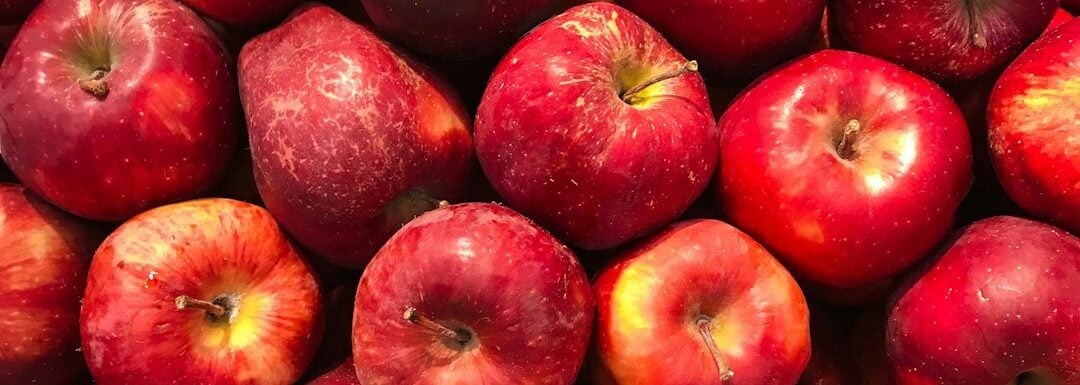
An apple is one of the lowest glycemic index fruits you can buy, and it comes with more fiber than most. It is also sold in sizes that range from a tennis ball to a softball, which changes the carbohydrate by a factor of two. This guide gives you the numbers by size, compares whole apples with applesauce, juice, and dried apple, and shows how to count a portion.
Quick answer: A medium apple weighing 182 grams has about 25 grams of carbohydrate, 4.4 grams of fiber, and 19 grams of sugars. A small one has about 21 grams and a large one about 31. The glycemic index of a raw apple is about 36, which is low. Apple juice has slightly more carbohydrate than a medium apple and almost none of the fiber. This is general education, not medical advice. Your care team can tell you how many carbohydrate grams fit a meal or snack for you.
What is in an apple, by size
The USDA entry for raw apples with skin lists 13.8 grams of carbohydrate, 2.4 grams of fiber, 10.4 grams of sugars, and 52 calories per 100 grams. The portions below use the weights on that entry.
| Portion | Weight | Carbs (g) | Fiber (g) | Sugars (g) | Calories |
|---|---|---|---|---|---|
| Half a medium apple | 91 g | 12.6 | 2.2 | 9.5 | 47 |
| 1 cup of slices | 109 g | 15.0 | 2.6 | 11.3 | 57 |
| Small (about 2 3/4 in) | 149 g | 20.6 | 3.6 | 15.5 | 77 |
| Medium (about 3 in) | 182 g | 25.1 | 4.4 | 18.9 | 95 |
| Large (about 3 1/4 in) | 223 g | 30.8 | 5.4 | 23.2 | 116 |
Many apples sold today are bigger than the USDA’s large. One source we read puts an extra-large Honeycrisp at 250 to 300 grams. At 13.8 grams of carbohydrate per 100 grams, that is 34.5 to 41.4 grams of carbohydrate, more than a large banana. If you buy big apples, half is a reasonable default portion.
Does the variety matter?
A little. The USDA’s Red Delicious entry lists 14.1 grams of carbohydrate per 100 grams, close to the all-variety figure. One source lists a medium Granny Smith at about 22 grams of carbohydrate against 25 for a typical medium apple. That is a gap of about 3 grams, which is smaller than the gap between a small and a medium apple of any kind. Size is the bigger lever.
Glycemic index and glycemic load
The 2008 international glycemic index (GI) tables list raw apple at 36, plus or minus 2. That is one of the lowest values for any common fruit. Apple juice is listed at 41, plus or minus 2, which is also low.
Glycemic load (GL) is GI times the carbohydrate in the portion, divided by 100. For a medium apple, carbohydrate minus fiber is 20.7 grams, so the GL is 20.7 times 36, divided by 100, or about 7.5. That is in the low band, which is 10 or under. A 300-gram apple works out to about 12. See glycemic index vs. glycemic load for the method.
A low GI does not mean an apple has no effect. A medium apple is still about 25 grams of carbohydrate, and it still counts.
Whole apple, applesauce, juice, and dried
| Form | Portion | Carbs (g) | Fiber (g) | Calories |
|---|---|---|---|---|
| Whole apple with skin | 1 medium (182 g) | 25.1 | 4.4 | 95 |
| Applesauce, unsweetened | 1/2 cup | about 14 | about 1.5 | about 50 |
| Applesauce, sweetened | 1/2 cup | about 25 | about 1.5 | about 97 |
| 100% apple juice | 1 cup (8 fl oz) | about 28 | 0.5 | 114 |
| 100% apple juice | 1/2 cup | about 14 | 0.2 | 57 |
| Dried apple | 4 rings | about 15 | varies | varies |
The pattern is the same as for other fruit. Processing removes fiber and water, and it removes chewing. A cup of juice has a little more carbohydrate than a medium apple, about one ninth of the fiber, and takes seconds to drink. Sweetened applesauce has nearly double the carbohydrate of unsweetened. The applesauce and juice figures are standard USDA-derived values as published by nutrition references, and the dried-apple portion comes from diabetes food lists. Check your own label, because brands differ.
Should you peel it?
Much of an apple’s fiber is in and near the skin. One source we read says peeling a medium apple removes roughly half of its 4.4 grams of fiber while saving only 10 to 15 calories. We did not verify that split against USDA data, so treat it as approximate. The direction is clear enough: if you tolerate the skin, leaving it on keeps more fiber for the same carbohydrate.
Worked example: counting a portion
Using 13.8 grams of carbohydrate per 100 grams, the amount of apple for a target is the target divided by 13.8, times 100.
| Carbohydrate target | Apple needed (edible) | Roughly |
|---|---|---|
| 15 g | 109 g | 1 cup of slices, or about 60 percent of a medium apple |
| 30 g | 217 g | 1 large apple |
| 45 g | 326 g | 1 large and 1/2 medium, or one very large apple |
Diabetes food lists describe a 15-gram fruit portion as one small apple of about 4 ounces, roughly the size of a tennis ball. That weight includes the core, which is why it lines up with about 109 grams of edible fruit. These targets are illustrations, not recommendations.
What the research says
A 2013 analysis in the BMJ pooled three long-running U.S. studies with 187,382 adults and 12,198 new cases of type 2 diabetes. For every three servings a week of apples and pears, the risk of developing type 2 diabetes was 7 percent lower (hazard ratio 0.93, 95% confidence interval 0.90 to 0.96). For fruit juice, which included apple juice, the same increase went with an 8 percent higher risk (1.08, 1.05 to 1.11).
This was an observational study of people without diabetes at the start. It shows an association with developing the condition. It does not show that apples treat diabetes, and it does not remove the need to count the carbohydrate.
How apples compare with other fruit
| Fruit | Portion | Carbs (g) | Fiber (g) | Published GI |
|---|---|---|---|---|
| Apple, medium | 182 g | 25.1 | 4.4 | 36 |
| Orange, medium | 131 g | 15.4 | 3.1 | 43 |
| Banana, medium | 118 g | 26.9 | 3.1 | 51 |
| Grapes, 1 cup | 151 g | 27.3 | 1.4 | about 46 |
| Strawberries, 1 cup | 147 g | 11.3 | 2.9 | about 40 |
A medium apple has about as much carbohydrate as a medium banana, with more fiber and a lower GI. An orange has less carbohydrate than either.
Ways to fit it in
- Buy small apples, or cut a large one in half and save the rest.
- Eat the skin if you tolerate it.
- Pair it with a protein or fat food such as cheese, nuts, or nut butter. We did not find a study that measures this pairing for apples in people with diabetes, so check your own readings. Nut butter adds its own calories and a little carbohydrate.
- Choose unsweetened applesauce, and measure it.
- Treat juice as a small measured portion, not a drink to refill.
How to test your own response
- Check glucose right before you eat.
- Eat a weighed or measured portion and write down the size.
- Check again at one hour and two hours, or look at your CGM trace for that window.
- Repeat on another day with a different size or a pairing, and compare.
Our post-meal glucose tracker is built for this kind of comparison, and how to read your CGM data explains what the curve means.
Frequently asked questions
Can people with diabetes eat apples?
Many do. An apple is a carbohydrate food, so it counts toward your carbohydrate for the meal or snack. A medium apple has about 25 grams, and a small one about 21 grams. Size is the main thing to watch.
How many carbs are in an apple?
About 25 grams in a medium apple weighing 182 grams, with 4.4 grams of fiber and about 19 grams of sugars, based on USDA data. A small apple has about 21 grams and a large one about 31 grams.
Do apples raise blood sugar?
Yes, like any carbohydrate food. The glycemic index of a raw apple is about 36, which is low, and the fiber slows things somewhat. How much your glucose rises depends on the size of the apple and on you, so check with a meter or CGM.
Are green apples better than red for blood sugar?
The difference is small. One source lists a medium Granny Smith at about 22 grams of carbohydrate against about 25 for a typical medium apple. The difference between a small and a large apple of any color is much bigger.
Is apple juice or applesauce the same as an apple?
No. A cup of apple juice has about 28 grams of carbohydrate and 0.5 grams of fiber, against 25 grams and 4.4 grams of fiber in a medium apple. Unsweetened applesauce is closer to the fruit, and sweetened applesauce has nearly double the carbohydrate of unsweetened.
About the author: Charles Kirkland is the founder of Metabolic Clarity Labs and author of The Journey Back. He is not a physician. This is general education, not a medically reviewed treatment plan.
Sources checked November 11, 2026: USDA FoodData Central (apples, raw, with skin, 171688; Red Delicious, 168201), the 2008 international tables of glycemic index values, American Diabetes Association fruit portion lists, and Muraki et al., BMJ 2013;347:f5001. Discuss personal decisions with a qualified clinician. Do not start, stop, or change prescribed treatment based on this article.