
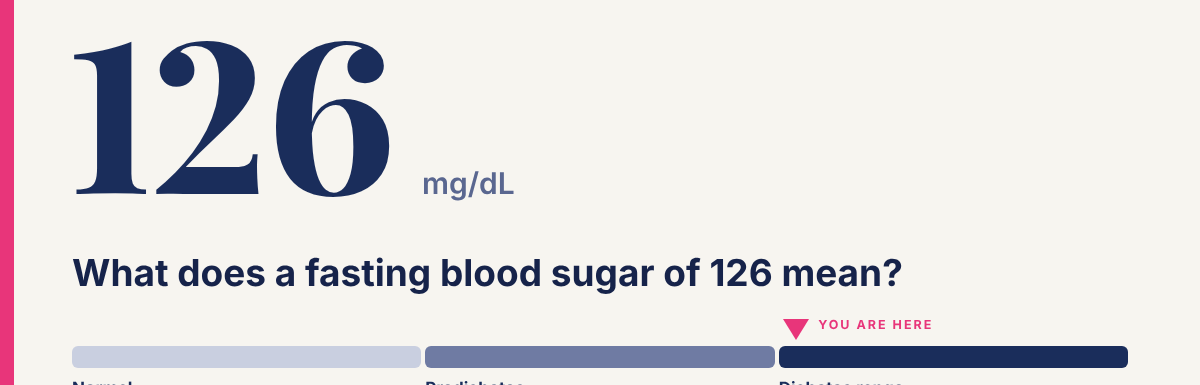
A fasting blood sugar of 126 mg/dL is the number written into every definition of diabetes. If it is on your lab report, or on your meter one morning, it is natural to assume the question is settled. It is not, yet. A single fasting value at the threshold needs to be confirmed, and there are several ordinary reasons it might not hold. This guide explains what 126 means, how confirmation works, and what to expect whichever way the second test goes.
Quick answer: A fasting plasma glucose of 126 mg/dL (7.0 mmol/L) or higher is in the diabetes range. In a person without clear symptoms, a diagnosis requires two abnormal results, either the same test repeated on another day or a second test such as an A1C of 6.5% or higher. A home meter reading of 126 is not a diagnostic result. If you already have diabetes, a fasting reading of 126 is inside the usual before-meal goal of 80 to 130 mg/dL. This is education, not medical advice.
Free tools: Normal blood sugar chart with checker and printable blood sugar log. Also see the blood sugar conversion chart.
Where 126 fits
| Fasting plasma glucose | In mmol/L | Category |
|---|---|---|
| Below 100 mg/dL | Below 5.6 | Normal |
| 100 to 125 mg/dL | 5.6 to 6.9 | Prediabetes (impaired fasting glucose) |
| 126 mg/dL or higher | 7.0 or higher | Diabetes range, when confirmed |
These bands come from the American Diabetes Association diagnostic criteria and match those of the World Health Organization. Fasting means at least eight hours with no calories. A reading of 126 is the first value in the top band. A reading of 125 is the last value in the prediabetes band, and nothing about your health differs between the two. For the lower end of the range, see a fasting blood sugar of 100 to 110.
Why the line is at 126
Before 1997, the fasting threshold for diabetes was 140 mg/dL. An expert committee lowered it to 126 for two reasons. First, population studies showed that diabetic eye disease began to appear in people whose fasting glucose was around the mid 120s, well below 140. Second, the old fasting threshold and the glucose tolerance test threshold of 200 mg/dL at two hours did not identify the same people. Most people who reached 200 on a tolerance test had fasting values far below 140. Moving the fasting line to 126 brought the two tests into closer agreement.
So the number has a rationale, and it is still a line drawn across a continuous slope. Risk does not jump between 124 and 127. What changes at 126 is the label and the care that follows from it.
One reading is not a diagnosis
The ADA criteria state that, unless there is unmistakable high blood sugar with symptoms, a diagnosis requires two abnormal test results. They can come from the same blood sample using two different tests, or from two separate samples.
| What you have | What it usually means |
|---|---|
| Fasting glucose 126 once, nothing else tested | Not confirmed. Expect a repeat fasting glucose or an A1C. |
| Fasting glucose 126 and A1C 6.5% or higher, same draw | Two tests above threshold. Confirmed. |
| Fasting glucose 126, repeat on another day 128 | Confirmed. |
| Fasting glucose 126, repeat 118 | Not confirmed. Treated as high-range prediabetes with close follow-up. |
| Fasting glucose 126, A1C 6.1% | The tests disagree. The fasting test is repeated, and the diagnosis depends on whether it stays at or above 126. |
| Random glucose 200 or higher with strong thirst, frequent urination, weight loss | Diagnosis can be made on that basis alone. |
When two different tests disagree, the guidance is to repeat the one that was above its threshold. If it is above again, the diagnosis is made on that test. People are sometimes surprised to learn that a diagnosis can stand on fasting glucose alone while A1C stays below 6.5%. It can, and the reverse is also true. See high fasting glucose with a normal A1C and the comparison of the three diabetes tests.
Reading 126 alongside your A1C
There is a coincidence that trips people up. An A1C of 6.0% converts to an estimated average glucose of 126 mg/dL. That does not mean a fasting glucose of 126 equals an A1C of 6.0. The A1C figure is an average across the entire day, including the hours after meals when glucose is highest. Fasting is normally the lowest point of the day. Someone whose lowest point is 126 will have an all-day average well above that.
| Fasting glucose | A1C on the same report | How it is usually read |
|---|---|---|
| 126 to 135 | Below 5.7% | Unusual. Check fasting conditions, recent illness or steroids, and factors that lower A1C falsely. Repeat. |
| 126 to 135 | 5.7% to 6.4% | Common near the threshold. Repeat the fasting test to decide. |
| 126 to 135 | 6.5% or higher | Both above threshold. Confirmed. |
| Below 126 | 6.5% or higher | Repeat the A1C. See an A1C of 6.5. |
If your A1C is much lower than your fasting glucose would suggest, ask whether anything could be shortening the life of your red blood cells, such as recent blood loss, anemia, or kidney disease. See why A1C can be wrong.
Lab result vs home meter
The diagnostic threshold applies to plasma glucose measured in a laboratory from a blood draw. A fingerstick meter is a different instrument with wider tolerances.
| Lab plasma glucose | Home fingerstick meter | |
|---|---|---|
| Accuracy requirement | Typically within a few percent | 95% of readings within 15% of the lab value at 100 mg/dL or above |
| What a reading of 126 could truly be | About 122 to 130 | About 107 to 145 |
| Valid for diagnosis | Yes | No |
If you saw 126 on a home meter, that is a reason to get a lab test. It is not a result to label yourself with. Before you retest at home, wash your hands with soap and water and dry them fully. Sugar from food, fruit, or lotion on the fingertip is a well-documented cause of falsely high readings. Check that your strips are in date and were stored closed. See choosing a blood sugar meter.
The same applies to continuous glucose monitors. Over-the-counter sensors are not cleared for diagnosis, and the ADA states there is not enough evidence to use CGM for diagnosing diabetes or prediabetes. A sensor showing 126 on waking is information for a conversation, not a result. See CGM vs fingerstick meter.
How much one fasting value can move
An individual’s fasting glucose normally varies by roughly 5 to 6 percent from day to day with nothing changed. For a person whose true fasting level is 120, that means lab results from about 113 to 127 are all expected. For a person whose true level is 132, results from about 124 to 140 are expected.
In practical terms, a single 126 is consistent with a true level anywhere from the high teens of prediabetes to the low 130s. That uncertainty is the whole reason for the second test. Two results on the same side of the line are much more reliable than one result sitting on it.
Temporary causes of a fasting 126
- Not truly fasting. Coffee with cream or sugar, juice, a late snack, or a sweetened cough syrup within eight hours.
- Steroid medicines. Prednisone, dexamethasone, and steroid injections into a joint or the spine can raise glucose for days to weeks. This is one of the most common causes of a surprise result.
- Acute illness or infection. Fever, a bad cold, a urinary infection, or recent surgery raises stress hormones and glucose with them.
- Severe pain or acute stress.
- A very poor night of sleep before the draw.
- Other medicines. Some antipsychotics, certain transplant and HIV medicines, thiazide diuretics at higher doses, and niacin can raise glucose.
- The dawn phenomenon. A normal early-morning hormone rise pushes glucose up toward waking. See high morning blood sugar.
None of these should be used to wave the result away. If one of them applies, tell your clinician and repeat the test once the cause has passed. A glucose that rose to 126 under stress still tells you something about your reserve.
126, 140, 180, 250: how the meaning changes
| Fasting glucose | General meaning |
|---|---|
| 126 to 139 mg/dL | At or just over the threshold. Often no symptoms. Confirmation matters most here. |
| 140 to 179 mg/dL | Clearly in the diabetes range. One repeat is still standard, but variation will not explain it. |
| 180 to 249 mg/dL | Above the level where glucose spills into urine. Thirst and frequent urination are more likely. Prompt appointment. |
| 250 mg/dL or higher | Contact your clinician the same day, sooner with symptoms. |
A fasting 126 is the mildest form of an abnormal result. Being found at this level, if it is confirmed, means being found early.
Symptoms, and when it is urgent
Most people with a fasting glucose of 126 have no symptoms at all. Symptoms of high blood sugar include increased thirst, frequent urination, blurred vision, tiredness, slow-healing sores, and unintended weight loss. They generally appear at higher levels.
Seek urgent care for high readings together with vomiting, abdominal pain, deep or rapid breathing, fruity-smelling breath, confusion, or severe drowsiness. Those can indicate a diabetic emergency.
If you are pregnant, a fasting glucose of 126 is treated very differently. Pregnancy uses lower thresholds, and a fasting value at this level early in pregnancy is handled as pre-existing diabetes. Contact your obstetric team promptly.
If it is confirmed
A confirmed diagnosis starts a standard baseline evaluation: a dilated eye exam, blood and urine tests of kidney function, a foot exam, a lipid panel, blood pressure, liver enzymes, and referral to a diabetes education program. Your clinician will also consider which type of diabetes fits your history. Most adults have type 2. An adult who is lean, losing weight without trying, or has a history of autoimmune disease may be tested for type 1.
Treatment for type 2 diabetes found at this level usually combines changes to eating, activity, sleep, and weight with a decision about medication. Some people start metformin at diagnosis. Others agree with their clinician on a defined period of lifestyle changes with a recheck at three months. Both are within accepted practice, and the choice depends on your overall health and risk. See what to do in the first 30 days, metformin in plain language, and the complete guide to type 2 diabetes.
If the repeat comes back lower
A repeat of 112 or 120 does not mean the first result was a mistake. It means you are in the upper part of the prediabetes range, with a fasting glucose that touches the diabetes line on some days. Research on prevention supports acting at this stage. In the Diabetes Prevention Program, a structured lifestyle program lowered the rate of new type 2 diabetes by 58% over about three years, and metformin lowered it by 31%. ADA guidance lists a fasting glucose of 110 mg/dL or higher among the situations where metformin for prevention may be considered. See the complete guide to prediabetes and the first month after a prediabetes diagnosis.
If you already have diabetes
For someone with diagnosed diabetes, a fasting reading of 126 means something else entirely. The ADA glycemic goals for many nonpregnant adults include a before-meal glucose of 80 to 130 mg/dL. A waking reading of 126 is inside that goal. If your fasting readings are consistently in the 120s and your A1C is still above goal, the excess is probably coming after meals. See what an A1C of 7.0 means and A1C goals by age.
What moves a fasting number
Overnight glucose is supplied by the liver, so the fasting value responds best to things that reduce liver fat and improve the liver’s response to insulin.
| Change | How soon a fasting reading can respond |
|---|---|
| Earlier, lighter evening meal and no late snacking | Days |
| Consistent sleep of seven hours or more | Days |
| Regular aerobic and resistance exercise | Days to weeks |
| Cutting back alcohol and sweet drinks | Weeks |
| Losing 5% or more of body weight | Weeks to months |
| Treating sleep apnea | Weeks |
| Starting a prescribed glucose-lowering medicine | Days to a few weeks, depending on the medicine |
These are typical patterns and vary between people. If you take insulin or a sulfonylurea, tell your prescriber before making significant changes, because doses may need to be lowered to avoid low blood sugar. See how quickly fasting blood sugar can change, sleep and blood sugar, and diet for type 2 diabetes.
Scenarios by situation
These are hypothetical illustrations, not case histories.
Annual physical, fasting glucose 126, A1C not ordered, no symptoms. Unconfirmed. A repeat fasting glucose with an A1C added will settle it.
Fasting glucose 126 and A1C 6.7% on the same report. Both above threshold. Confirmed, and the baseline workup follows.
Fasting glucose 126 five days after a steroid injection for back pain. The steroid is a likely contributor. Repeat in a few weeks.
Home meter reads 126 on waking, lab fasting glucose a week later is 104. The lab result is the reference. This is the low end of prediabetes, and the meter may read high.
Fasting glucose 126, then 131 two weeks later, A1C 6.3%. Confirmed on fasting glucose even though A1C is below 6.5%. The diagnosis stands on the repeated test.
Diagnosed three years ago, fasting readings now 120 to 128. Within the usual before-meal goal.
Questions for your clinician
- Should this be repeated, and should an A1C be added?
- Was the sample handled as a fasting plasma glucose?
- Could a recent illness, injection, or medicine explain it?
- If the tests disagree, which one decides?
- If confirmed, which baseline exams do I need and what is my A1C goal?
- If not confirmed, how often should I be rechecked, and am I eligible for a prevention program?
- Would home monitoring be useful for me, and at what times?
Bottom line by situation
| Situation | Bottom line |
|---|---|
| One lab fasting glucose of 126 | Diabetes range but unconfirmed; get the second test |
| Two results at or above threshold | Confirmed; start the workup and plan |
| Repeat is 100 to 125 | High-range prediabetes; act now and recheck |
| Reading came from a home meter | Get a lab test |
| Recent steroids or illness | Repeat after recovery, and mention it |
| Known diabetes, fasting 126 | Within the usual before-meal goal |
| Pregnant | Contact your obstetric team promptly |
Frequently asked questions
Is a fasting blood sugar of 126 diabetes?
It is the lowest value in the diabetes range. A diagnosis requires a second abnormal result unless clear symptoms of high blood sugar are present.
What is 126 mg/dL in mmol/L?
7.0 mmol/L.
Can a fasting blood sugar of 126 be a one-time thing?
Yes. Illness, steroid medicines, poor sleep, stress, or not fully fasting can produce a single reading at this level. That is why it is repeated.
What A1C goes with a fasting blood sugar of 126?
There is no fixed match. People with a fasting glucose around 126 often have an A1C between about 6.0% and 7.0%, depending on how high glucose rises after meals.
My fasting glucose is 126 but my A1C is normal. Do I have diabetes?
Not on the basis of one test. The fasting glucose is repeated, and if it is 126 or higher again, the diagnosis can be made on that test even with a lower A1C.
Is 125 different from 126?
Only in the label. A value of 125 is classified as prediabetes and 126 as the diabetes range, but the difference is within normal day-to-day variation.
Is 126 after eating a problem?
No. A glucose of 126 mg/dL after a meal is normal. Two hours after eating, values below 140 are considered normal.
My home meter says 126 in the morning. What should I do?
Wash your hands, retest, and if morning readings stay in that area, ask for a lab fasting glucose and A1C. Meters can differ from a lab result by up to 15%.
Can a fasting blood sugar of 126 come down?
Fasting glucose often falls with weight loss, activity, better sleep, and earlier evening meals, and with medication when prescribed. How much varies by person.
Do I need medication for a fasting blood sugar of 126?
Only after the result is confirmed, and then it depends on your overall health. Some people start metformin and others begin with a defined trial of lifestyle changes.
How soon should the test be repeated?
Usually within days to a few weeks, or after recovery if you were ill or on steroids.
Is a fasting 126 good if I already have diabetes?
Yes, for most adults. The usual before-meal goal is 80 to 130 mg/dL.
Does a fasting blood sugar of 126 cause symptoms?
Usually not. Symptoms such as thirst and frequent urination generally appear at higher levels.
Why was the threshold lowered from 140 to 126?
Studies showed diabetic eye disease appearing at fasting levels well below 140, and 126 agreed better with the glucose tolerance test.
About the author: Charles Kirkland is the founder of Metabolic Clarity Labs and author of The Journey Back. He is not a physician. This is general education, not a medically reviewed treatment plan.
Sources checked November 12, 2026: American Diabetes Association Standards of Care, World Health Organization, NIDDK, and the Diabetes Prevention Program. Do not start, stop, or change prescribed treatment based on this article.