
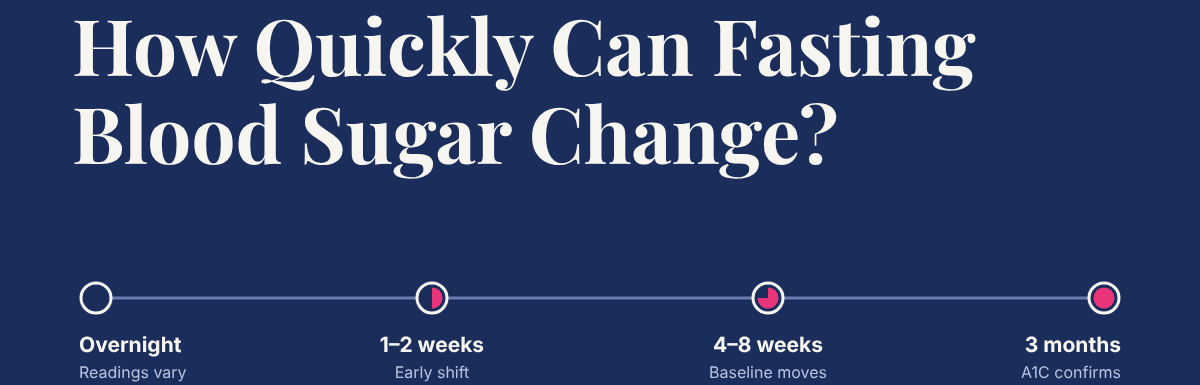
Fasting blood sugar is the reading you take after at least eight hours without food, usually first thing in the morning. It is one of the easiest numbers to check at home and one of the easiest to misread, because it moves on two time scales at once.
Quick answer: Fasting glucose can differ by several points from one morning to the next for reasons that have nothing to do with progress, including sleep, stress, illness, and what you ate late the night before. A real change in your baseline shows up as a shift in your weekly average, usually over two to eight weeks after a lasting change. This is education, not medical advice.
Free tools: Normal blood sugar chart with checker and printable blood sugar log.
What the numbers mean
The American Diabetes Association uses these ranges for a lab fasting plasma glucose test:
| Fasting plasma glucose | Category |
|---|---|
| Below 100 mg/dL | Normal range |
| 100 to 125 mg/dL | Prediabetes range |
| 126 mg/dL or higher | Diabetes range, usually confirmed with a second test |
These cutoffs apply to laboratory tests. A home meter reading is useful for trends, but a diagnosis rests on lab work. See A1C vs fasting glucose vs OGTT.
What changes it overnight
| Factor | Usual direction | Why |
|---|---|---|
| Short or broken sleep | Up | Stress hormones rise and insulin works less well the next day |
| Illness or infection | Up | The body releases glucose to fight it |
| Stress or pain | Up | Stress hormones signal the liver to release glucose |
| Large or late dinner, late snack | Often up | Digestion is still under way; you may not be fully fasted |
| Alcohol the night before | Often down | The liver is busy clearing alcohol; risky with insulin or sulfonylureas |
| Hard evening exercise | Often down | Muscles keep taking up glucose for hours |
| Steroid medicines | Up | They raise glucose directly |
| Dehydration | Up slightly | Blood is more concentrated |
| Sugar on your fingers | Falsely up | Wash and dry your hands before testing |
Because so many things nudge a single morning, a swing of 5 to 15 points between two days is ordinary and not a sign that your plan stopped working.
The dawn effect
In the early morning hours the body releases cortisol and other hormones that prepare you to wake. They prompt the liver to release glucose. In people without diabetes, insulin rises to match. With insulin resistance or diabetes, the match is incomplete, and the waking number can be the highest of the day even when the rest of the day looks good. This is why some people see a stubborn fasting reading while their after-meal numbers and A1C improve. Our article on the dawn phenomenon explains the pattern and what to ask about it.
What changes your baseline over weeks
| Lasting change | When the weekly average tends to respond |
|---|---|
| A new glucose-lowering medication | Days to a few weeks, depending on the medicine |
| Eating fewer refined carbohydrates and sweet drinks | Often within one to two weeks |
| Regular activity, especially after meals | Two to six weeks |
| Weight loss | Builds over one to three months as weight comes off |
| Better sleep | Days to weeks |
| Earlier, lighter dinner | Days |
Fasting glucose is often the slowest of your daily numbers to improve. After-meal readings usually respond first, fasting follows, and A1C confirms later. See how quickly A1C can change.
If you take insulin or a sulfonylurea, improving your habits can push fasting readings low enough to cause symptoms. Tell your prescriber about changes so doses can be reviewed.
How to track a real trend
- Test at the same time each morning, before food, coffee, or exercise.
- Wash and dry your hands first.
- Write the number down with a short note: sleep, illness, late meal, alcohol.
- Average seven mornings. Compare this week’s average with last week’s.
- Change one thing at a time and give it two weeks.
| Example week | Readings (mg/dL) | Average |
|---|---|---|
| Week 1 | 112, 118, 109, 121, 115, 110, 117 | 802 / 7 = 114.6 |
| Week 4 | 106, 111, 103, 114, 108, 104, 109 | 755 / 7 = 107.9 |
In this example, individual mornings still overlap between the two weeks, but the average fell by nearly 7 points. That is the signal. You do not need to test every day forever. Many people do a week of mornings once a month.
Meter vs lab
A home meter reads capillary blood from a fingertip, and meters are allowed a margin of error. A lab measures plasma from a vein. The two can differ by several points on the same morning. Use your meter to follow your own trend with the same device, and use lab results for decisions about diagnosis. Best blood sugar meter for beginners covers accuracy standards.
When to call your clinician
- Fasting readings repeatedly at or above 126 mg/dL with no diagnosis.
- Readings climbing week over week without an obvious reason.
- Very high readings with extreme thirst, frequent urination, blurred vision, or unexplained weight loss.
- Low readings with shakiness, sweating, or confusion, especially if you take insulin or a sulfonylurea. Treat a low first, then call.
Common mistakes
- Reacting to one morning.
- Testing after coffee with cream or sugar and calling it fasting.
- Skipping hand washing.
- Comparing readings taken at different times.
- Judging your whole plan by the fasting number when it is often the last to improve.
- Diagnosing yourself from a meter.
Evening habits worth testing
Your waking number is shaped largely by what happened in the twelve hours before it. That makes the evening the most practical place to experiment. Test one change for a week and compare weekly averages.
| Change to test | How to run it | What to compare |
|---|---|---|
| Earlier dinner | Finish eating at least three hours before bed | Seven-morning average against your baseline week |
| Lighter dinner | Smaller starch portion, more vegetables and protein | Same |
| No late snack | Nothing but water after dinner | Same |
| Walk after dinner | Ten to fifteen minutes | Same |
| Less alcohol | None on test nights | Same, and note any low readings |
| Longer sleep | Consistent bedtime; seven hours or more | Same |
If you take insulin or a sulfonylurea, do not skip food or add evening exercise without talking with your prescriber first. Those changes can cause low blood sugar overnight.
Scenarios by situation
These are hypothetical illustrations, not case histories.
Fasting readings of 104, 96, 110, and 99 on four mornings. This spread is ordinary day-to-day variation. The average is about 102. More mornings, taken the same way, would show whether the baseline sits just above or just below 100.
Fasting number stuck around 115 while after-meal readings have improved. This is a common order of events. Fasting is often the last to respond. If it has not moved after a couple of months, the dawn effect and overnight liver output are worth raising with a clinician.
Fasting reading jumped 25 points during a cold. Illness raises glucose. The reading is noted and not counted toward the trend. Readings usually return to baseline after recovery.
Low morning readings after starting to walk in the evening, while taking a sulfonylurea. Improved habits plus an unchanged dose can push glucose too low. This person should contact the prescriber promptly.
Meter says 108, lab says 99 on the same morning. Both can be right within their margins. The lab value is used for diagnosis. The meter is used for the trend.
Questions for your clinician
- What fasting range should I aim for?
- How often should I test, and for how long?
- Could the dawn effect explain my mornings?
- Do any of my medicines raise morning glucose?
- If my fasting numbers fall, should any doses change?
- When should we repeat the lab test?
Bottom line by situation
| Situation | Bottom line |
|---|---|
| One high morning | Ignore it; look at the week |
| Weekly average rising | Review evenings, sleep, and medicines; call if it continues |
| Weekly average falling | Keep going; expect A1C to follow |
| Fasting high, rest of day good | Ask about the dawn effect |
| Repeated readings of 126 or higher, no diagnosis | Arrange lab testing |
| Low readings on insulin or a sulfonylurea | Treat the low, then call your prescriber |
Frequently asked questions
What is the fastest way to lower fasting blood sugar?
Medication prescribed by your clinician acts soonest. Among habits, an earlier and lighter dinner, no late snack, a walk after dinner, and better sleep are the changes most likely to show within a week or two. Compare weekly averages.
Does drinking water lower fasting blood sugar?
Being well hydrated avoids the slight rise that dehydration can cause, but water does not treat high blood sugar.
Can exercise the night before lower my morning reading?
Often, yes. Muscles continue to take up glucose for hours after activity. If you take insulin or a sulfonylurea, evening exercise can cause overnight lows, so plan it with your prescriber.
Is a fasting reading of 105 a problem?
A lab fasting glucose of 100 to 125 mg/dL is in the prediabetes range. One home reading of 105 is not a diagnosis. A week of readings and a lab test give a clearer answer.
Can fasting blood sugar change from day to day?
Yes. Differences of 5 to 15 mg/dL between mornings are common and are driven by sleep, stress, illness, the previous evening’s food and activity, and normal meter variation.
How long does it take to lower fasting blood sugar?
A lasting change usually shows in your weekly average within two to eight weeks, depending on what you changed. Medication can act faster. Weight loss acts over months.
Why is my fasting blood sugar higher than my reading before bed?
Early-morning hormones prompt the liver to release glucose. With insulin resistance, the body does not fully offset it. This dawn effect is common and worth discussing with your clinician if the gap is large.
Does one high fasting reading mean I have diabetes?
No. Diagnosis requires lab testing, and an abnormal result is usually confirmed with a second test. A single home reading can be raised by many short-term factors.
Does what I eat for dinner affect my fasting number?
It can. A large or late meal, or a late snack, may leave your morning reading higher. An earlier, lighter dinner is a simple thing to test for a week.
How many hours should I fast before testing?
At least eight hours with nothing but water. Coffee with additions, juice, and gum with sugar all break the fast.
Why is my fasting glucose high when my A1C is normal?
The two measure different things. Fasting glucose is one moment; A1C is a multi-month average. See our guide to high fasting glucose with a normal A1C for the usual explanations.
Should I test every morning?
Not necessarily. A week of mornings every month, or the schedule your clinician suggests, is enough for most people who are not adjusting insulin.
About the author: Charles Kirkland is the founder of Metabolic Clarity Labs and author of The Journey Back. He is not a physician. This is general education, not a medically reviewed treatment plan.
Sources checked November 12, 2026. Do not start, stop, or change prescribed treatment based on this article.