
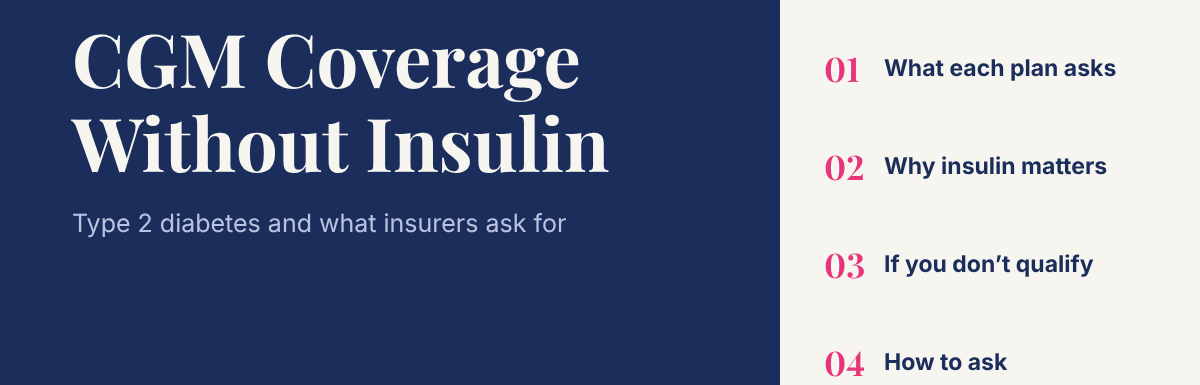
Quick answer: Coverage for people with type 2 diabetes who do not take insulin is the hardest case. Medicare covers a CGM for people not on insulin only if they have documented problematic low blood sugar. Many private plans and state Medicaid programs still ask for insulin or a history of lows. Where coverage is denied, the lower-cost route is an over-the-counter sensor, which is cleared for certain adults not on insulin. Rules vary by plan and change, so confirm yours before you order.
If you take metformin, a GLP-1, or only diet and exercise, you have probably heard “CGMs are for people on insulin.” That was close to the whole rule for years. It is loosening, but unevenly. This guide lays out what each type of coverage asks for, what to do if you do not qualify, and how to talk to your prescriber. It is general education, not advice about starting or changing any medicine.
What each kind of coverage asks for
| Coverage type | Typical rule for type 2 not on insulin | Where to read more |
|---|---|---|
| Original Medicare (Part B) | Covered if you have documented problematic hypoglycemia: recurrent glucose readings under 54 mg/dL despite more than one treatment change, or one severe low that needed another person’s help. Without that, the insulin path does not apply | Medicare CGM guide |
| State Medicaid | Varies. Some states require insulin, some also accept medicines that can cause lows, and Hawaii will require coverage regardless of insulin use starting January 1, 2027 | Medicaid CGM guide |
| Private insurance | Most published policies look for insulin use, often multiple daily injections or a pump, though some include basal insulin. Plans differ | Medicare vs private insurance |
| No coverage | Over-the-counter sensors are cleared for certain adults not on insulin and can be bought without a prescription | CGM cost without insurance |
Sources: CMS Medicare Coverage Database, glucose monitor Local Coverage Determination pages, and Noridian Medicare CGM clinician checklist; Diatribe, “How to navigate CGM insurance coverage” (last updated May 2024); Center for Health Care Strategies (CHCS), “CGM Access for Medicaid Beneficiaries with Diabetes: State-by-State Coverage,” September 2026 (data current as of July 2026). Plan rules change; confirm with your insurer.
Why insulin became the gate
Insurers built these policies around risk. People on insulin can have dangerous lows, and the early CGM research was in people on multiple daily injections. Coverage followed the evidence and the cost. For people not on insulin, the evidence is thinner, so plans often call a CGM “not medically necessary” unless there is a safety reason. That does not mean a CGM is useless for you. It means the policy language has not caught up everywhere.
What is changing: Medicare added the hypoglycemia pathway in 2023, state Medicaid programs are widening coverage (all seven states that once covered only type 1 have added type 2), and over-the-counter sensors now exist. The CHCS review also notes that CGMs are recommended for type 2 patients who use insulin, take non-insulin drugs that can cause hypoglycemia, or could otherwise benefit.
Medicines that can cause lows
Some non-insulin diabetes medicines can lower blood sugar enough to cause hypoglycemia, especially with skipped meals, more exercise, or alcohol. Sulfonylureas are the usual example. If you have had lows on one of these, tell your prescriber, because documented lows are exactly what can open Medicare and some other plans. Never change a medicine on your own. The point is to document what is happening so your prescriber can decide.
If you do not qualify: your realistic options
| Option | What it is | Tradeoff |
|---|---|---|
| Over-the-counter sensor | A sensor cleared for adults not on insulin, bought without a prescription | Out-of-pocket cost; check the maker’s indication and whether it fits your situation |
| Appeal with documentation | Prescriber adds lows, medicines, A1C history, and why finger sticks are not enough | Takes time; no guarantee |
| Short-term trial | Some people use a sensor for a few weeks to learn food and exercise responses | Not a substitute for coverage; Medicare does not consider very short-term use reasonable and necessary |
| Finger-stick meter | Standard strips are widely covered | Gives point-in-time readings, not trends |
Compare devices in Which CGM Is Right for Your Goal? and Prescription vs Over-the-Counter CGM.
How to ask your prescriber well
- Bring a short log. Any symptoms of lows, the times they happen, and any readings below 70 or 54 mg/dL.
- Ask what you want to learn. “I want to see how meals and exercise affect my numbers” is a clinical goal your prescriber can document.
- Ask whether any of your medicines can cause lows.
- Ask for the exact diagnosis codes and notes your plan wants.
- Ask what happens if the plan says no. Many clinics can file the appeal.
If you want to understand the data once you have it, see How to Read CGM Data.
Frequently asked questions
Does insurance cover a CGM for type 2 diabetes if I am not on insulin?
Often not, but it depends. Original Medicare covers it only with documented problematic hypoglycemia. Many private plans and some state Medicaid programs still require insulin. Check your own plan.
Can I get a CGM for type 2 diabetes without insulin?
You may be able to through coverage if you have documented lows, or you can buy an over-the-counter sensor cleared for certain adults not on insulin. Confirm the sensor’s indication first.
What counts as problematic hypoglycemia for Medicare?
Recurrent level 2 events (glucose under 54 mg/dL) that continue despite more than one attempt to adjust medicines or the treatment plan, or one severe event with altered mental or physical state that needed another person’s help.
Do metformin or GLP-1 users get CGM coverage?
Those medicines rarely cause lows on their own, so a plan that requires insulin or lows usually will not approve on that basis alone. Some states and plans are broader, so ask.
Will my doctor prescribe a CGM if I am not on insulin?
Some will, especially to guide food and exercise decisions, but whether insurance pays is a separate question. Ask both.
Is an over-the-counter CGM worth it if insurance says no?
It can be, as a lower-cost way to learn patterns, but the cost adds up and the sensor is cleared for specific adults. See our cost guide for the math.
Can I use an HSA or FSA to buy a CGM?
Plans differ, so check with your plan administrator. Our Stelo HSA/FSA and insurance guide covers what we found.
How do I appeal a CGM denial?
Ask for the reason in writing, have your prescriber add documentation of diagnosis, medicines, lows and why finger sticks are insufficient, and file within the plan’s deadline.
Does Hawaii cover CGMs for type 2 without insulin?
According to the 2026 CHCS report, Hawaii will require insurers, including Medicaid managed care, to cover CGMs for enrollees with diabetes regardless of insulin use starting January 1, 2027.
Should I start a CGM before talking to my clinician?
Talk to your prescriber first, especially if you take any diabetes medicine. A CGM shows data; deciding what to do with it is a clinical conversation.
Not insurance, legal or medical advice. Do not start, stop or change any medicine based on this article. Coverage decisions are made by your plan.
Sources
- CMS Medicare Coverage Database, glucose monitor Local Coverage Determination pages, and Noridian Medicare CGM clinician checklist
- Center for Health Care Strategies (CHCS), “CGM Access for Medicaid Beneficiaries with Diabetes: State-by-State Coverage,” September 2026 (data current as of July 2026)
- Diatribe, “How to navigate CGM insurance coverage” (last updated May 2024)
By insurer: see what each 2026 policy says for Aetna, UnitedHealthcare, Cigna, Blue Cross Blue Shield, Kaiser Permanente, and Humana. Compare them all in CGM insurance coverage by insurer.
About the author: Charles Kirkland is the founder of Metabolic Clarity Labs and author of The Journey Back. He is not a physician. This is general education, not a medically reviewed treatment plan.
Sources checked November 6, 2026. Discuss personal decisions with a qualified clinician. Do not start, stop, or change prescribed treatment based on this article.
Related: 10 best books for diabetics, and who each one is for.
Related: Diabetes rates by state, ranked from highest to lowest.