
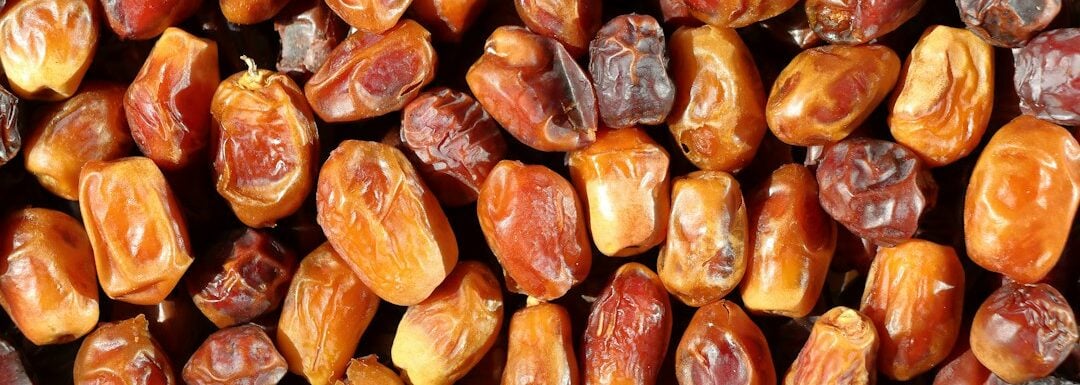
Dates are a dried fruit, even when they are sold as fresh. By weight they are about three quarters carbohydrate, which puts them in a different class from an apple or a bowl of berries. They are also small, and the two common varieties differ in size by a factor of three. This guide gives you the numbers per date so you can count them.
Quick answer: One pitted Medjool date weighing 24 grams has about 18 grams of carbohydrate, 1.6 grams of fiber, and 16 grams of sugars. One Deglet Noor date weighing about 7 grams has about 5 grams of carbohydrate. That means a single Medjool is already more than one 15-gram fruit portion, and three Deglet Noor dates are about one. Glycemic index values for dates range widely by variety. Dates can fit, but they are counted by the piece. This is general education, not medical advice. Your care team can tell you how many carbohydrate grams fit a meal or snack for you.
What is in a date
The USDA has separate entries for the two varieties most often sold in the United States. Per 100 grams they are nearly identical. Per date they are not.
| Per 100 g | Carbs (g) | Fiber (g) | Sugars (g) | Calories |
|---|---|---|---|---|
| Medjool | 75.0 | 6.7 | 66.5 | 277 |
| Deglet Noor | 75.0 | 8.0 | 63.4 | 282 |
| Portion | Weight | Carbs (g) | Fiber (g) | Sugars (g) | Calories |
|---|---|---|---|---|---|
| 1 Deglet Noor date, pitted | 7.1 g | 5.3 | 0.6 | 4.5 | 20 |
| 3 Deglet Noor dates | 21.3 g | 16.0 | 1.7 | 13.5 | 60 |
| 1 Medjool date, pitted | 24 g | 18.0 | 1.6 | 16.0 | 66 |
| 2 Medjool dates | 48 g | 36.0 | 3.2 | 31.9 | 133 |
| 1 cup chopped Deglet Noor | 147 g | 110.3 | 11.8 | 93.1 | 415 |
One Medjool date weighs about as much as three and a half Deglet Noor dates. If a recipe or a tracking app says four dates, the answer could be about 21 grams of carbohydrate or about 72 grams, depending on which kind. Package labels also vary with the size of the fruit. One store-brand Medjool label lists 2 dates at 40 grams with 31 grams of carbohydrate, and another brand lists a 46-gram serving with 33 grams.
How dates compare with fresh fruit
The gap is easiest to see by weight.
| Fruit | Carbs per 100 g | Amount for 15 g of carbohydrate |
|---|---|---|
| Dates | 75.0 | 20 g, less than 1 Medjool |
| Banana | about 23 | 66 g, about half a medium banana |
| Grapes | 18.1 | 83 g, about 17 small grapes |
| Mango | 15.0 | 100 g, about 0.6 cup |
| Apple | 13.8 | 109 g, about 1 cup of slices |
| Strawberries | 7.7 | 195 g, about 1.3 cups |
| Watermelon | 7.55 | 199 g, about 1.3 cups |
Gram for gram, dates have about ten times the carbohydrate of watermelon or strawberries. Twenty grams of dates and 195 grams of strawberries deliver the same 15 grams of carbohydrate, and one of those is a few bites.
Glycemic index: a wide range
Glycemic index (GI) figures for dates are less settled than for most fruit. The 2008 international tables list dates at 42, plus or minus 4, which is in the low range. Other published charts list dried dates at about 61, in the medium range, and at least one widely cited older figure is above 100. Reviewers note that values run from low to high depending on the variety tested, and the 2021 edition of the international tables added new date varieties for that reason. We would not rely on any single number.
Glycemic load (GL) is GI times the carbohydrate in the portion, divided by 100. The table shows it at both the low and the medium figure. See glycemic index vs. glycemic load for the method.
| Portion | Carbs minus fiber (g) | GL at GI 42 | GL at GI 61 |
|---|---|---|---|
| 3 Deglet Noor dates | 14.3 | 6.0 | 8.7 |
| 1 Medjool date | 16.4 | 6.9 | 10.0 |
| 2 Medjool dates | 32.8 | 13.8 | 20.0 |
| 4 Medjool dates | 65.6 | 27.6 | 40.0 |
One Medjool is in or at the edge of the low band, which is 10 or under. Two is medium to high. Four is high under either figure. With this much uncertainty in the index, your own meter or CGM is the better guide.
Worked example: counting a portion
| Carbohydrate target | Dates by weight | Medjool | Deglet Noor |
|---|---|---|---|
| 15 g | 20 g | about 0.8 of a date | about 3 dates |
| 30 g | 40 g | about 1.7 dates | about 6 dates |
| 45 g | 60 g | 2.5 dates | about 8 dates |
The arithmetic is the target divided by 75, times 100, then divided by 24 grams for a Medjool or 7.1 grams for a Deglet Noor. These targets are illustrations, not recommendations.
Do dates have anything going for them?
Yes. Per 100 grams they have 6.7 to 8 grams of fiber, and USDA data lists roughly 650 to 700 milligrams of potassium. Two Medjool dates supply about 3.2 grams of fiber. The trade-off is that those two dates also bring 36 grams of carbohydrate, so dates are not an efficient way to get fiber compared with raspberries, beans, or vegetables. If you have kidney disease or take a medicine that raises potassium, ask your care team before adding high-potassium foods.
Dates as a sweetener
Date paste, date syrup, and date sugar are sold as natural alternatives to table sugar. They are still sugar, and the body counts them as carbohydrate. Recipes for energy balls, date bars, and naturally sweetened desserts often use six to twelve Medjool dates per batch, which is 108 to 216 grams of carbohydrate before the oats or chocolate are added. Divide the batch total by the number of pieces to see what one serving really holds. For how other sweeteners compare, see honey vs. sugar and sweeteners and blood sugar.
Ways to fit them in
- Decide on a number before you open the package: one Medjool, or two or three Deglet Noor.
- Buy Deglet Noor if you want more pieces for the same carbohydrate.
- Stuff one date with nut butter or eat it with a few nuts. We did not find a study that measures this pairing for dates in people with diabetes, so check your own readings. The nut butter adds calories.
- Chop one date into oatmeal or yogurt instead of eating several whole.
- During Ramadan or other occasions where dates are traditional, count them like any other carbohydrate, and talk with your care team in advance if you take insulin or a medicine that can cause low glucose while fasting.
How to test your own response
- Check glucose right before you eat.
- Eat one Medjool or three Deglet Noor dates and write down which.
- Check again at one hour and two hours, or look at your CGM trace for that window.
- Repeat on another day with a pairing or a different number, and compare.
Our post-meal glucose tracker is built for this kind of comparison, and how to read your CGM data explains what the curve means.
Frequently asked questions
Can people with diabetes eat dates?
Yes, as a counted carbohydrate. One Medjool date has about 18 grams of carbohydrate and one Deglet Noor about 5 grams. They are concentrated, so the number of dates matters more than with fresh fruit.
How many dates can I eat with diabetes?
There is no single number. About 20 grams of dates equals one 15-gram carbohydrate portion, which is a little less than one Medjool or about three Deglet Noor. Ask your care team or a dietitian how many carbohydrate grams fit your snacks and meals.
How many carbs are in one date?
About 18 grams in a pitted Medjool date weighing 24 grams, with 1.6 grams of fiber and 16 grams of sugars. About 5.3 grams in a Deglet Noor date weighing 7.1 grams. Both figures are from USDA data.
Do dates have a low glycemic index?
Some tables say so. The 2008 international tables list dates at 42, but other charts show about 61 and some older figures are much higher. Values differ by variety, so check your own response instead of relying on one number.
Are dates healthier than sugar?
Dates come with fiber and potassium that table sugar lacks, and they are still mostly sugar by weight, about 63 to 67 grams per 100 grams. Date syrup, date sugar, and date-sweetened desserts count as carbohydrate like any other sweetener.
About the author: Charles Kirkland is the founder of Metabolic Clarity Labs and author of The Journey Back. He is not a physician. This is general education, not a medically reviewed treatment plan.
Sources checked November 11, 2026: USDA FoodData Central (dates, medjool; dates, deglet noor; branded Medjool date labels), the 2008 and 2021 international tables of glycemic index values, and published glycemic index charts. Discuss personal decisions with a qualified clinician. Do not start, stop, or change prescribed treatment based on this article.