
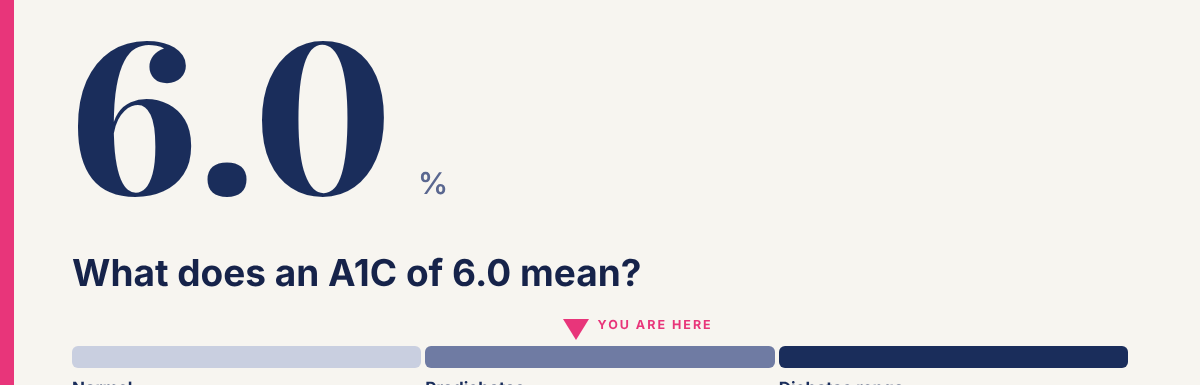
You opened your lab report and saw an A1C of 6.0%. It is flagged, but nobody has said the word diabetes, and the note from the office may be one line long. This guide explains exactly where 6.0 sits, what average blood sugar it represents, how sure you can be of the result, and what a sensible next three months look like.
Quick answer: An A1C of 6.0% is in the prediabetes range (5.7% to 6.4%) used in the United States. It is not diabetes, which starts at 6.5%. It equals an estimated average glucose of about 126 mg/dL (7.0 mmol/L) over the past two to three months. It sits in the middle of the range, where the chance of progressing is meaningfully higher than at 5.7%, and it is the level where some guidelines begin to discuss more active prevention. This is education, not medical advice.
Free tools: A1C chart with checker and prediabetes: start here. Also see the A1C mmol/mol converter.
Where 6.0 fits
The American Diabetes Association and the National Institute of Diabetes and Digestive and Kidney Diseases use three A1C bands for adults who are not pregnant.
| A1C result | Usual category | Where 6.0 sits |
|---|---|---|
| Below 5.7% | Normal range | 0.4 points below you |
| 5.7% to 6.4% | Prediabetes range | You are here, near the midpoint |
| 6.5% or higher | Diabetes range | 0.5 points above you |
So 6.0% is three tenths of a point past the start of the prediabetes range and five tenths short of the diabetes threshold. That half point is real room, and it is also less room than most people assume. A1C moves in tenths, and a few tenths in either direction over a year is common.
The word prediabetes can sound like a countdown. It is better read as a risk category. Many people in this range never reach 6.5%, some return below 5.7%, and some move upward. Which of those happens depends partly on things you can influence, which is the reason the category exists. If your result was 5.7, see what an A1C of 5.7 means. If it was 6.5, see what an A1C of 6.5 means.
What average blood sugar 6.0 represents
A1C can be converted into an estimated average glucose (eAG) using the formula published by the NGSP: eAG in mg/dL = 28.7 x A1C – 46.7. For 6.0, that is 28.7 x 6.0 – 46.7 = 125.5, usually rounded to 126 mg/dL.
| A1C (%) | A1C (mmol/mol) | Estimated average glucose (mg/dL) | Estimated average glucose (mmol/L) |
|---|---|---|---|
| 5.7 | 39 | 117 | 6.5 |
| 5.8 | 40 | 120 | 6.6 |
| 5.9 | 41 | 123 | 6.8 |
| 6.0 | 42 | 126 | 7.0 |
| 6.1 | 43 | 128 | 7.1 |
| 6.2 | 44 | 131 | 7.3 |
| 6.3 | 45 | 134 | 7.4 |
| 6.4 | 46 | 137 | 7.6 |
| 6.5 | 48 | 140 | 7.8 |
Two cautions about that 126 figure.
It is not a fasting number. A fasting glucose of 126 mg/dL is the diabetes threshold on a fasting test, and people often see the two 126s and panic. They measure different things. An average of 126 across the whole day, including the hours after meals, is what you would expect in the prediabetes range. Someone with an A1C of 6.0 commonly has fasting readings around 95 to 110 mg/dL and higher values after eating.
It is an estimate. Two people with the same A1C can have true averages that differ by 15 mg/dL or more, because red blood cells do not live exactly the same length of time in everyone. You can run any value through the A1C and average glucose calculator or look it up on the A1C to average glucose chart.
Why the middle of the range matters
The prediabetes range is treated as one category on a lab report, but risk rises across it. The American Diabetes Association Standards of Care summarize a review of 16 cohort studies covering about 44,000 people followed for an average of 5.6 years:
| Starting A1C | Share who developed diabetes within about 5 years |
|---|---|
| 5.5% to 6.0% | Roughly 9% to 25% |
| 6.0% to 6.5% | Roughly 25% to 50% |
An A1C of exactly 6.0 sits on the line between those two groups. Read the table both ways. At the upper band, a quarter to half of people progressed within five years, which is a serious risk. It also means that half to three quarters did not, even though most of those studies did not involve any organized prevention effort.
These are group averages. Your own odds shift with age, family history, weight around the waist, a history of gestational diabetes, sleep, activity, and whether your number is rising or holding steady. A 6.0 that has been 6.0 for four years is a different situation from a 6.0 that was 5.5 two years ago.
Why 6.0 is a threshold in some countries
If you read health sites from outside the United States, you may see 6.0% treated as the starting line instead of 5.7%. That is not a mistake. The United Kingdom and several other health systems report A1C in mmol/mol and define the high-risk range as 42 to 47 mmol/mol, which is 6.0% to 6.4%. An international expert committee that reviewed the test in 2009 also singled out 6.0% and above as the range that warranted the most intensive prevention efforts.
So under US categories, 6.0 is mid-range prediabetes. Under UK categories, 6.0 is the first value flagged at all. Both systems agree on the two points that matter: 6.0 is below the diabetes threshold of 6.5% (48 mmol/mol), and it is high enough to act on.
How to confirm the result
One result places you in a range. It does not, on its own, settle the question. Guidance from the NIDDK and the CDC is that an abnormal result in someone without symptoms should be checked again, either by repeating the A1C or by using a different test.
| Test | What it measures | Prediabetes range | Diabetes range |
|---|---|---|---|
| A1C | Two to three month average | 5.7% to 6.4% | 6.5% or higher |
| Fasting plasma glucose | Glucose after at least 8 hours without food | 100 to 125 mg/dL | 126 mg/dL or higher |
| 2-hour oral glucose tolerance test | Glucose 2 hours after a 75 g glucose drink | 140 to 199 mg/dL | 200 mg/dL or higher |
The three tests do not always agree, because they look at different parts of the day. Some people have a normal fasting glucose and an A1C of 6.0 because their glucose rises mainly after meals. Others have a fasting value above 100 with a normal A1C. Neither result cancels the other. See normal fasting glucose with a high A1C, high fasting glucose with a normal A1C, and the comparison of the three diabetes tests.
If your 6.0 came from a home kit or a fingerstick machine at a pharmacy, treat it as a screening result. Those devices are useful for tracking, but diagnosis should rest on a laboratory test. Our guide to home A1C test kits explains how far they can be trusted.
How precise is a single A1C?
Laboratory A1C methods are certified against a reference standard, and a certified method is allowed to differ from that reference by roughly 5 percent of the value. For a true A1C of 6.0, that works out to a reported result anywhere from about 5.7 to 6.3. In practice modern lab instruments are usually tighter than the limit, but a swing of one or two tenths between two tests on the same person, with nothing changed, is ordinary.
That has two practical consequences.
- A move from 5.9 to 6.0, or from 6.0 to 6.1, is not evidence that anything changed. Look for a shift of three tenths or more, or a steady direction across three or more tests.
- Comparing results from two different laboratories adds a little more noise. When you can, use the same lab.
Separately, some conditions shift A1C away from the true average regardless of how good the lab is. Iron deficiency tends to raise it. Recent blood loss, a transfusion, hemolytic anemia, late pregnancy, and treatment with erythropoietin tend to lower it. Kidney failure and certain hemoglobin variants can interfere in either direction. If any of these apply, tell your clinician, because a glucose-based test may be the better choice. Why A1C can be wrong covers each case.
The same 6.0 in different histories
Never diagnosed with anything. A first 6.0 is a prediabetes-range result that needs confirmation, a look at earlier values if any exist, and a plan with a follow-up date.
Already diagnosed with type 2 diabetes. A 6.0 while on treatment means your current average is below the diagnostic threshold. That is usually a good result, and it describes glucose under your current treatment. It does not mean the diagnosis has been removed, and it is not a signal to stop a medicine. If you take insulin or a sulfonylurea and your A1C is 6.0, ask whether low blood sugar episodes are part of how you got there. See A1C goals by age.
Taking metformin for prediabetes or PCOS. The 6.0 reflects glucose with the medicine on board. Whether it counts as progress depends on where you started.
Pregnant or recently delivered. A1C is not the standard test for gestational diabetes, and pregnancy changes red blood cell turnover. Follow the testing your obstetric team orders.
Recently on steroids, or recently ill. A course of prednisone or a significant illness can push glucose up for weeks. If that fell inside the two months before the test, the result may overstate your usual level. Mention it and ask about a repeat.
What 6.0 does not tell you
- When your glucose is high. The same 126 average can come from a slightly raised fasting level all day or from normal fasting levels and large after-meal rises.
- How much insulin it is taking to hold that level. A1C measures glucose, not insulin. See insulin resistance with a normal A1C and the HOMA-IR calculator.
- Why it rose. Weight change, less activity, poor sleep, a new medicine, and aging can all contribute, and A1C cannot rank them.
- Whether lows are being averaged in. Uncommon without diabetes medicines, but relevant if you take them.
- What a specific food does. One number over three months cannot identify one meal.
If you want to see the pattern behind the average, a few weeks of structured fingerstick checks or a short trial of a sensor can show it. See whether you need a CGM with prediabetes and the post-meal glucose tracker.
The other numbers to read with it
A1C in the prediabetes range often travels with other changes. Clinicians look at five measurements together when they assess metabolic syndrome: waist size, triglycerides, HDL cholesterol, blood pressure, and fasting glucose. Three or more out of range changes the picture more than any single one.
| Number | Level that counts toward metabolic syndrome | Read more |
|---|---|---|
| Fasting glucose | 100 mg/dL or higher | Fasting blood sugar of 105 |
| Triglycerides | 150 mg/dL or higher | Triglycerides of 150, 200, 500 |
| HDL cholesterol | Below 40 mg/dL in men, below 50 in women | Low HDL explained |
| Blood pressure | 130/85 mm Hg or higher | Blood pressure of 130/85 |
| Waist | Over 40 inches in men, over 35 in women (US cut points) | How to measure your waist |
You can enter all five in the metabolic syndrome calculator. If your A1C is 6.0 and the other four are normal, the conversation is mostly about glucose. If two or three others are also out of range, the conversation is about the whole pattern, and the plan is usually broader.
What the research supports doing
The strongest evidence comes from the Diabetes Prevention Program, a US trial of more than 3,000 adults with prediabetes. One group received an intensive lifestyle program aimed at losing 7% of body weight and reaching 150 minutes of activity a week. Over about three years that group developed type 2 diabetes 58% less often than the placebo group. Among participants aged 60 and older, the reduction was 71%. A group that took metformin developed diabetes 31% less often.
What the lifestyle group did was not exotic: modest weight loss, brisk walking most days, and regular coaching. The coaching is the part people skip, and it likely mattered. The CDC recognizes programs across the country that follow the same curriculum, and many insurers and Medicare cover them.
| Change | How soon daily glucose responds | When A1C can show it |
|---|---|---|
| Replacing sweet drinks with water or unsweetened drinks | Same day | 4 to 12 weeks |
| A 10 to 15 minute walk after meals | Same meal | 4 to 12 weeks |
| Smaller portions of refined starch, more fiber and protein at meals | Same meal | 4 to 12 weeks |
| 150 minutes a week of moderate activity | Days to weeks | 8 to 12 weeks |
| Resistance training twice a week | Weeks | About 3 months |
| Losing 5% to 7% of body weight | Weeks to months | 3 to 6 months |
| Treating sleep apnea, regular sleep | Days to weeks | About 3 months |
The timelines are general patterns, not promises for any one person. For more on what studies measured, see lowering A1C without medication, walking after meals, diet for prediabetes, and the first month after a prediabetes diagnosis.
Does 6.0 call for medication?
Usually not as a first step, and it is a fair question to raise. The American Diabetes Association prevention guidance says metformin should be considered for adults at high risk of type 2 diabetes, and it names the groups where the evidence is strongest: adults aged 25 to 59 with a body mass index of 35 or higher, people with a fasting glucose of 110 mg/dL or higher, people with an A1C of 6.0% or higher, and women with a history of gestational diabetes.
Notice that 6.0 is on that list. That does not mean you need a prescription. It means that at this level, the option is legitimately on the table, and a clinician may bring it up or be open to discussing it, particularly if lifestyle changes have not moved the number or if other risk factors are present. Metformin was less effective than the lifestyle program in the trial overall, and it has its own considerations, including stomach side effects and a known effect on vitamin B12 levels over time. See metformin in plain language and metformin and vitamin B12.
No supplement has evidence comparable to the lifestyle program or metformin for preventing diabetes. If you are considering one, read the evidence first and tell your clinician what you take.
When to retest
- To confirm a first result: your clinician may repeat it within weeks or order a fasting glucose instead.
- After you make changes: about three months gives a clean reading. Half of the A1C value reflects the most recent month, so a test at six weeks shows only part of the change. See how quickly A1C can change.
- When stable: at least once a year is the usual recommendation for people with prediabetes, and more often when the number is at 6.0 or above or rising.
Scenarios by situation
These are hypothetical illustrations, not case histories.
A1C 6.0, fasting glucose 92, normal weight, age 44. The fasting value is normal, so the average is probably being pushed up after meals, or the A1C is reading a little high. A repeat A1C plus a check for iron deficiency is a reasonable request. See normal weight with high blood sugar.
A1C 6.0, fasting glucose 108, triglycerides 210, waist 42 inches. Three metabolic syndrome criteria are met before blood pressure and HDL are counted. The plan is about the whole pattern, and weight around the waist is the common thread.
A1C was 5.6, then 5.8, now 6.0 across three years. No single result is alarming. The direction is the finding. This is the moment when acting is easiest.
A1C was 6.4 six months ago and is now 6.0 after changes. Same category, opposite story. The plan is working, and the next test tells you whether it holds.
A1C 6.0, age 78, otherwise well. A1C tends to drift upward with age, and progression to diabetes from this level is slower in older adults. Many clinicians monitor without intensive intervention.
Questions for your clinician
- Should this be confirmed with a repeat A1C or a fasting glucose?
- What were my last few A1C and fasting glucose results, and which way are they moving?
- Is there anything in my history, such as anemia or a hemoglobin variant, that could make my A1C misleading?
- Do my triglycerides, HDL, blood pressure, and waist suggest metabolic syndrome?
- Am I eligible for a CDC-recognized diabetes prevention program, and is it covered?
- Given a 6.0, is metformin something we should discuss now or later?
- When exactly should I be retested?
Bottom line by situation
| Situation | Bottom line |
|---|---|
| First 6.0, no symptoms | Prediabetes range; confirm it and set a retest date |
| 6.0 and rising over several tests | The trend is the signal; act now while the gap to 6.5 is half a point |
| 6.0 and falling from a higher value | Progress; keep doing what moved it |
| 6.0 with other metabolic syndrome numbers | Treat the pattern, not only the glucose |
| 6.0 with anemia, kidney disease, or pregnancy | Ask whether a glucose-based test is more reliable |
| 6.0 on diabetes medication | Below the diagnostic threshold on treatment; do not change doses yourself |
Frequently asked questions
Is an A1C of 6.0 bad?
It is in the prediabetes range, so it is higher than ideal, and it is below the diabetes threshold of 6.5%. It is best treated as an early warning with time to respond.
Is an A1C of 6.0 prediabetes?
Under US categories, yes. Prediabetes covers 5.7% to 6.4%. A first result should be confirmed with a repeat A1C or a glucose-based test.
Is an A1C of 6.0 diabetes?
No. Diabetes is diagnosed at 6.5% or higher, generally confirmed with a second test when symptoms are absent.
What is the average blood sugar for an A1C of 6.0?
About 126 mg/dL, or 7.0 mmol/L. This is an estimated average over the whole day for two to three months, not a fasting value.
What is 6.0% in mmol/mol?
About 42 mmol/mol. In the United Kingdom, 42 to 47 mmol/mol is the range reported as high risk for type 2 diabetes.
Can an A1C of 6.0 go back to normal?
A1C can fall below 5.7% in people who start at 6.0, particularly with weight loss and regular activity. Not everyone gets there, and a lower number should still be followed over time.
How long does it take to lower an A1C of 6.0?
A sustained change in average glucose starts to show in four to six weeks and is mostly reflected by three months. How far it falls depends on what changed and on the individual.
How likely is 6.0 to turn into diabetes?
In pooled cohort studies, roughly 25% to 50% of people with an A1C of 6.0% to 6.5% developed diabetes within about five years, and risk was lower just below 6.0. Individual risk varies with age, weight, family history, and trend.
Do I need metformin for an A1C of 6.0?
Not automatically. Lifestyle programs have the strongest evidence. Guidelines list an A1C of 6.0% or higher among the situations where metformin may be considered, so it is reasonable to ask.
Should I check my blood sugar at home with an A1C of 6.0?
It is optional. A short period of structured checks before and after meals can show which meals raise your glucose most. Ask your clinician what readings would be useful and what you would do with them.
Can my A1C be 6.0 if my fasting glucose is normal?
Yes. Fasting glucose is a single moment, and A1C reflects the whole day, including after meals. A1C can also read slightly high with iron deficiency.
Is 6.0 worse than 5.7?
Both are prediabetes, and risk rises across the range. Studies show a higher rate of progression at 6.0 and above than at 5.7.
Does an A1C of 6.0 cause symptoms?
Usually none. Most people in the prediabetes range feel normal, which is why the result often comes as a surprise.
How often should I retest after a 6.0?
About three months after making changes, then at least yearly once stable. Your clinician may choose a shorter interval if the number is rising.
About the author: Charles Kirkland is the founder of Metabolic Clarity Labs and author of The Journey Back. He is not a physician. This is general education, not a medically reviewed treatment plan.
Sources checked November 12, 2026: NIDDK, CDC, NGSP, the Diabetes Prevention Program, and the American Diabetes Association Standards of Care. Do not start, stop, or change prescribed treatment based on this article.