
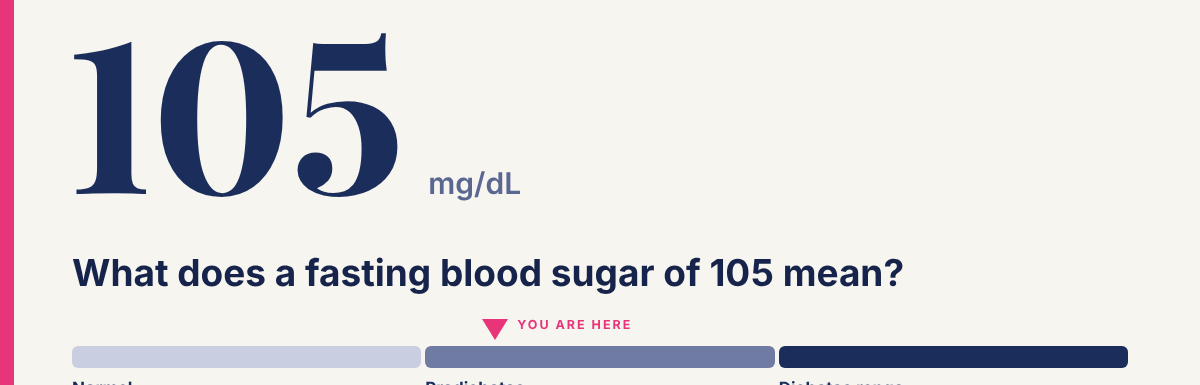
A fasting blood sugar of 102, 105, or 108 is one of the most common flagged results on a routine blood panel. It is only a few points above the reference range, the comment next to it is usually brief, and it is hard to tell whether it is a real finding or a blip. This guide covers every value from 100 to 110 mg/dL: what the category means, how much to trust one reading, what can push a fasting number up for a day, and what is worth doing about it.
Quick answer: In the United States, a fasting plasma glucose of 100 to 125 mg/dL is classified as prediabetes, also called impaired fasting glucose. A reading of 105 mg/dL (5.8 mmol/L) is at the low end of that range and well below the diabetes threshold of 126. One fasting value moves around by several points from day to day, so a single result between 100 and 110 should be repeated or paired with an A1C before it is treated as established. A fasting glucose of 100 or higher is also one of the five criteria for metabolic syndrome. This is education, not medical advice.
Free tools: Normal blood sugar chart with checker and printable blood sugar log. Also see the blood sugar conversion chart, the fasting insulin levels chart and the HOMA-IR chart.
Where 100 to 110 fits
The American Diabetes Association diagnostic criteria define three bands for a fasting plasma glucose measured after at least eight hours without calories.
| Fasting plasma glucose | In mmol/L | Category |
|---|---|---|
| Below 100 mg/dL | Below 5.6 | Normal |
| 100 to 125 mg/dL | 5.6 to 6.9 | Prediabetes (impaired fasting glucose) |
| 126 mg/dL or higher | 7.0 or higher | Diabetes range, if confirmed |
A value between 100 and 110 is in the lower half of the middle band. At 105 you are 5 points above the top of normal and 21 points below the diabetes threshold. For the upper boundary, see what a fasting blood sugar of 126 means.
Every number from 100 to 110
| Fasting glucose (mg/dL) | In mmol/L | US category (ADA) | WHO category |
|---|---|---|---|
| 99 | 5.5 | Normal | Normal |
| 100 | 5.6 | Prediabetes | Normal |
| 101 | 5.6 | Prediabetes | Normal |
| 102 | 5.7 | Prediabetes | Normal |
| 103 | 5.7 | Prediabetes | Normal |
| 104 | 5.8 | Prediabetes | Normal |
| 105 | 5.8 | Prediabetes | Normal |
| 106 | 5.9 | Prediabetes | Normal |
| 107 | 5.9 | Prediabetes | Normal |
| 108 | 6.0 | Prediabetes | Normal |
| 109 | 6.1 | Prediabetes | Normal |
| 110 | 6.1 | Prediabetes | Impaired fasting glucose |
To convert mg/dL to mmol/L, divide by 18. The table shows why this range causes so much confusion: the same result can be labeled prediabetes by one authority and normal by another.
Why some sources say 100 and others say 110
Until 2003, the American Diabetes Association defined impaired fasting glucose as 110 to 125 mg/dL. It then lowered the bottom of the range to 100. The reasoning was that 100 did a better job of identifying people who would go on to develop diabetes and brought the fasting test into closer agreement with the glucose tolerance test. The World Health Organization reviewed the same question and kept 110 (6.1 mmol/L), on the grounds that lowering the line would label a very large share of adults as having a condition without clear evidence that doing so improved their outcomes.
Both positions are defensible, and together they tell you something useful. A fasting glucose of 100 to 109 is a zone of early, modest risk that experts disagree about how to name. From 110 upward, every major body agrees the result is abnormal. If your number is 105, you are in the part of the range where the correct response is attention and a recheck, not alarm.
Was it truly a fasting test?
The categories above apply only to a true fasting sample. Before reading anything into a 105, check the conditions.
- At least eight hours with no calories. Water is fine. Black coffee or plain tea has little direct effect on glucose for most people, but many labs ask for water only.
- Cream, sugar, milk, juice, or a breath mint with sugar breaks the fast.
- A late large dinner or dessert finished at 11 p.m. and a 7 a.m. draw is technically eight hours, but digestion of a heavy meal can still be influencing the result.
- Was the test marked fasting? A glucose on a basic or comprehensive metabolic panel is often drawn whenever the appointment happens to be. If you ate that day, a glucose of 105 is simply a normal non-fasting value. Two hours after a meal, anything below 140 mg/dL is considered normal.
If you cannot be sure you were fasting, the result does not tell you much either way. Repeat it properly.
Lab draw vs home meter
A laboratory fasting plasma glucose and a fingerstick meter reading are not interchangeable at this level of precision.
| Lab plasma glucose | Home fingerstick meter | |
|---|---|---|
| Sample | Venous blood, plasma measured | Capillary whole blood, converted to a plasma-equivalent value |
| Accuracy | Typically within a few percent | The international standard requires 95% of readings to be within 15 mg/dL of the lab value below 100, and within 15% at 100 or above |
| What a reading of 105 could truly be | About 101 to 109 | About 89 to 121 |
| Used for diagnosis | Yes | No |
A home meter is a good tool for seeing trends and comparing one morning with another on the same device. It cannot reliably tell 98 from 105. If a meter is the only source of your number, a lab test is the next step. Technique also matters: wash and dry your hands first, because traces of fruit or lotion on a fingertip can add 20 points or more. See choosing a blood sugar meter and CGM vs fingerstick meter.
Lab samples have their own quirk. Blood cells continue to consume glucose in the tube, so a sample that sits for a long time before processing can read a few points low. That works in the opposite direction from most errors and is one more reason a single value should not be over-interpreted.
How much fasting glucose varies day to day
Fasting glucose is less stable than most people expect. Even with nothing changed, an individual’s fasting value typically varies by about 5 to 6 percent from one day to the next. For someone whose true level is 100, that means readings from roughly 94 to 106 are all normal variation.
The consequence is that a person can test at 98 one month and 104 the next with no change in their health, and move between normal and prediabetes on paper. The ADA notes that fasting glucose has high within-person variability compared with A1C. This is the main reason a fasting value in the low 100s is confirmed before anyone draws conclusions. See how quickly fasting blood sugar can change.
Things that raise a fasting reading temporarily
| Factor | What happens |
|---|---|
| A short or broken night of sleep | Even one night of poor sleep reduces insulin sensitivity the next morning |
| Illness or infection | Stress hormones raise glucose, sometimes for days |
| Acute stress, including anxiety about the blood draw | Adrenaline and cortisol prompt the liver to release glucose |
| Steroid medicines | Tablets, injections, and high-dose inhalers can all raise glucose |
| Other medicines | Thiazide diuretics, some antipsychotics, niacin, and some others can raise it modestly |
| The dawn phenomenon | A normal early-morning hormone surge raises glucose between about 3 a.m. and 8 a.m. |
| A heavy or late evening meal | High-fat, high-carbohydrate dinners can keep glucose raised overnight |
| Very long fasts before the draw | Fasting far beyond 12 hours can shift results in either direction |
Some people who follow a very low-carbohydrate diet notice fasting readings in the low 100s alongside a normal A1C. The usual explanation offered is that the body adapts by sparing glucose for the brain. Researchers have not settled how much this matters, and it should be discussed with a clinician instead of assumed to be harmless. See the dawn phenomenon and high fasting glucose with a normal A1C.
How to confirm it
- Repeat the fasting glucose on a different day under proper fasting conditions.
- Add an A1C. It reflects two to three months and is not affected by what happened the night before. An A1C of 5.7% to 6.4% supports prediabetes. An A1C below 5.7% with a fasting glucose of 103 suggests a mild, isolated fasting elevation. See an A1C of 5.7 and an A1C of 6.0.
- Consider a 2-hour oral glucose tolerance test if results conflict or risk is high. It is the only one of the three that shows how you handle a glucose load.
The three tests identify overlapping but different groups of people. Many people with a raised fasting glucose have a normal A1C, and the reverse. See the comparison of the three diabetes tests.
What a raised fasting glucose reflects
Overnight, with no food coming in, your blood glucose is supplied almost entirely by the liver. Insulin is the signal that tells the liver to hold back. A fasting glucose that sits a little high generally means the liver is releasing somewhat more glucose than needed, either because it is responding less well to insulin or because the early insulin response is slightly reduced.
That is different from a problem that shows up mainly after meals, where the main issue is muscle taking up glucose slowly. People can have one pattern, the other, or both. A raised fasting value with normal after-meal readings is often linked with fat stored in and around the liver, weight carried at the waist, and raised triglycerides. See how blood sugar, fatty liver, belly fat, and triglycerides connect and the guide to fatty liver.
Fasting glucose and metabolic syndrome
A fasting glucose of 100 mg/dL or higher is one of the five criteria for metabolic syndrome, as described by the National Heart, Lung, and Blood Institute. Meeting any three of the five defines the syndrome.
| Criterion | Cut point | Read more |
|---|---|---|
| Fasting glucose | 100 mg/dL or higher, or on treatment for high glucose | This page |
| Waist circumference | Over 40 inches in men, over 35 in women (US cut points) | How to measure your waist |
| Triglycerides | 150 mg/dL or higher | Triglyceride levels explained |
| HDL cholesterol | Below 40 mg/dL in men, below 50 in women | Low HDL explained |
| Blood pressure | 130/85 mm Hg or higher, or on treatment | Blood pressure of 130/85 |
This is where a 105 becomes more or less significant. On its own, with the other four in range, it is a mild finding. Alongside a waist over the cut point and triglycerides of 180, it completes a pattern. Enter your numbers in the metabolic syndrome calculator. Fasting glucose is also used with triglycerides in the TyG index calculator and with fasting insulin in the HOMA-IR calculator.
How much risk does 105 carry?
Risk rises gradually through this range. Studies that follow people over time consistently find that those with fasting glucose from 110 to 125 develop diabetes at a clearly higher rate than those from 100 to 109, and that the 100 to 109 group is only modestly above people in the high 90s. Overall, roughly 5% to 10% of people with prediabetes progress to diabetes each year, with those at the lower end of the range progressing more slowly.
The American Diabetes Association reflects this gradient in its prevention guidance. When it lists who might be considered for metformin to prevent diabetes, it names a fasting glucose of 110 mg/dL or higher, not 100. In other words, 110 is where the conversation becomes more active.
Other things shift your individual risk more than the difference between 103 and 107: a parent or sibling with type 2 diabetes, a history of gestational diabetes, weight carried around the waist, an A1C that is also raised, and a fasting number that has been climbing from year to year.
What tends to lower fasting glucose
The best evidence for preventing progression is the Diabetes Prevention Program, in which a structured lifestyle program lowered the rate of new type 2 diabetes by 58% over about three years. Its goals were a 7% weight loss and 150 minutes of activity a week. Participants in that trial were selected on the basis of their glucose tolerance test results, so its findings apply most directly to people with raised after-meal glucose, but the same habits are the standard recommendation for a raised fasting value.
Several factors bear on the fasting number in particular.
- Weight around the middle. Losing even 5% of body weight reduces liver fat, and the liver is the source of overnight glucose.
- Evening eating. Finishing dinner earlier and keeping late-night snacks small often shows up in the morning number within days.
- Sleep. Seven or more hours, and evaluation for sleep apnea if you snore heavily or wake unrefreshed. See metabolic syndrome and sleep apnea.
- Alcohol. Regular heavy drinking promotes liver fat.
- Activity. Both aerobic and resistance exercise improve insulin sensitivity for a day or more after each session. See walking after meals.
- Sweet drinks. Sugar-sweetened beverages and large servings of juice are associated with liver fat and raised triglycerides.
For food patterns, see diet for prediabetes and diet for insulin resistance. For a plan, see the first month after a prediabetes diagnosis.
When to retest
- To confirm a first reading: within a few weeks, properly fasted, ideally with an A1C.
- After making changes: fasting glucose responds within days to weeks, so a recheck at six to twelve weeks is informative.
- Long term: at least once a year for anyone in the prediabetes range.
Scenarios by situation
These are hypothetical illustrations, not case histories.
Fasting glucose 103 on an annual panel, A1C 5.4, normal weight, slept four hours the night before. Most likely a normal person on a bad morning. Repeat next year or sooner if you like.
Fasting glucose 105, A1C 5.9, waist 41 inches, triglycerides 190. Two tests agree, and three metabolic syndrome criteria are met. This is a pattern worth a plan and a follow-up date.
Fasting glucose 96, then 101, then 106 across three annual visits. No single value is striking. The steady climb is the finding.
Home meter shows 108 every morning, lab test shows 97. The lab value is the reference. The meter may read high, or the mornings at home differ from the morning of the draw. Compare the meter against the lab on the same morning to find out.
Fasting glucose 110, mother and brother with type 2 diabetes, history of gestational diabetes. At the level where every authority agrees the result is abnormal, with strong risk factors. A full discussion of prevention, including whether medication has a role, is appropriate.
Questions for your clinician
- Was this sample taken fasting, and should it be repeated?
- Can we add an A1C to see whether the two agree?
- What have my fasting values been over the past few years?
- Do my waist, triglycerides, HDL, and blood pressure add up to metabolic syndrome?
- Could any of my medicines be raising my glucose?
- Should I be checked for sleep apnea or fatty liver?
- Is a diabetes prevention program available to me?
- When should this be rechecked?
Bottom line by situation
| Situation | Bottom line |
|---|---|
| One reading of 100 to 105, everything else normal | Mild; repeat it and add an A1C |
| Repeated readings of 100 to 110 | Prediabetes by US criteria; build habits and recheck yearly |
| 110 or higher | Abnormal by every standard; have a fuller prevention discussion |
| Raised fasting glucose plus two other metabolic syndrome criteria | Address the whole pattern |
| Number came from a home meter only | Get a lab test before drawing conclusions |
| Not sure you were fasting | The result cannot be interpreted; repeat it |
Frequently asked questions
Is a fasting blood sugar of 105 normal?
It is slightly above the normal range. US criteria classify 100 to 125 mg/dL as prediabetes. A single reading at this level should be repeated before it is treated as established.
Is a fasting blood sugar of 105 prediabetes?
By American Diabetes Association criteria, yes, if confirmed. The World Health Organization does not label fasting glucose as impaired until 110 mg/dL.
Is a fasting blood sugar of 110 diabetes?
No. Diabetes is diagnosed at a fasting glucose of 126 mg/dL or higher, confirmed by a second test. A value of 110 is in the prediabetes range.
Is a fasting blood sugar of 100 OK?
It is the first value in the prediabetes range under US criteria and within normal day-to-day variation of a result in the high 90s. It is worth rechecking, not worrying over.
What is 105 mg/dL in mmol/L?
About 5.8 mmol/L. Divide mg/dL by 18 to convert.
Is 105 normal if I had eaten?
Yes. A glucose of 105 mg/dL after eating is a normal value. The fasting categories apply only to samples taken after at least eight hours without calories.
Can stress or poor sleep raise fasting blood sugar?
Yes. Stress hormones and even a single short night of sleep can raise a fasting reading by several points.
Why is my fasting blood sugar high but my A1C normal?
Fasting glucose is one moment, and A1C is a multi-month average. A mildly raised fasting value with normal after-meal levels can leave the A1C in the normal range.
How can I lower my fasting blood sugar?
The approaches with the most support are modest weight loss, regular activity, earlier and lighter evening eating, better sleep, and limiting alcohol and sweet drinks. Results vary by person.
How accurate is a home meter at 105?
Meters are allowed to differ from a lab by up to 15%. A meter reading of 105 could reflect a true value from about 89 to 121 mg/dL.
Is fasting blood sugar higher in older adults?
Fasting glucose tends to rise slightly with age. The diagnostic categories are the same at every adult age.
Does a fasting blood sugar of 105 need medication?
Rarely. Lifestyle measures are the standard first step. Guidelines discuss medication for prevention mainly at higher levels and with additional risk factors.
What if I am pregnant and my fasting glucose is 105?
Pregnancy uses lower thresholds. Fasting values in the mid 90s can already meet criteria for gestational diabetes on a glucose tolerance test, so contact your obstetric team about a fasting value of 105.
How often should fasting glucose be rechecked?
Repeat once to confirm, then at least yearly if you are in the prediabetes range, or sooner after making changes.
About the author: Charles Kirkland is the founder of Metabolic Clarity Labs and author of The Journey Back. He is not a physician. This is general education, not a medically reviewed treatment plan.
Sources checked November 12, 2026: American Diabetes Association Standards of Care, World Health Organization, NHLBI, NIDDK, and the Diabetes Prevention Program. Do not start, stop, or change prescribed treatment based on this article.