
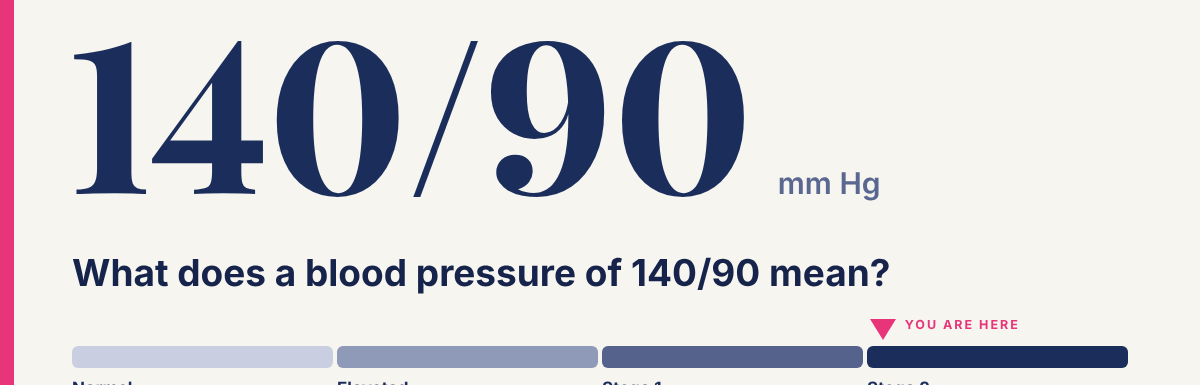
There is plenty of debate about whether 130/80 should be called high blood pressure. There is none about 140/90. Every major guideline in the world treats a confirmed blood pressure of 140/90 as hypertension, and US guidelines place it in stage 2. If this is your reading, the useful questions are whether it is your true average, what your clinician will want to check, and what treatment at this level normally involves. This guide takes them in that order.
Quick answer: A blood pressure of 140/90 mm Hg is the lowest reading in stage 2 hypertension under the American Heart Association and American College of Cardiology guideline. Either number is enough: a systolic of 140 or higher, or a diastolic of 90 or higher. It is not an emergency. Once confirmed with repeated or home readings, guidelines recommend blood pressure medication together with lifestyle changes, with a goal of getting below 130/80. A home average of 135/85 is considered equivalent to 140/90 in a clinic. This is education, not medical advice.
Free tools: Blood pressure chart with checker and printable blood pressure log.
Where 140/90 fits
| Category | Systolic (top number) | Diastolic (bottom number) | |
|---|---|---|---|
| Normal | Below 120 | and | Below 80 |
| Elevated | 120 to 129 | and | Below 80 |
| Stage 1 hypertension | 130 to 139 | or | 80 to 89 |
| Stage 2 hypertension | 140 or higher | or | 90 or higher |
These categories were set in 2017 and kept in the 2025 guideline. The American Heart Association publishes them for patients. Stage 2 is a wide category that runs from 140/90 all the way up, so being at its lowest edge is very different from being at 170/105. For the category below, see what a blood pressure of 130/80 means.
Readings near 140/90
| Reading | US category | Why |
|---|---|---|
| 136/84 | Stage 1 | Both numbers in the stage 1 range |
| 138/88 | Stage 1 | Top of stage 1 |
| 138/92 | Stage 2 | Diastolic has reached 90 |
| 140/90 | Stage 2 | Both at the threshold |
| 144/82 | Stage 2 | Systolic at or above 140 |
| 150/95 | Stage 2 | Clearly within the range |
| 160/100 | Stage 2 | Twenty points over the threshold; treatment is not delayed |
| Above 180 and/or above 120 | Severe | Needs prompt medical attention; an emergency if symptoms are present |
Only one number has to cross the line. A reading of 142/78 is stage 2 on the strength of the systolic. In older adults a high top number with a normal bottom number, called isolated systolic hypertension, is the most common pattern and is treated as seriously as any other. See systolic vs diastolic blood pressure.
The one threshold everyone agrees on
| Guideline | What it calls 140/90 |
|---|---|
| American Heart Association and American College of Cardiology | Stage 2 hypertension |
| European Society of Cardiology | Hypertension |
| European Society of Hypertension | Grade 1 hypertension |
| International Society of Hypertension | Grade 1 hypertension |
| World Health Organization | Hypertension |
The grade or stage number differs because US guidelines start counting at 130/80 and most others start at 140/90. The practical conclusion is the same everywhere. A confirmed 140/90 is high blood pressure, and it is the level at which treatment has the longest and strongest record of preventing strokes, heart attacks, heart failure, and kidney disease.
Confirming it: clinic, home, and 24-hour readings
Blood pressure is variable, and a single clinic reading of 140/90 is not enough to label anyone. The definition is an average of at least two careful readings on at least two occasions, and the guideline recommends confirming with measurements taken outside the clinic.
Home and ambulatory readings run lower than clinic readings at this level, so the thresholds are not the same.
| Where it is measured | Reading equivalent to 140/90 in a clinic |
|---|---|
| Clinic or office | 140/90 |
| Home average | 135/85 |
| Daytime ambulatory average | 135/85 |
| 24-hour ambulatory average | 130/80 |
| Night-time ambulatory average | 120/70 |
This matters in both directions. If your home average is 135/85, do not conclude you are comfortably below 140/90. You are at its equivalent. And if the clinic shows 140/90 while your careful home average is 124/78, you may have white coat hypertension, which is usually monitored instead of medicated.
To get a reliable home average, use a validated upper-arm cuff, sit quietly for five minutes with your back and arm supported, and take two readings each morning and evening for seven days. See how to take your blood pressure at home, the seven-day log, choosing a validated monitor, and the blood pressure average calculator. For the two mismatch patterns, see white coat and masked hypertension.
What sustained 140/90 does over time
High blood pressure rarely causes symptoms, which is why it goes untreated so often. Headaches, nosebleeds, and flushing are unreliable signs. Most people at 140/90 feel entirely well.
The harm comes from years of extra force on artery walls and on the organs those arteries supply. Large pooled studies show the risk of fatal heart disease and stroke roughly doubling for each increase of 20 points systolic or 10 points diastolic, starting from about 115/75. On that curve, a sustained 140/90 carries roughly twice the risk of 120/80.
| Organ | What long-term high pressure can lead to |
|---|---|
| Brain | Stroke, and a higher risk of cognitive decline and dementia |
| Heart | Thickened heart muscle, heart failure, heart attack, atrial fibrillation |
| Kidneys | Gradual loss of filtering function, protein in the urine |
| Eyes | Damage to the small vessels of the retina |
| Arteries | Stiffening, aneurysm, peripheral artery disease |
The same evidence shows the risk comes down with treatment. In trials, lowering systolic pressure by about 10 points reduces major cardiovascular events by roughly a fifth, with larger reductions in stroke and heart failure. The 2025 guideline also cites evidence that lowering blood pressure reduces the risk of dementia. High blood pressure is among the most treatable of the major risk factors.
What your clinician will check
A new finding of hypertension normally comes with a baseline evaluation. Its purpose is to look for early effects on organs, find other risk factors, and spot any underlying cause.
| Test | What it looks for |
|---|---|
| Basic metabolic panel with creatinine and eGFR | Kidney function, sodium, potassium |
| Urine albumin-to-creatinine ratio | Early kidney damage; the 2025 guideline recommends this for everyone with hypertension |
| Lipid panel | Cholesterol, for overall cardiovascular risk |
| Fasting glucose or A1C | Diabetes or prediabetes, which change treatment thresholds |
| Thyroid-stimulating hormone | Thyroid disease as a contributor |
| Complete blood count and urinalysis | General screening |
| Electrocardiogram | Signs of strain or thickening of the heart |
| Aldosterone and renin, in selected people | Primary aldosteronism, an under-recognized hormonal cause |
The 2025 guideline broadened the recommendation to test for primary aldosteronism, and testing may be considered for people with stage 2 hypertension as well as those whose blood pressure is hard to control. If your results include glucose or cholesterol numbers you want to understand, see a fasting blood sugar of 100 to 110, an A1C of 6.0, and an LDL of 130.
Things that can be pushing it up
Most hypertension has no single cause. It develops from a combination of genetics, age, weight, sodium intake, and activity. It is still worth going through the list of things that raise blood pressure and can be changed.
- Pain relievers of the NSAID type such as ibuprofen and naproxen, especially with regular use
- Decongestants containing pseudoephedrine or phenylephrine
- Stimulant medicines and high caffeine intake
- Hormonal contraceptives containing estrogen
- Steroid medicines
- Some antidepressants and certain cancer and transplant medicines
- Alcohol, particularly more than one to two drinks a day
- Black licorice and some herbal products
- Obstructive sleep apnea, which is very common in people with hypertension and often undiagnosed
- Kidney disease, thyroid disease, and adrenal conditions
Bring a full list of prescriptions, over-the-counter medicines, and supplements to your visit. See supplements and blood pressure medicines and metabolic syndrome and sleep apnea.
What treatment looks like at 140/90
For adults with confirmed stage 2 hypertension, the 2025 guideline recommends starting blood pressure medication along with lifestyle changes. It does not recommend a trial of lifestyle changes alone at this level, which is the main difference from stage 1.
| Element | What the guideline describes |
|---|---|
| When to start | At confirmation of stage 2, together with lifestyle changes |
| First-line medicine classes | Thiazide-type diuretics, ACE inhibitors, angiotensin receptor blockers, long-acting calcium channel blockers |
| How many | Two first-line medicines from different classes are preferred for stage 2, ideally combined in a single pill |
| Goal | Below 130/80 for most adults, with a systolic below 120 encouraged when well tolerated |
| Follow-up | About monthly until the goal is reached, then every few months |
Starting with two medicines surprises many people. The reasoning is that each standard-dose medicine lowers systolic pressure by about 9 to 10 points on average, the goal is more than 10 points below 140, and two medicines at low doses tend to work better with fewer side effects than one medicine at a high dose. A single combined pill also makes the routine simpler. For someone only just at 140/90, or an older or frailer adult, a clinician may reasonably begin with one. The choice of class depends on your other conditions, kidney function, and potassium level.
Many people need two or three medicines to reach goal. That reflects how blood pressure is regulated and is not a sign that treatment is failing. See blood pressure medications: what to know before you start.
What lifestyle changes add
Lifestyle measures are recommended alongside medication at every stage. They can reduce the number or dose of medicines needed, and they improve glucose, weight, and cholesterol at the same time. Figures are approximate average reductions in systolic pressure from trials in people with hypertension.
| Change | Approximate effect on systolic pressure |
|---|---|
| DASH-style eating pattern | Up to about 11 points |
| Lower sodium, ideally toward 1,500 mg a day | About 5 to 6 points |
| Weight loss, if overweight | About 1 point per kilogram lost |
| Aerobic exercise most days | About 5 to 8 points |
| More potassium from food, if your kidneys and medicines allow | About 4 to 5 points |
| Less alcohol | About 4 points in regular drinkers |
If you take an ACE inhibitor, an angiotensin receptor blocker, or a potassium-sparing diuretic, or you have kidney disease, ask before using potassium salt substitutes or potassium supplements. See diet for high blood pressure and sodium and blood pressure.
How quickly it should come down
| Time after starting treatment | What to expect |
|---|---|
| First days | Some medicines begin lowering pressure within hours to days |
| 2 to 4 weeks | Most of the effect of a given dose is visible; diuretics and calcium channel blockers can take a little longer to reach full effect |
| About 1 month | Follow-up visit with your home readings; doses are adjusted if you are above goal |
| Within about 3 months | Most people can be brought to goal with adjustments |
There is no advantage to lowering blood pressure abruptly at this level. A steady decline over weeks is safer and better tolerated. Keep measuring at home, because those readings guide the adjustments. See how quickly blood pressure can change.
If you are already on medication
If you are being treated and your average is still 140/90, you are above the goal of below 130/80, and the plan should be reviewed. Before a dose is raised, a careful clinician will check several things.
- Technique and equipment. Wrong cuff size and rushed readings are common.
- Home readings. A high clinic reading with a home average of 126/78 is a white coat effect on treatment, and more medicine could cause dizziness.
- Whether doses are being missed. Side effects, cost, and complicated schedules are frequent reasons.
- Interfering substances. NSAIDs, decongestants, alcohol, and high sodium intake blunt the effect of treatment.
- Timing and combination. A different class or a combination pill may work better than a higher dose.
Blood pressure that stays above goal on three medicines at adequate doses, one of them a diuretic, is called resistant hypertension. It calls for a search for underlying causes, including sleep apnea and primary aldosteronism.
Diabetes, kidney disease, pregnancy, and older age
- Diabetes or chronic kidney disease. Treatment is recommended from 130/80, so 140/90 is well past the starting point. ACE inhibitors or angiotensin receptor blockers are often chosen when there is protein in the urine. See an A1C of 7.0.
- Pregnancy. A reading of 140/90 is the threshold for hypertension in pregnancy. After 20 weeks it prompts evaluation for preeclampsia. Call your obstetric team the same day, and immediately if you have a severe headache, vision changes, upper abdominal pain, or sudden swelling. Several common blood pressure medicines are not used in pregnancy.
- Older adults. Treatment is beneficial at older ages, and the goal is generally the same for people living independently. It is individualized for those who are frail or prone to falls. Standing blood pressure is checked to avoid drops on rising.
When it is an emergency
A reading of 140/90 is not an emergency and does not need a visit to the emergency department. A reading above 180/120 needs prompt attention. If such a reading comes with chest pain, shortness of breath, severe headache, back pain, numbness or weakness, a change in vision, confusion, or trouble speaking, call 911. Without symptoms, rest quietly for several minutes, measure again, and contact your clinician the same day if it is still that high.
Scenarios by situation
These are hypothetical illustrations, not case histories.
Age 50, clinic 142/92 on two visits, home average 137/88. Confirmed. A baseline workup and starting medication with lifestyle changes is the guideline recommendation.
Age 44, clinic 140/90, home average 122/78. White coat pattern. Usually monitored with periodic home series, since some people in this group develop sustained hypertension later.
Age 71, 148/74, otherwise well. Isolated systolic hypertension, the usual pattern at this age. It is treated, with attention to dizziness on standing.
Age 36, 138/94, takes ibuprofen daily for back pain and snores heavily. Stage 2 on the diastolic, with two modifiable contributors. Addressing them may change the picture considerably.
Age 62, on one medicine for three years, average has crept from 128/80 to 141/89. Above goal on treatment. Adding a second class is the usual next step.
Questions for your clinician
- Is this confirmed, or should I do a week of home readings first?
- What baseline tests do I need, including a urine albumin test?
- Could any medicine, supplement, or sleep problem be contributing?
- Are you recommending one medicine or two, and why that class?
- What side effects should I watch for, and which blood tests follow?
- What average am I aiming for at home?
- When do we recheck, and what happens if I am not at goal?
- Should I be tested for sleep apnea or primary aldosteronism?
Bottom line by situation
| Situation | Bottom line |
|---|---|
| One clinic reading of 140/90 | Not yet a diagnosis; confirm with repeat and home readings |
| Home average of 135/85 or higher | Equivalent to 140/90 in a clinic; confirmed |
| Confirmed stage 2 | Medication plus lifestyle changes; goal below 130/80 |
| High in clinic, normal at home | White coat pattern; monitor |
| On treatment and still 140/90 | Above goal; review technique, adherence, and the regimen |
| Pregnant | Call your obstetric team the same day |
| Above 180/120 with symptoms | Call 911 |
Frequently asked questions
Is a blood pressure of 140/90 high?
Yes. It is stage 2 hypertension under US guidelines and is classified as hypertension by every major international guideline, once confirmed by repeated readings.
Is 140/90 dangerous?
It is not an immediate danger. Left untreated for years, it roughly doubles the risk of heart disease and stroke compared with 120/80, and that risk falls with treatment.
Do I need medication for 140/90?
If the reading is confirmed, current US guidelines recommend medication together with lifestyle changes. The final decision is made with your clinician.
Can 140/90 be lowered without medication?
Lifestyle changes can lower blood pressure substantially and are recommended for everyone. At stage 2, guidelines advise using them with medication instead of relying on them alone.
Is 140/90 OK for a 70-year-old?
The categories do not change with age, and treating blood pressure at older ages lowers the risk of stroke and heart failure. Goals are individualized for frail adults.
What if only one number is high?
A systolic of 140 or higher or a diastolic of 90 or higher is enough for stage 2. The higher category applies.
What home reading equals 140/90?
A home average of 135/85 is considered equivalent to a clinic reading of 140/90.
Should I go to the ER for 140/90?
No. Schedule a regular appointment. Emergency care is for readings above 180/120 with symptoms such as chest pain, shortness of breath, weakness, or trouble speaking.
Will I have symptoms at 140/90?
Usually not. High blood pressure typically causes no symptoms, which is why measuring is the only way to know.
How long does blood pressure medication take to work?
Some effect appears within days, and most of the effect of a dose is seen within two to four weeks. Follow-up is usually about a month after starting.
Will I need medication for life?
Many people do. Some are able to reduce doses after sustained weight loss or other changes, under supervision. Do not stop on your own.
Is 140/90 high in pregnancy?
Yes. It is the threshold for hypertension in pregnancy and should be reported to your obstetric team the same day.
Why two medicines instead of one?
Two medicines from different classes at lower doses usually lower pressure more, with fewer side effects, than one medicine at a high dose. The guideline prefers this approach for stage 2.
What is the goal once I am treated?
Below 130/80 for most adults.
About the author: Charles Kirkland is the founder of Metabolic Clarity Labs and author of The Journey Back. He is not a physician. This is general education, not a medically reviewed treatment plan.
Sources checked November 12, 2026: the 2025 AHA/ACC high blood pressure guideline, the American Heart Association, and the European Society of Cardiology. Do not start, stop, or change prescribed treatment based on this article.