
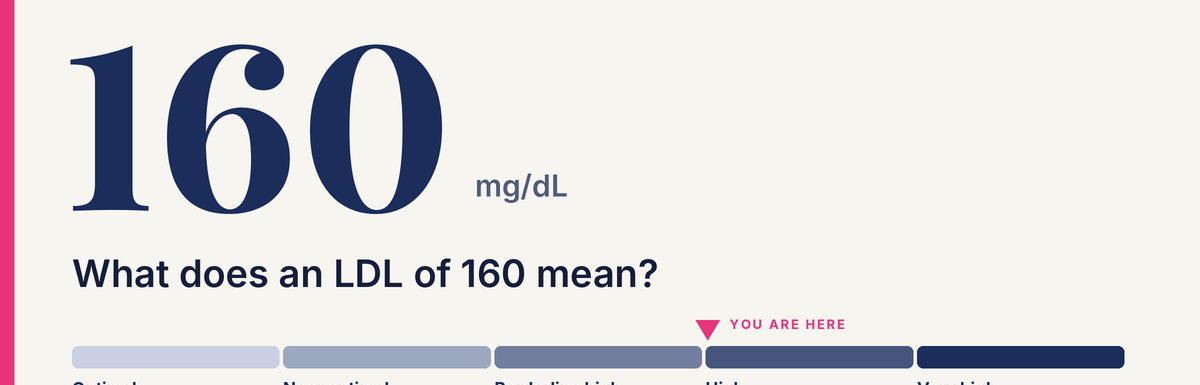
An LDL cholesterol of 160 mg/dL is past the point where a lab report hedges. It is labeled high, it sits well above every goal in current guidelines, and a level that stays at 160 is treated as a risk factor in its own right. It is also a number people live with for years without knowing, because it causes no symptoms. This guide explains what 160 means, the questions it should prompt about family history and other causes, and how far different treatments can realistically move it.
Quick answer: An LDL cholesterol of 160 mg/dL (4.1 mmol/L) is the lowest value in the range traditionally labeled high, which runs from 160 to 189. Current guidelines set a goal below 100 mg/dL for most adults without cardiovascular disease and below 70 or 55 for those at higher risk, so 160 is 60 points or more above goal. It is not an emergency. It does warrant a risk assessment, a check for treatable causes such as an underactive thyroid, a look at family history, and a real conversation about treatment. An LDL of 190 or higher is a separate category in which medication is recommended regardless of other risk factors. This is education, not medical advice.
Free tools: Cholesterol levels chart with checker and LDL cholesterol calculator.
Where 160 fits
| LDL cholesterol (mg/dL) | In mmol/L | Traditional label |
|---|---|---|
| Below 100 | Below 2.6 | Optimal |
| 100 to 129 | 2.6 to 3.3 | Near optimal |
| 130 to 159 | 3.4 to 4.1 | Borderline high |
| 160 to 189 | 4.1 to 4.9 | High |
| 190 or higher | 4.9 or higher | Very high |
These labels appear on most lab reports and are published by the National Library of Medicine. For the band below, see what an LDL of 130 means.
How far 160 is from goal
The 2026 guideline from the American College of Cardiology and American Heart Association restored numeric LDL goals based on risk.
| Who | LDL goal | Points to lose from 160 | Percent reduction needed |
|---|---|---|---|
| No cardiovascular disease; low, borderline, or intermediate 10-year risk | Below 100 mg/dL | More than 60 | About 38% |
| No cardiovascular disease; high 10-year risk | Below 70 mg/dL | More than 90 | About 56% |
| Established cardiovascular disease | Below 70 mg/dL | More than 90 | About 56% |
| Established cardiovascular disease at very high risk | Below 55 mg/dL | More than 105 | About 66% |
The percentages are the important column. A reduction of about 38% is more than dietary change achieves for most people. That is the central fact about an LDL of 160: for the large majority, reaching goal involves medication, with food and activity working alongside it.
Why the years matter as much as the number
Plaque in the arteries accumulates in proportion to two things: how high LDL is, and how long it stays there. Researchers sometimes describe this as cumulative exposure. The 2026 guideline builds on that idea, emphasizing earlier treatment to reduce lifetime exposure to plaque-forming particles.
| LDL level | Years at that level | Relative cumulative exposure |
|---|---|---|
| 100 mg/dL | 30 | Reference |
| 130 mg/dL | 30 | 30% more |
| 160 mg/dL | 30 | 60% more |
| 160 mg/dL for 10 years, then 80 mg/dL for 20 years | 30 | About 7% more |
This is simple arithmetic to illustrate a principle, and real risk depends on much more than LDL. The last row carries the point. Lowering LDL earlier removes far more exposure than lowering it later. It is also why a 160 in a 35-year-old with low short-term risk is not something to set aside until age 60.
How the current guideline treats 160
Risk is estimated with the PREVENT equations, which sort 10-year risk into low (below 3%), borderline (3% to under 5%), intermediate (5% to under 10%), and high (10% or more), and also estimate 30-year risk.
| Your situation with an LDL of 160 to 189 | General direction of the guideline |
|---|---|
| Age 30 to 59, low 10-year risk, 30-year risk of 10% or higher | Statin therapy may be considered, to reduce long-term exposure |
| Low 10-year risk and low 30-year risk | Intensive lifestyle changes; recheck; discuss options if it stays high |
| Borderline or intermediate 10-year risk | Statin therapy is generally favored; a persistently high LDL at this level strengthens the case |
| High 10-year risk | Statin therapy recommended, aiming below 70 |
| Diabetes, age 40 or older | Statin therapy recommended for most |
| Established cardiovascular disease | High-intensity statin therapy, adding other medicines as needed to reach below 70 or 55 |
| LDL reaches 190 or higher | A separate category: statin therapy recommended regardless of calculated risk |
The first row is new and directly relevant. Under earlier guidance, a 40-year-old with an LDL of 165 and no other risk factors would often have been told to come back in a few years, because 10-year risk at that age is low for nearly everyone. The 2026 guideline recognizes that 30-year risk can be substantial even when 10-year risk is not, and names an LDL of 160 to 189 as a situation where earlier treatment may be considered. Ask your clinician to run the PREVENT calculator with you.
Confirming the result
- Repeat it once. LDL varies by roughly 8 percent from day to day, so a true 160 can report from about 147 to 173. Guidelines refer to LDL that is persistently at this level, meaning on more than one test.
- Check how it was calculated. Most LDL values are calculated from total cholesterol, HDL, and triglycerides. If triglycerides are above about 200, the calculation becomes less reliable, and above 400 the traditional equation is not valid. A direct LDL, non-HDL cholesterol, or apolipoprotein B is used instead.
- Test when you are well. Serious illness, surgery, and rapid weight loss can shift LDL temporarily.
- Not during pregnancy. LDL rises substantially in pregnancy and is not interpreted against these ranges.
The complete cholesterol numbers calculator shows LDL, non-HDL, and ratios from one panel.
Treatable causes to rule out
Before an LDL of 160 is attributed to diet or genetics, a few conditions and exposures should be considered, because correcting them can lower LDL without any cholesterol medicine.
| Cause | How it is checked |
|---|---|
| Underactive thyroid | Thyroid-stimulating hormone blood test |
| Kidney disease with protein loss | Urine protein or albumin, kidney function tests |
| Liver disease with blocked bile flow | Liver panel |
| Medicines | Review of prescriptions: some diuretics, steroids, retinoids, cyclosporine, certain HIV medicines, anabolic steroids |
| Menopause | History; LDL commonly rises in the years around it |
| Diet very high in saturated fat | Diet history, including very low-carbohydrate and carnivore-style diets |
| Large amounts of unfiltered coffee | History: French press, boiled, or Turkish coffee |
A small number of people see very large LDL increases on low-carbohydrate diets high in saturated fat, sometimes well past 160. If your LDL rose after a major dietary change, tell your clinician, because the number often falls when saturated fat is reduced even if carbohydrate stays low. See keto and low-carb diets with type 2 diabetes.
Family history and inherited high cholesterol
Familial hypercholesterolemia is an inherited condition in which the liver clears LDL poorly from birth. It affects about 1 in 250 people, and most do not know they have it. Because LDL has been high since childhood, cumulative exposure is large, and heart disease can appear decades early. It is very treatable once identified.
The condition is usually suspected in adults when LDL is 190 or higher. An LDL of 160 to 189 does not suggest it by itself, but it should prompt the question when combined with any of the following:
- A parent, sibling, or child with heart attack, stent, or bypass before age 55 in men or 65 in women
- A close relative with very high cholesterol
- An LDL that was already high in your teens or twenties
- Cholesterol deposits in the tendons or around the eyes
- Your current 160 is measured while already taking a cholesterol medicine
If the condition is diagnosed, first-degree relatives should be tested, including children. Finding one case typically uncovers several others in a family.
Other tests worth asking about
| Test | Why it matters at an LDL of 160 |
|---|---|
| Lipoprotein(a) | An inherited particle that adds to risk and is not lowered by diet or statins. The 2026 guideline recommends testing once in every adult. A high level strengthens the case for lowering LDL. |
| Non-HDL cholesterol | Already on your report as total minus HDL. The goal is 30 points above your LDL goal. See non-HDL cholesterol explained. |
| Apolipoprotein B | A direct count of plaque-forming particles. Useful when triglycerides are raised or in diabetes. |
| Coronary artery calcium score | Shows whether calcified plaque is already present. Most useful when the treatment decision is uncertain. A score of zero does not rule out risk in younger adults or when LDL has been high for years. |
LDL of 160 alongside metabolic syndrome or diabetes
LDL cholesterol is not one of the five criteria for metabolic syndrome, which are waist circumference, triglycerides, HDL cholesterol, blood pressure, and fasting glucose. Insulin resistance tends to raise triglycerides and lower HDL more than it raises LDL. A person with metabolic syndrome whose LDL is also 160 therefore has two separate problems stacked together: a high cholesterol load and an environment in which arteries are more easily damaged.
The combination raises estimated risk considerably, and it is one of the situations where guidelines most clearly favor treatment. With diabetes, lipid-lowering therapy is recommended for adults aged 40 and older at any LDL level. See high LDL with normal triglycerides, the metabolic syndrome calculator, blood pressure of 140/90, and an A1C of 6.5.
What each approach can do to 160
These are approximate average reductions from clinical studies, and individuals vary.
| Approach | Typical LDL reduction | What 160 might become |
|---|---|---|
| Replacing saturated fat with unsaturated fat | About 5% to 10% or more | About 144 to 152 |
| Soluble fiber, 5 to 10 g a day | About 5% to 10% | About 144 to 152 |
| Plant sterols or stanols, about 2 g a day | About 5% to 10% | About 144 to 152 |
| Combined dietary approach, well followed | About 15% to 25% | About 120 to 136 |
| Moderate-intensity statin | 30% to 49% | About 82 to 112 |
| High-intensity statin | 50% or more | 80 or lower |
| Statin plus ezetimibe | About 15% to 25% beyond the statin | Often 60 to 90 |
| Injectable PCSK9-targeting medicines, added when needed | About 50% beyond other therapy | Often below 55 |
Compare the right-hand column with the goals. Diet alone, done well, typically brings 160 into the 120s or 130s, which is a worthwhile improvement and usually still above 100. A moderate-intensity statin reaches below 100 for many people. Reaching below 70 usually takes a high-intensity statin, often with a second medicine. Lifestyle and medication are complementary: a good diet can mean a lower dose or one fewer medicine.
Statins: what to know
Statins are the first-line medicine because they have the most evidence. Across large trials, each reduction of about 39 mg/dL in LDL lowers heart attacks, strokes, and related events by roughly a fifth, and the benefit accumulates with years of treatment. From a starting point of 160, a moderate or high-intensity statin commonly lowers LDL by 50 to 80 points.
- Muscle symptoms. Aches are commonly reported. In blinded trials, where participants did not know whether they were taking a statin or a placebo, most muscle symptoms occurred at similar rates in both groups, and the share clearly caused by the statin was small. If symptoms occur, options include a lower dose, a different statin, or a different schedule. Serious muscle injury is rare.
- Blood sugar. Statins slightly raise the chance of crossing into the diabetes range, mainly in people who are already close to it, such as those with prediabetes or metabolic syndrome. Major guidelines conclude that the cardiovascular benefit clearly outweighs this effect, and they recommend monitoring glucose, not avoiding treatment. If your glucose is borderline, see an A1C of 6.0.
- Liver. Mild enzyme rises can occur and serious liver injury is rare.
- Pregnancy. Most lipid-lowering medicines are deferred around conception, pregnancy, and breastfeeding.
- Interactions. Some supplements and medicines interact with statins. See supplements and statins and CoQ10 and statin muscle symptoms.
People who cannot take a statin have alternatives, including ezetimibe, bempedoic acid, and injectable medicines. Do not replace a prescribed medicine with a supplement without discussing it. Red yeast rice contains a statin-like compound in amounts that vary from product to product. See red yeast rice and quality and the evidence on supplements for cholesterol.
What dietary change looks like
- Shift fats. Less butter, fatty and processed meat, full-fat dairy, and coconut or palm oil. More olive oil, nuts, seeds, avocado, and fish.
- Add soluble fiber daily. Oats, barley, beans, lentils, and psyllium. See psyllium and cholesterol and beta-glucan from oats and barley.
- Eat more plants overall. Mediterranean and DASH-style patterns lower LDL and improve blood pressure and glucose together. See the Mediterranean diet.
- Filter your coffee. Paper filters remove most of the compounds that raise LDL.
- Lose weight if you carry extra. The effect on LDL is modest and the effect on triglycerides, blood pressure, and glucose is larger.
When to retest
- To confirm a first result: within a few weeks, when you are well.
- After dietary change: six to twelve weeks.
- After starting or changing a medicine: four to twelve weeks, then periodically until at goal, then about yearly.
See how quickly cholesterol can change.
Scenarios by situation
These are hypothetical illustrations, not case histories.
Age 39, LDL 162 on two tests, no other risk factors, 10-year risk low, 30-year risk above 10%. Under the 2026 guideline this is a case where a statin may be considered to reduce decades of exposure, alongside dietary change. A lipoprotein(a) test would add information.
Age 45, LDL 160, TSH markedly raised. An underactive thyroid is a likely cause. LDL is rechecked after thyroid treatment before any decision about cholesterol medicine.
Age 51, LDL 168, mother had a heart attack at 52, LDL was 170 at age 25. A long-standing high LDL with early heart disease in the family. Inherited high cholesterol should be considered, and relatives may need testing.
Age 56, type 2 diabetes, blood pressure 138/86, LDL 160. Multiple major risk factors. Statin therapy is recommended, with a goal that may be below 70.
Age 42, LDL rose from 115 to 165 after six months on a very low-carbohydrate diet heavy in butter and red meat. Diet is the probable driver. Reducing saturated fat while keeping the parts of the diet that are working, then rechecking, is a reasonable first step.
Questions for your clinician
- Should this be repeated to confirm it is persistent?
- What are my 10-year and 30-year risk estimates, and what LDL goal applies to me?
- Has my thyroid been checked? Could any of my medicines be raising LDL?
- Does my family history suggest inherited high cholesterol? Should my relatives be tested?
- Can I have lipoprotein(a) measured?
- Would a calcium score help, or is the decision already clear?
- If we start a statin, which intensity, and when do we recheck?
- If I want to try dietary change first, how long do we give it and what result would change the plan?
Bottom line by situation
| Situation | Bottom line |
|---|---|
| First LDL of 160 | High; repeat it, check thyroid, review family history |
| Persistently 160 to 189, young, low short-term risk | Long-term exposure is the concern; treatment may be considered |
| 160 with borderline, intermediate, or high risk | Statin therapy is generally favored or recommended |
| 160 with diabetes or cardiovascular disease | Treatment is recommended; goals are 70 or lower |
| 160 with early heart disease in the family | Ask about inherited high cholesterol and lipoprotein(a) |
| 160 after a major diet change | Review saturated fat and recheck |
| LDL 190 or higher | A different category; medication is recommended regardless of other risk |
Frequently asked questions
Is an LDL of 160 high?
Yes. It is the start of the range labeled high and is 60 points above the goal of below 100 mg/dL used for most adults.
Is an LDL of 160 dangerous?
It poses no immediate danger. Sustained over years, it increases the buildup of arterial plaque and the risk of heart attack and stroke, which is why it is worth lowering.
Do I need a statin for an LDL of 160?
It depends on your overall risk, and at this level many people do. Guidelines favor treatment with borderline or higher risk, diabetes, or cardiovascular disease, and allow it to be considered in younger adults with high 30-year risk.
Can I lower an LDL of 160 with diet alone?
Diet can lower it by about 15% to 25% when followed well, typically into the 120s or 130s. That is a real improvement and usually not enough to reach below 100.
What is 160 mg/dL in mmol/L?
About 4.1 mmol/L.
What causes an LDL of 160?
Usually a combination of inherited tendency and diet. An underactive thyroid, kidney or liver conditions, menopause, and certain medicines can also raise it.
Is an LDL of 160 genetic?
Genes play a large part in LDL levels generally. Familial hypercholesterolemia is usually suspected at 190 or higher, or at lower levels with a strong family history of early heart disease.
How quickly can an LDL of 160 come down?
Statins reach most of their effect in about four weeks. Dietary changes show in four to six weeks.
Is 160 OK if my HDL is high and my triglycerides are low?
That pattern is more favorable than the reverse, but a high HDL does not neutralize a high LDL. The LDL goal still applies.
Should I get a calcium score?
It can help when the decision about treatment is uncertain. In younger adults a score of zero is common even when long-term risk is high, so it should not be over-interpreted.
What is lipoprotein(a), and should I be tested?
It is an inherited particle that raises cardiovascular risk. Current guidance recommends measuring it once in adulthood, and it is especially informative when LDL is high.
Will a statin raise my blood sugar?
Statins slightly increase the chance of developing diabetes in people already near the threshold. Guidelines conclude that the heart benefits outweigh this, with glucose monitored.
What should my LDL be?
Below 100 mg/dL for most adults without cardiovascular disease, below 70 at high risk or with cardiovascular disease, and below 55 at very high risk.
What happens if my LDL reaches 190?
An LDL of 190 or higher is treated as severe high cholesterol. Statin therapy is recommended regardless of other risk factors, and inherited causes are considered.
About the author: Charles Kirkland is the founder of Metabolic Clarity Labs and author of The Journey Back. He is not a physician. This is general education, not a medically reviewed treatment plan.
Sources checked November 12, 2026: the 2026 ACC/AHA guideline on the management of dyslipidemia, the American College of Cardiology, and the National Library of Medicine. Do not start, stop, or change prescribed treatment based on this article.