
Quick answer: Yes, Blue Cross Blue Shield plans cover continuous glucose monitors, but there is no single Blue Cross rule. Blue Cross Blue Shield is a federation of more than 30 independent companies, and each writes its own CGM policy. In the four 2026 policies we read, every plan covers people with diabetes who use insulin, the details differ on how much insulin and what else must be documented, and coverage without insulin usually depends on a history of serious lows. One plan, the Federal Employee Program, also accepts GLP-1 injections in place of insulin.
This page compares those four policies side by side so you can see the range, then shows how to find the rule for your own plan. It is general education. It is not insurance, legal, or medical advice, and your plan documents decide what is covered.
Policies last checked: November 13, 2026. Each Blue plan sets its own rules, so confirm yours.
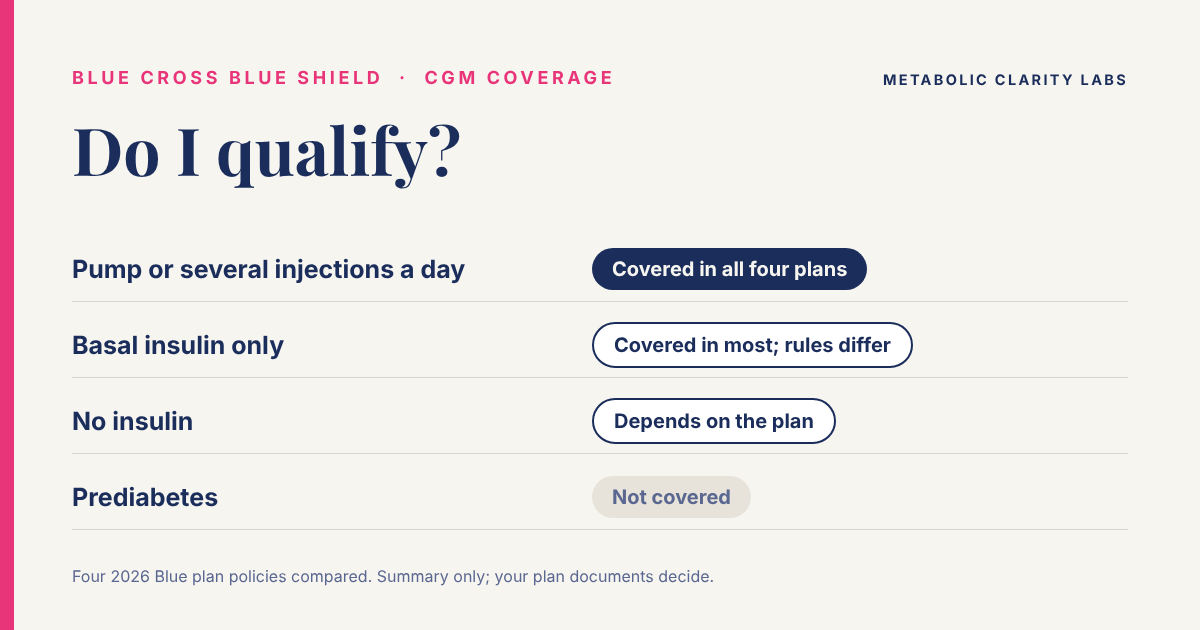
Do I qualify? A quick table
| Your treatment | Anthem | Federal Employee Program | Michigan | Kansas |
|---|---|---|---|---|
| Type 1 | Yes, with one sign of inadequate control | Yes | Yes | Yes |
| Type 2, pump or several injections a day | Yes, with one sign of inadequate control | Yes, with added conditions | Yes | Yes |
| Type 2, basal insulin only | Yes, with one sign of inadequate control | Only through the pharmacy-history exemption | Yes | Yes |
| Type 2, GLP-1 injection, no insulin | No | Yes, with added conditions or the exemption | Only with problematic lows | Only with significant lows |
| Type 2, pills only | No | No | Only with problematic lows | Only with significant lows |
| Prediabetes | No | No | No | No |
Free tools: time in range calculator, GMI calculator and printable meal and CGM log.
Why the answer depends on your Blue plan
The name on your card might be Anthem, Florida Blue, Highmark, Blue Cross Blue Shield of Texas, CareFirst, or one of many others. They share a brand and a national network, but each is a separate company with its own medical policies, drug lists, and prior authorization rules. A friend’s experience with Blue Cross in another state tells you little about yours. Even within one company, an employer that self-funds its plan can choose different rules.
Four Blue policies side by side
| Plan and policy | Insulin requirement | Path without insulin |
|---|---|---|
| Anthem, guideline CG-DME-42 (published April 15, 2026) | Insulin injections or a pump, plus one sign that control is not adequate | None in the guideline |
| Federal Employee Program, policy 5.99.014 (effective April 1, 2026) | For type 2: more than three injections a day, a pump, or GLP-1 injections, plus other conditions | GLP-1 agonist injections count |
| Blue Cross Blue Shield of Michigan and Blue Care Network (effective January 1, 2026) | Currently uses insulin | Problematic hypoglycemia, or pregnancy with high after-meal glucose |
| Blue Cross and Blue Shield of Kansas (effective February 26, 2026) | For type 2: treated with insulin, or significant hypoglycemia | Significant hypoglycemia; otherwise experimental |
Anthem
Anthem’s clinical guideline CG-DME-42 applies to Anthem Blue Cross and Blue Shield plans in the states where Anthem operates. For personal use of a CGM, all of the following have to be true:
- a diagnosis of diabetes of any type,
- insulin injections or an insulin pump are required to maintain control, and
- despite ongoing self-monitoring and adjustment of the insulin regimen, at least one of these is present: A1C above target, persistent fasting hyperglycemia, recurring hypoglycemia below 54 mg/dL, or hypoglycemia unawareness that puts the person or others at risk.
The guideline does not set a number of injections a day, so basal insulin can qualify if one of those signs is documented. Continued use requires documentation of benefit, such as improved or stable A1C or fewer symptomatic lows or highs. A replacement device is covered only when the old one is out of warranty, malfunctioning, and cannot be refurbished. An implanted sensor follows the same criteria for adults 18 and older. The guideline says it does not address over-the-counter CGMs and that they may be excluded from coverage.
Federal Employee Program
The Blue Cross and Blue Shield Service Benefit Plan for federal employees and retirees covers Dexcom G6, Dexcom G7, FreeStyle Libre 14 day, Libre 2, and Libre 3 through the pharmacy benefit under policy 5.99.014. Other CGMs go through the medical equipment benefit.
- Type 1 diabetes: the diagnosis is the only requirement.
- Type 2 diabetes: all of the following: more than three insulin injections a day, or pump therapy with frequent dose adjustments for more than six months, or GLP-1 agonist injections with or without insulin; uncontrolled diabetes with a documented average of at least five glucose self-tests a day over the previous two months; A1C above 7.0 percent or frequent hypoglycemia; a completed comprehensive diabetes education program; agreement to share readings with a clinician; and no concurrent test strips at prior-approval quantities.
There is an important shortcut. Members are exempt from prior approval, up to the quantity limits, if pharmacy records show at least 84 days of insulin, a diabetes GLP-1 injection, or a combination product, or a CGM fill within the past 180 days. Initial approval lasts 12 months.
| Product | Quantity limit in policy 5.99.014 |
|---|---|
| FreeStyle Libre 14 day, Libre 2, Libre 3 | 6 sensors per 84 days |
| Dexcom G6 | 9 sensors and 1 transmitter per 90 days |
| Dexcom G7 (10-day sensors) | 9 sensors per 90 days |
| Dexcom G7 (15-day sensors) | 6 sensors per 90 days |
| Reader or receiver | 1 per 365 days |
Blue Cross Blue Shield of Michigan
Starting January 1, 2026, Blue Cross Blue Shield of Michigan and Blue Care Network changed CGM coverage for commercial members. A member has to meet at least one of these:
- currently uses insulin;
- has diabetes and a history of problematic hypoglycemia, shown by recurrent level 2 lows (below 54 mg/dL) that continue despite multiple adjustments to medicine or the treatment plan, or one level 3 low that involved altered mental or physical state and needed another person’s help; or
- has diabetes, is currently pregnant, and has high glucose after meals.
Members with a paid pharmacy claim for insulin in the prior 365 days get a CGM at the pharmacy without prior authorization. Others need a prior authorization request. The same notice ended an earlier exception for members whose CGMs were prescribed through a Michigan type 2 quality program, so those members now have to meet one of the three criteria.
Blue Cross and Blue Shield of Kansas
The Kansas medical policy treats long-term CGM as medically necessary for type 1 diabetes. For type 2, it may be medically necessary when the person is willing and able to use the device, has adequate medical supervision, and either experiences significant hypoglycemia or is treated with insulin. The policy defines significant hypoglycemia as recurrent, unexplained, or severe lows, or impaired awareness of lows that puts the person or others at risk. Other type 2 use is considered experimental. CGM may be medically necessary in gestational diabetes for adults. The policy considers the implantable Eversense sensor not medically necessary, which is stricter than Cigna, Aetna, and Anthem.
Type 2 not on insulin
Across these four policies, the pattern for someone managing type 2 with pills or a GLP-1 medicine is:
- Anthem: no path in the guideline.
- Federal Employee Program: GLP-1 injections count toward the treatment requirement, but the other conditions, including five self-tests a day for two months, still apply unless you qualify for the pharmacy-history exemption.
- Michigan: documented problematic hypoglycemia.
- Kansas: significant hypoglycemia.
If none fits, an over-the-counter sensor is the usual alternative. See CGM coverage for type 2 when you are not on insulin, the best CGM without a prescription, and CGM cost without insurance.
How to find your own plan’s policy
- Read the front and back of your card for the company name and the member services number. The three-letter prefix on your member ID identifies your home plan.
- Search that company’s website for its medical policy on continuous glucose monitoring. Most Blue plans post them publicly.
- Check the drug list for Dexcom and FreeStyle Libre, and whether prior authorization or a quantity limit is marked.
- Call and ask whether the CGM is covered under pharmacy, medical equipment, or both, since several Blue plans moved CGMs to the pharmacy benefit in 2025 and 2026.
- If your employer self-funds the plan, ask your benefits office whether it follows the standard policy.
How to ask for approval
- Confirm the benefit and the preferred brand with member services.
- Ask whether a recent insulin fill removes the prior authorization step, as it does in Michigan and the Federal Employee Program.
- Give your prescriber what your plan’s policy asks for: insulin regimen, recent A1C against target, fasting readings, and any lows with dates and values.
- Keep records of benefit once you start, because plans such as Anthem ask for it to continue coverage.
If your plan says no
Ask for the denial in writing and the policy it was based on. Compare the reason with the policy text, since denials often turn on one missing item. Your prescriber can resubmit or ask for a peer-to-peer review. You can appeal internally and, for most plans, request an independent external review. Federal employees appeal through the process described in their plan brochure.
How this compares with current guidelines
The American Diabetes Association’s Standards of Care in Diabetes 2026 recommends CGM for adults on insulin therapy, for those on non-insulin medicines that can cause hypoglycemia, and for those on any diabetes treatment where CGM helps management. Requirements such as five fingersticks a day for two months are not part of that recommendation. A May 2026 report from Georgetown University’s Center on Health Insurance Reforms found wide variation in CGM criteria across plans and frequent gaps between plan criteria and the ADA standards.
What you will pay
Cost sharing is set by your specific Blue plan, and the recent move from medical suppliers to pharmacies has changed it for many members.
- If your plan covers sensors at the pharmacy, you pay the drug-list tier amount. Members who used to receive sensors by mail from a supplier and paid coinsurance may now pay a flat copay, or the reverse.
- If your plan still uses a medical supplier, expect the deductible first and then coinsurance.
- Federal employees pay according to their plan option. Standard Option, Basic Option, and FEP Blue Focus have different pharmacy tiers and cost sharing, so check the brochure for your option.
An illustration with invented numbers, which are not figures from any Blue plan:
| Illustration | How it is charged | Cost for 12 months |
|---|---|---|
| Pharmacy tier copay of $45 a month | 12 fills at $45 | $540 |
| Pharmacy tier at 30% coinsurance, plan price $260 a month | 12 fills at $78 | $936 |
| Medical supplier, $3,000 deductible not yet met, plan price $260 a month | About 11.5 months at full price, then 20% | about $3,024 |
The third row is the high-deductible case, where sensors alone never get far past the deductible. In that situation a pharmacy discount-card price can be lower than the insured price. See the dated examples in CGM cost without insurance.
Dexcom G7, Libre 3 Plus, Eversense, and Stelo
Does Blue Cross Blue Shield cover the Dexcom G7?
In the policies we read, yes when criteria are met. The Federal Employee Program covers Dexcom G7 through the pharmacy at nine 10-day sensors, or six 15-day sensors, per 90 days. Anthem’s guideline does not name brands and applies to any prescription CGM. Check your plan’s drug list for the tier.
Does Blue Cross Blue Shield cover FreeStyle Libre 3 Plus?
The Federal Employee Program policy lists FreeStyle Libre 14 day, Libre 2, and Libre 3 at six sensors per 84 days. It does not name the Plus sensors in the version we read, so federal employees should confirm how Libre 3 Plus is handled. Other Blue plans list their covered Libre models on their own drug lists.
Does Blue Cross Blue Shield cover Eversense 365?
This is where plans split. Anthem covers an implanted sensor for adults 18 and older who meet its CGM criteria. Blue Cross and Blue Shield of Kansas considers an implantable CGM not medically necessary. If you want Eversense, read your own plan’s policy before the insertion visit. See Eversense 365 vs. Dexcom G7.
Does Blue Cross Blue Shield cover Stelo or Lingo?
Anthem’s guideline says it does not address CGMs approved for use without a prescription and that over-the-counter devices may be excluded from coverage. We did not find a Blue policy that covers them. Stelo was listed at $89 to $99 a month and Lingo at $89 for four weeks when we checked in November 2026. See Stelo vs. Lingo.
Employer, marketplace, Medicare, and Medicaid plans
- Employer plans. A large share of Blue members are in self-funded employer plans, where the employer can adopt the Blue company’s policy or change it. Michigan’s notice, for example, applies to its commercial members, and a self-funded group there could differ.
- Marketplace plans. Blue companies are the largest marketplace insurers in many states. These plans follow the company’s commercial policy and state law.
- Federal Employee Program. This is one national plan with one policy, described above, regardless of which state you live in.
- Blue Medicare Advantage. These plans follow Medicare’s CGM rules: diabetes treated with insulin, or documented problematic hypoglycemia, plus a visit within six months before the order. Blue Cross Blue Shield of Michigan’s Medicare policy, for instance, points to the Medicare coverage determination. See Medicare CGM coverage for type 2.
- Blue Medicaid plans. State Medicaid rules apply. See Medicaid CGM coverage by state.
Prior authorization checklist
Start with whatever your own plan’s policy lists. Across the four policies above, these are the items reviewers look for:
- Diagnosis and type of diabetes.
- Insulin regimen, with names, doses, and number of daily injections, or pump use. For the Federal Employee Program, GLP-1 injections as well.
- Most recent A1C with date and your target. Anthem asks for A1C above target or another sign that control is inadequate.
- Fasting glucose pattern, if persistent fasting highs are the reason.
- Lows: dates, readings below 54 mg/dL, any severe event, and the treatment changes made in response.
- For the Federal Employee Program: self-testing frequency over the previous two months, completion of a diabetes education program, and agreement to share readings.
- For pregnancy in Michigan: after-meal glucose readings.
- For renewals: evidence of benefit, such as improved or stable A1C or fewer lows.
Sample appeal letter
Replace the brackets, name your own plan’s policy, and attach records. Ask your prescriber to send a letter of medical necessity with it.
[Date]
[Name of your Blue Cross Blue Shield company] Appeals
[Address from your denial letter]
Re: Appeal of denial for continuous glucose monitor
Member: [Name], ID [number], Reference [number]
I am appealing the denial dated [date] of coverage for [device name]. The stated reason was [reason given].
Your policy, [policy name and number], considers a CGM medically necessary when [quote or summarize the criterion from your plan’s policy]. I meet this criterion:
- I have [type 1 / type 2] diabetes.
- I take [insulin name and schedule]. [Or: I use an insulin pump.]
- My A1C on [date] was [value], above my target of [value]. [Or: my fasting readings have stayed above [value] on [dates].]
- [If applicable] I had glucose readings below 54 mg/dL on [dates], despite changes to my treatment on [dates].
Clinic notes, lab results, and glucose logs are enclosed. Please reverse the denial.
Sincerely,
[Name, phone, address]
Federal employees who are still denied after the plan’s reconsideration can ask the U.S. Office of Personnel Management to review the decision. The steps are in the disputed claims section of the plan brochure.
Frequently asked questions
Does Blue Cross Blue Shield cover the Dexcom G7?
Many Blue plans do when their criteria are met. The Federal Employee Program, for example, covers Dexcom G6 and G7 through the pharmacy benefit. Check your own plan’s drug list.
Does Blue Cross Blue Shield cover FreeStyle Libre?
Many Blue plans do. The Federal Employee Program lists FreeStyle Libre 14 day, Libre 2, and Libre 3 with a limit of six sensors per 84 days.
Does Blue Cross Blue Shield cover a CGM for type 2 diabetes?
Yes for people who use insulin, under every Blue policy we read. The amount of insulin and the extra documentation required differ by plan.
Does Blue Cross cover a CGM if I am not on insulin?
It depends on the plan. Michigan and Kansas allow it with documented significant hypoglycemia. The Federal Employee Program counts GLP-1 injections. Anthem’s guideline requires insulin.
Does Anthem cover a CGM with basal insulin only?
Anthem’s guideline requires insulin injections or a pump without setting a number of daily injections, plus one sign such as A1C above target, persistent fasting hyperglycemia, or recurring lows below 54 mg/dL.
Does the Federal Employee Program require prior approval for a CGM?
Yes, unless pharmacy records show at least 84 days of insulin or a diabetes GLP-1 injection, or a CGM fill in the past 180 days. Those members are exempt up to the quantity limits.
Does Blue Cross cover a CGM for prediabetes?
None of the four policies we read covers CGM without a diabetes diagnosis.
Does Blue Cross cover Eversense?
It varies. Anthem covers an implanted sensor for adults who meet its CGM criteria. Blue Cross and Blue Shield of Kansas considers it not medically necessary.
Does Blue Cross cover Stelo or Lingo?
Anthem’s guideline says over-the-counter CGMs may be excluded from coverage. Expect to pay out of pocket unless your plan says otherwise.
Why did my Blue plan move my CGM to the pharmacy?
Several Blue plans shifted Dexcom and FreeStyle Libre from medical suppliers to the pharmacy benefit in 2025 and 2026. Your prescriber may need to send a new prescription to a network pharmacy.
How much does a CGM cost with Blue Cross Blue Shield?
It depends on your Blue company and plan. Pharmacy fills are charged at the drug-list tier. Supplier orders go against the deductible and then coinsurance.
How do I know which Blue Cross company I have?
The company name is on your card, and the three-character prefix at the start of your member ID identifies your home plan. Member services at the number on the card can confirm it.
Does Anthem cover a CGM for type 2 diabetes without insulin?
No. Guideline CG-DME-42 requires insulin injections or an insulin pump for personal CGM use.
Does the Federal Employee Program cover a CGM with a GLP-1 medicine?
GLP-1 agonist injections count toward the treatment requirement for type 2, and members with at least 84 days of a diabetes GLP-1 injection in the past 180 days are exempt from prior approval up to the quantity limits.
Does Blue Cross Blue Shield of Michigan require prior authorization for a CGM?
Not for commercial members with a paid pharmacy claim for insulin in the prior 365 days. Others need a prior authorization request showing problematic hypoglycemia or pregnancy with high after-meal glucose.
Does a Blue Cross plan in one state follow another state’s policy?
No. Each Blue company writes its own medical policy. When you get care out of state, your home plan’s rules still decide coverage.
Not insurance, legal or medical advice. Coverage rules change and are set by each Blue Cross Blue Shield company and your plan. Metabolic Clarity Labs has no relationship with the Blue Cross Blue Shield Association or any of its member companies.
Sources
Read the documents: Anthem guideline CG-DME-42, Federal Employee Program policy 5.99.014, Blue Cross Blue Shield of Michigan CGM alert, Blue Cross and Blue Shield of Kansas CGM policy, and ADA Standards of Care 2026.
- Anthem Clinical UM Guideline CG-DME-42, Continuous Glucose Monitoring Devices (published April 15, 2026; last reviewed February 19, 2026)
- Blue Cross and Blue Shield Federal Employee Program, policy 5.99.014, Continuous Glucose Monitors and Supplies (effective April 1, 2026)
- Blue Cross Blue Shield of Michigan and Blue Care Network, provider alert on CGM coverage changes for commercial members (posted September 25, 2025; effective January 1, 2026)
- Blue Cross and Blue Shield of Kansas, medical policy on Continuous Glucose Monitoring (effective February 26, 2026)
- American Diabetes Association, Standards of Care in Diabetes 2026, diabetes technology section and summary of revisions
- Georgetown University Center on Health Insurance Reforms, report on CGM coverage criteria and prior authorization (May 2026)
About the author: Charles Kirkland is the founder of Metabolic Clarity Labs and author of The Journey Back. He is not a physician. This is general education, not a medically reviewed treatment plan.
Sources checked November 13, 2026. Discuss personal decisions with a qualified clinician. Do not start, stop, or change prescribed treatment based on this article.