
Quick answer: Yes, Kaiser Permanente covers continuous glucose monitors, and the rules depend on your Kaiser region. Each region sets its own criteria. In the regional documents we read, every one covers people with diabetes who use insulin, but they draw the line in different places: the Mid-Atlantic policy accepts insulin once a day, Georgia generally asks for three or more injections a day, and the Northwest criteria accept any chronic insulin if there is also a hypoglycemia, vision, or dexterity problem. None of them shows a routine path for type 2 diabetes managed without insulin.
Kaiser also works differently from other insurers, because your doctor and your health plan are part of the same organization. This page explains what that changes, compares the regional criteria, and lists what to ask. It is general education. It is not insurance, legal, or medical advice, and your Evidence of Coverage decides what is covered.
Criteria last checked: November 13, 2026. Kaiser regions revise their criteria separately, so confirm with your own region.
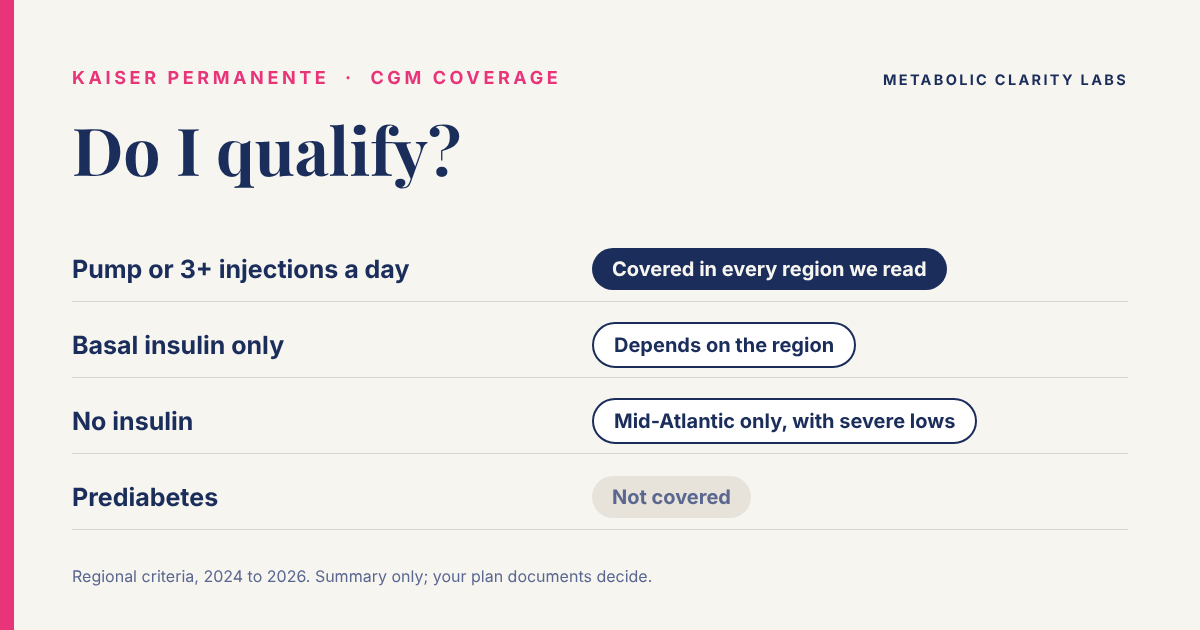
Do I qualify? A quick table
| Your treatment | Mid-Atlantic | Georgia | Northwest |
|---|---|---|---|
| Type 1, pump or 3+ injections a day | Yes | Yes, if not at target or having lows | Yes |
| Type 2, pump or 3+ injections a day | Yes | Yes, if not at target or having lows | Yes, with 2 visits in 6 months |
| Type 2, basal insulin only | Yes | Only if A1C is above 9% or another route applies | Only with lows, vision or dexterity limits, or pregnancy |
| Type 2, no insulin | Only with documented severe lows | No | No |
| Already using a CGM when you join | Yes, with proof | Yes, if on insulin | Yes, under new-member criteria |
| Prediabetes | No | No | No |
Free tools: time in range calculator, GMI calculator and printable meal and CGM log.
Why Kaiser works differently
With most insurers, your doctor writes a prescription and a separate company decides whether to pay. At Kaiser Permanente, the health plan, the medical group, and usually the pharmacy belong to one system. That has three practical effects:
- The request starts with your Kaiser clinician. You cannot take an outside prescription to a retail pharmacy and expect the plan to pay, except in limited cases.
- Criteria are regional. Kaiser operates eight regions, and each has its own utilization criteria, preferred devices, and supplier.
- Follow-up is built in. Several regions require contact with the diabetes team at set intervals to keep supplies coming.
Regional criteria side by side
| Region and document | Main insulin requirement for adults | Other routes |
|---|---|---|
| Mid-Atlantic States (policy approved May 23, 2024) | Insulin at least once a day, or a pump, with a visit in the prior 6 months | Severe hypoglycemia; prior CGM use; pregnancy with type 1 or insulin-requiring type 2 |
| Georgia (revised April 16, 2026) | Type 2: insulin three or more times a day, a visit in the prior 6 months, and not meeting targets or having lows | A1C above 9 percent on any insulin; chronic insulin plus dexterity, vision, or severe-low criteria |
| Northwest (FreeStyle Libre criteria, effective March 7, 2024) | Basal plus mealtime insulin or a pump, with two diabetes visits in the prior 6 months | Chronic insulin at any dose plus hypoglycemia, impaired dexterity or vision, pregnancy, or age 18 or younger |
| Washington (criteria effective March 1, 2026) | Uses a licensed guideline that is not published | Ask for the criteria used in your decision |
Mid-Atlantic States
The Kaiser Permanente Mid-Atlantic States policy, which covers Maryland, Virginia, and Washington, D.C., is the broadest of the group. An adult qualifies by meeting any one of these:
- Diabetes, insulin injections at least once daily or an insulin pump, and an in-person or telehealth visit within six months before the order.
- Diabetes with documented severe hypoglycemia that has not responded to regimen changes: a low needing assistance, glucagon, or an emergency visit in the past three months; hypoglycemia with seizures in the past six months; glucose below 50 mg/dL during sleep at least three times a week over the past month; or at least one hypoglycemic seizure in the past year.
- Successful CGM use in the month before joining Kaiser, with either the criteria met or proof of the prior insurer’s authorization.
- Type 1 or insulin-requiring type 2 diabetes before conception and during pregnancy.
To keep coverage, the member has to be in contact with the diabetes team within three months of receiving the system and have an encounter with diabetes providers every six months. The policy also says a phone or other smart device used to display readings is not covered equipment, and that the supply allowance is not covered if a member never uses a covered receiver or pump to display the data.
Georgia
The Georgia region’s adult criteria were revised on April 16, 2026. For type 2 diabetes, the standard route requires all three of: a visit within six months with a primary care physician, clinical pharmacist, diabetes nurse, or endocrinologist; not meeting glycemic targets, or having hypoglycemia; and taking insulin three or more times a day.
There are two other routes for type 2:
- A1C above 9 percent. A CGM may be requested after the first visit when the member is on insulin, including once-daily basal insulin, and the A1C was measured within two months of the visit.
- Chronic insulin at any dose, plus one of: severe dexterity impairment, severe vision impairment that cannot be corrected, severe hypoglycemia not responding to regimen changes, or a need for more than 200 units of insulin a day with U-500 insulin prescribed by endocrinology.
For type 1, the criteria ask for a pump or three or more injections a day, glucose checks as instructed, a visit within six months, and either not meeting targets or having lows. Members who were using a CGM successfully in the month before joining and who meet an insulin requirement also qualify.
Northwest
In the Northwest region, serving Oregon and southwest Washington, FreeStyle Libre is covered on the prescription benefit for 12 months under criteria effective March 7, 2024. A new start qualifies with confirmed type 1 diabetes, or with diabetes plus one of two patterns:
- Multiple daily injections or a pump, with at least two diabetes visits in the six months before the request.
- Chronic insulin at any dose, plus at least one of: three or more readings below 60 mg/dL in the past month that persist despite treatment adjustments; any severe low that needed another person’s help or involved seizure or loss of consciousness; no symptoms at a fingerstick below 70 mg/dL; severe dexterity or vision impairment; pregnancy; or age 18 or younger.
Coverage continues for another 12 months when the member has an office or telehealth visit with the treating provider every six months that documents adherence.
Washington
Kaiser Foundation Health Plan of Washington uses a licensed MCG guideline for members who are not on Medicare, updated effective March 1, 2026. The guideline text is proprietary and is not posted, but Kaiser says it will share the specific criteria used in an individual decision, so ask for them. For Medicare members it follows Medicare coverage rules. The Washington document does list what reviewers want to see: the last six months of clinical notes, the last six months of lab work, and one to two months of home glucose logs or a CGM printout. Since January 2024, any provider managing a member’s diabetes, including primary care, can place the order. A 2022 revision removed an older requirement to check glucose four times a day.
California, Colorado, and Hawaii
We did not find a posted criteria document for the California or Hawaii regions. For Northern California, an October 2026 article from the Kaiser Permanente Division of Research describes current eligibility this way: people with type 2 diabetes qualify for a monitor if they take insulin or have a history of dangerously low blood sugar. That article reported on a three-year study of 2,771 Northern California members who started a CGM, published in JAMA Network Open, which found lower A1C at one year that mostly held through three years. A research article is not a coverage document, so ask your care team or member services for the criteria that apply to you, and for Southern California and Hawaii in particular. For Colorado, Kaiser’s page for its Colorado Option individual plans lists FreeStyle Libre 2 and Dexcom G7 as covered through the medical equipment benefit from a contracted supplier, with prior authorization review.
Type 2 not on insulin
None of the regional criteria we read includes a standard route for type 2 diabetes treated with pills or a GLP-1 medicine alone. The Mid-Atlantic severe hypoglycemia route does not mention insulin, so a member there with a documented severe low could ask to be reviewed under it. Otherwise, the usual options are to ask your Kaiser clinician about a short-term clinic-placed sensor, or to pay for an over-the-counter sensor. See CGM coverage for type 2 when you are not on insulin, the best CGM without a prescription, and CGM cost without insurance.
New to Kaiser and already using a CGM
Three of the regional documents address this directly. Mid-Atlantic accepts successful use in the month before enrollment along with proof of the previous insurer’s authorization. Georgia accepts prior use when an insulin requirement is met. Northwest has separate, somewhat looser criteria for members already using a Libre. Bring your prior authorization letter, recent CGM reports, and your prescription history to your first Kaiser visit, and ask for the CGM order before your current supply runs out.
How to ask
- Message or see your Kaiser clinician and ask whether you meet your region’s CGM criteria.
- Check the visit requirement. Most regions want a diabetes visit in the past six months, and Northwest wants two for one of its routes.
- Bring your numbers: insulin doses and times, recent A1C, and a log of any lows with dates and readings.
- Ask which device and supplier your region uses and whether it comes from the Kaiser pharmacy or a contracted supplier.
- Ask what your Evidence of Coverage says about cost. Equipment and pharmacy benefits can have different cost sharing.
- Keep the follow-up contacts, since missing them can stop supplies.
If the answer is no
Ask for the criteria used in the decision and the reason in writing. If the issue is a missing visit or missing documentation, that can usually be fixed. You can file a grievance or appeal with the health plan, and most members can request an independent external review. Your denial notice lists the steps and deadlines for your state.
How this compares with current guidelines
The American Diabetes Association’s Standards of Care in Diabetes 2026 recommends CGM for adults on insulin therapy, for those on non-insulin medicines that can cause hypoglycemia, and for those on any diabetes treatment where CGM helps management. The Mid-Atlantic policy is close to the first part of that. Regions that ask for three or more injections a day are narrower. Regional criteria are revised on their own schedules, so check the current version.
What you will pay
At Kaiser, the cost depends on whether your region supplies the CGM through the pharmacy benefit or the durable medical equipment benefit, and on your specific plan.
- Pharmacy benefit. The Northwest region covers FreeStyle Libre on the prescription drug benefit, so members there pay their drug copay or coinsurance for the tier it falls under.
- Durable medical equipment benefit. Mid-Atlantic, Georgia, and the Colorado Option plans describe the CGM as medical equipment. Many Kaiser plans charge a percentage for equipment, and some apply the deductible first.
- Deductible plans. If you are on a high-deductible plan with a health savings account, you may pay the full Kaiser price until the deductible is met.
An illustration with invented numbers, which are not Kaiser figures:
| Illustration | How it is charged | Cost for 12 months |
|---|---|---|
| Pharmacy benefit, $25 copay per month | 12 fills at $25 | $300 |
| Equipment benefit at 20% coinsurance, no deductible, plan price $240 a month | 12 months at $48 | $576 |
| Equipment benefit, $1,500 deductible not yet met, then 20%, plan price $240 a month | About 6 months at full price, then 20% | about $1,776 |
Your Evidence of Coverage lists the cost share for durable medical equipment and for each drug tier. Member services can tell you which one your region uses for CGMs. If you do not qualify, the dated cash prices in CGM cost without insurance show what an over-the-counter or cash-pay sensor runs.
Dexcom G7, Libre 3 Plus, Eversense, and Stelo
Does Kaiser cover the Dexcom G7?
Kaiser’s Colorado Option plan page lists the Dexcom G7 as covered through a contracted equipment supplier with prior authorization review. The Washington order form lists Dexcom among the products a clinician can request. Other regions choose their own devices, so ask which one yours supplies.
Does Kaiser cover FreeStyle Libre 3 Plus?
The Northwest criteria apply to all commercially available FreeStyle Libre products and name the 14 day, Libre 2, and Libre 3. Colorado lists FreeStyle Libre 2. We did not see the Plus sensors named in the documents we read, so ask your region which Libre model it currently dispenses.
Does Kaiser cover Eversense 365?
None of the commercial criteria we read addresses an implantable sensor. For Medicare members, the Washington document points to Medicare’s coverage determination for implantable CGMs. Ask your endocrinology team whether your region offers it. See Eversense 365 vs. Dexcom G7.
Does Kaiser cover Stelo or Lingo?
The regional criteria cover prescription systems. Over-the-counter sensors are bought directly from the maker or a retailer. Stelo was listed at $89 to $99 a month and Lingo at $89 for four weeks when we checked in November 2026. If you buy one, you can still share the reports with your Kaiser clinician. See Stelo vs. Lingo.
Employer, individual, Medicare, and Medicaid plans
- Employer and individual plans. The regional criteria above apply to commercial members. Your Evidence of Coverage sets the cost share and any exclusions.
- Kaiser Permanente Senior Advantage (Medicare). The regional documents say Medicare members are reviewed under Medicare’s coverage rules first: diabetes treated with insulin, with no minimum number of injections, or documented problematic hypoglycemia, plus a visit within six months before the order. For a member on basal insulin, that can be more favorable than the commercial criteria in Georgia or the Northwest. See Medicare CGM coverage for type 2.
- Medicaid members. In states where Kaiser serves Medicaid members, state Medicaid rules apply and may be broader. See Medicaid CGM coverage by state.
- Federal employees. Kaiser offers plans in the federal employee program in its regions. The regional criteria apply.
What to bring to the visit
At Kaiser, the request is built from your chart, so the goal is to make sure the chart contains what the criteria ask for.
- A recent diabetes visit. Most regions want one in the past six months. Northwest wants two for its multiple-daily-injection route. Book one if you are overdue.
- Your insulin regimen written out: each insulin, dose, and time of day. Say plainly how many injections you take.
- A recent A1C. Georgia’s A1C route needs a result above 9 percent within two months of the visit.
- A log of lows with dates, readings, the time of day, and whether you needed help. Overnight lows and lows without symptoms each have their own criterion in some regions.
- Vision or dexterity limits that make fingersticks hard, if they apply. Georgia and Northwest both list these.
- Pregnancy or plans to conceive, if they apply.
- If you are new to Kaiser: your prior insurer’s approval letter and recent CGM reports.
Washington’s document adds that reviewers look for six months of clinical notes, six months of labs, and one to two months of glucose logs.
Sample appeal letter
If a request is declined, ask first whether a missing visit or record is the reason, since that is quicker to fix than an appeal. If you do appeal, adapt this template and attach your records.
[Date]
Kaiser Permanente Member Services, Appeals
[Address from your denial notice]
Re: Appeal of denial for continuous glucose monitor
Member: [Name], medical record number [number], Reference [number]
I am appealing the decision dated [date] not to cover [device name]. The stated reason was [reason given].
The [region] criteria for continuous glucose monitors cover a member with diabetes who [state the criterion, for example: uses insulin at least once daily and has had a visit within six months]. I meet this criterion:
- I have [type 1 / type 2] diabetes.
- I take [insulin names, doses, and times].
- I was seen for diabetes on [date or dates] by [clinician].
- [If applicable] My A1C on [date] was [value]. I had low readings on [dates and values], including [describe overnight or severe lows].
- [If new to Kaiser] I used a CGM before enrolling, and my prior insurer’s authorization is attached.
Please send me the specific criteria used in the decision, and reverse the denial.
Sincerely,
[Name, phone, address]
Your denial notice explains the grievance and appeal steps and your right to an independent review. In California, that review is the Independent Medical Review run by the state Department of Managed Health Care.
Frequently asked questions
Does Kaiser cover the Dexcom G7?
It depends on the region. Kaiser’s Colorado Option plan page lists the Dexcom G7 through the medical equipment benefit with prior authorization review. Ask your region which devices it supplies.
Does Kaiser cover FreeStyle Libre?
Several regions do. The Northwest region covers FreeStyle Libre on the prescription benefit for 12 months when its criteria are met, and Colorado lists FreeStyle Libre 2.
Does Kaiser cover a CGM for type 2 diabetes?
Yes for members who use insulin and meet the regional criteria. Mid-Atlantic accepts insulin once a day. Georgia generally asks for three or more injections a day unless A1C is above 9 percent or another route applies.
Does Kaiser cover a CGM if I am not on insulin?
The regional criteria we read do not include a standard route for type 2 without insulin. In the Mid-Atlantic region, documented severe hypoglycemia is a separate route.
Can I use an outside prescription for a CGM at Kaiser?
Generally the request has to come through a Kaiser clinician and be filled through Kaiser or its contracted supplier. Check your Evidence of Coverage.
I just joined Kaiser and already use a CGM. Will it be covered?
Often, if you bring proof. Mid-Atlantic, Georgia, and Northwest each have a provision for members who were already using a CGM successfully before enrolling.
How often do I need a visit to keep my CGM at Kaiser?
Mid-Atlantic and Northwest both call for an encounter every six months. Mid-Atlantic also requires contact with the diabetes team within three months of receiving the system.
Does Kaiser cover a CGM for prediabetes?
No. The regional criteria require diabetes.
Does Kaiser cover Stelo or Lingo?
The criteria we read cover prescription systems. Over-the-counter sensors are generally paid for out of pocket.
Does Kaiser Medicare Advantage follow the same criteria?
Medicare members are reviewed under Medicare coverage rules first. See our Medicare CGM guide.
How much does a CGM cost with Kaiser?
It depends on your plan and whether your region supplies the CGM through the pharmacy or the equipment benefit. Your Evidence of Coverage lists the cost share for each.
Does Kaiser Northern California cover a CGM for type 2 diabetes?
A Kaiser Permanente Division of Research article from October 2026 says people with type 2 diabetes there are currently eligible if they take insulin or have a history of dangerously low blood sugar. Confirm the details with your care team.
Does Kaiser cover a CGM with basal insulin only?
Mid-Atlantic does, with insulin at least once a day and a recent visit. Georgia does when A1C is above 9 percent or another route applies. Northwest does when there is also hypoglycemia, a vision or dexterity limit, or pregnancy.
Who can order a CGM at Kaiser?
It varies by region. In Washington, any provider managing your diabetes, including primary care, has been able to order one since January 2024. Georgia accepts visits with primary care, a clinical pharmacist, a diabetes nurse, or endocrinology.
Can I use my phone instead of a reader at Kaiser?
You can use the phone app, but the Mid-Atlantic policy says a smart device is not covered equipment and that the supply allowance is not covered if a member never uses a covered receiver or pump to display readings. Ask your region how it applies this.
What is the independent review if Kaiser denies my CGM?
After the plan’s own appeal, most members can ask for a review by an outside organization. In California it is the Independent Medical Review through the Department of Managed Health Care.
Not insurance, legal or medical advice. Coverage rules change and are set by Kaiser Permanente and your plan. Metabolic Clarity Labs has no relationship with Kaiser Permanente.
Sources
Read the documents: Mid-Atlantic CGM policy, Georgia adult CGM criteria, Northwest FreeStyle Libre criteria, Washington CGM criteria, and the Kaiser Permanente Division of Research article (October 7, 2026).
- Kaiser Permanente Mid-Atlantic States, Continuous Glucose Monitor Medical Coverage Policy (approved May 23, 2024)
- Kaiser Permanente Georgia Region, Continuous Glucose Monitors: Adults, clinical review criteria (revised April 16, 2026)
- Kaiser Foundation Health Plan of the Northwest, Criteria for Drug Coverage: FreeStyle Libre (effective March 7, 2024)
- Kaiser Foundation Health Plan of Washington, Continuous Glucose Monitor clinical review criteria and provider notice (criteria effective March 1, 2026)
- Kaiser Permanente, covered diabetic supplies for Colorado Option plans
- American Diabetes Association, Standards of Care in Diabetes 2026, diabetes technology section and summary of revisions
About the author: Charles Kirkland is the founder of Metabolic Clarity Labs and author of The Journey Back. He is not a physician. This is general education, not a medically reviewed treatment plan.
Sources checked November 13, 2026. Discuss personal decisions with a qualified clinician. Do not start, stop, or change prescribed treatment based on this article.