
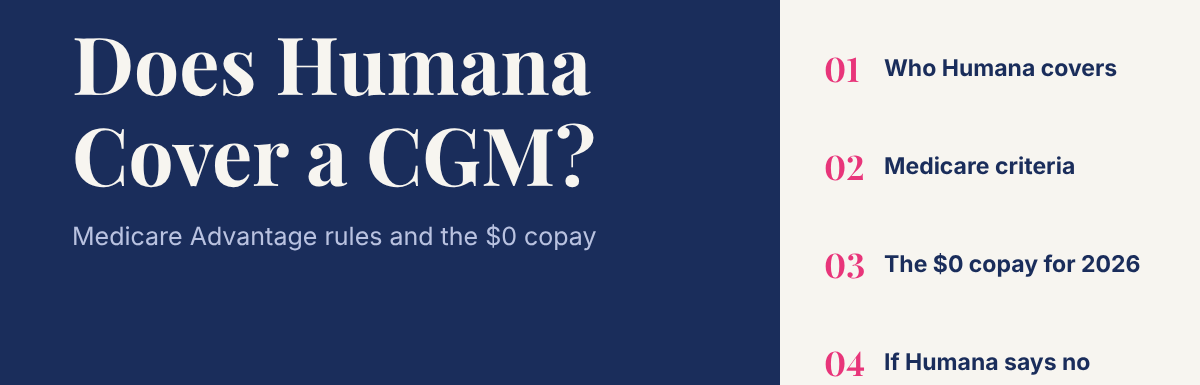
Quick answer: Yes. Most Humana members are in Medicare Advantage plans, and those plans cover continuous glucose monitors under Medicare’s rules: you have diabetes and either take insulin, with no minimum number of injections, or have documented problematic low blood sugar. For 2026, Humana told providers that members of its individual Medicare Advantage prescription drug plans can get Dexcom and FreeStyle Libre systems for a $0 copay at in-network pharmacies, as long as they meet Medicare’s criteria.
Humana is different from the other large insurers because it no longer sells employer medical plans. This page covers what that means, the Medicare criteria Humana applies, where to fill the prescription, and what to do if you are turned down. It is general education. It is not insurance, legal, or medical advice, and your plan’s Evidence of Coverage decides what is covered.
Information last checked: November 13, 2026.
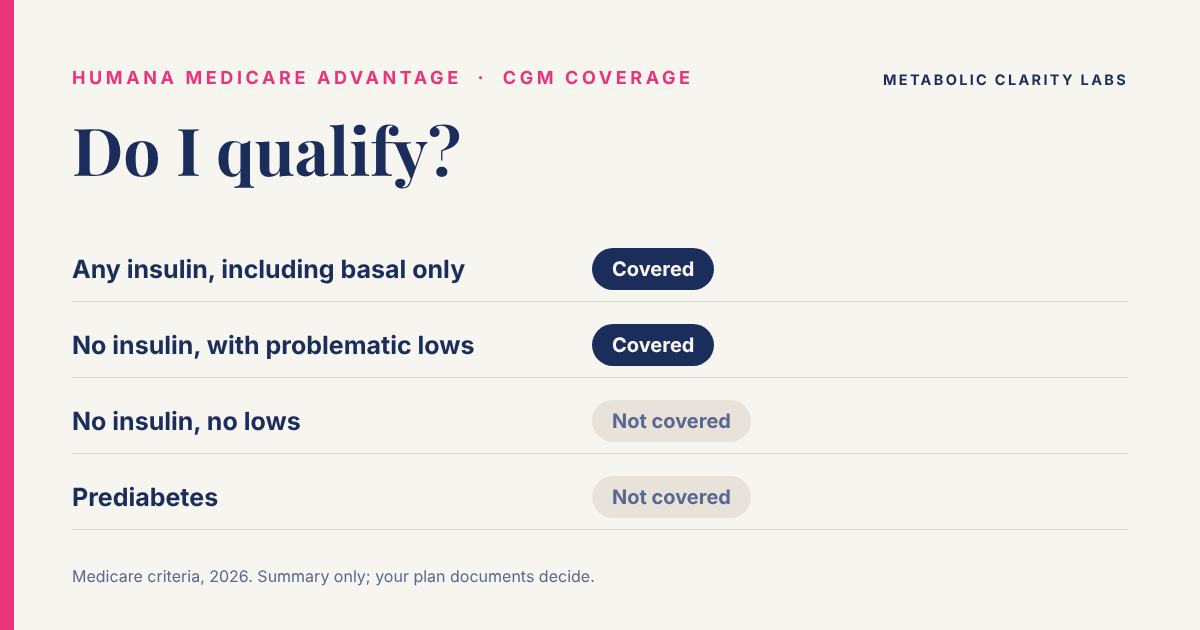
Do I qualify? A quick table
| Your situation | Humana Medicare Advantage | What to document |
|---|---|---|
| Type 1 or type 2, any insulin, including basal only | Covered under Medicare criteria | The insulin prescription and a visit in the past 6 months |
| Type 2, no insulin, with problematic lows | Covered under Medicare criteria | Repeated readings under 54 mg/dL despite treatment changes, or one severe low |
| Type 2, no insulin, no lows | Not covered | Consider an over-the-counter sensor |
| Prediabetes | Not covered | Consider an over-the-counter sensor |
Free tools: time in range calculator, GMI calculator and printable meal and CGM log.
Who Humana covers now
In February 2023, Humana announced it would leave the employer group commercial medical business, including fully insured, self-funded, and federal employee medical plans. That exit is complete. Today a person with Humana medical coverage is almost always in one of these:
- An individual Medicare Advantage plan, usually with drug coverage included.
- A group Medicare Advantage plan offered to retirees by a former employer, union, or state retirement system.
- A Humana Medicaid plan in a state where Humana holds a contract.
- TRICARE, where Humana Military administers the East region for the Defense Health Agency.
If you have an employer plan today and are comparing insurers, see the guides for Aetna, UnitedHealthcare, Cigna, Blue Cross Blue Shield, and Kaiser Permanente.
The Medicare criteria Humana applies
Medicare Advantage plans must cover what Original Medicare covers. Medicare’s CGM rule is set out in a coverage determination for glucose monitors, and Humana’s 2026 provider notice says members need to satisfy the Medicare criteria to get CGM supplies. In plain terms, Medicare covers a CGM when all of the following are true:
- You have diabetes.
- You are treated with insulin, or you have a history of problematic hypoglycemia.
- Your prescriber has seen you, in person or by an approved telehealth visit, within the six months before ordering the CGM, and has concluded the criteria are met.
- You or your caregiver have been trained to use the device.
- You continue to see your prescriber about every six months to review how the CGM and your treatment plan are working.
Medicare describes problematic hypoglycemia as recurrent level 2 lows, meaning glucose below 54 mg/dL, that continue despite more than one attempt to adjust medicines or the treatment plan, or at least one level 3 low, meaning a low with altered mental or physical state that needed another person’s help.
Two things stand out compared with employer plans. There is no minimum number of insulin injections, so a single daily dose of basal insulin qualifies. And there is no fingerstick-frequency requirement. Medicare dropped the old rule that required testing four times a day. Our Medicare CGM coverage guide has the full criteria and a worked cost example.
The $0 copay for 2026
A Humana notice to providers says that, effective January 1, 2026, CGM access for Medicare Advantage members expanded to include a $0 copay at in-network pharmacies, including CenterWell Pharmacy, Humana’s own mail-order and retail pharmacy. The notice lists these products:
| Product | Items listed at $0 copay |
|---|---|
| Dexcom G6 | Receiver, transmitter, and sensor |
| Dexcom G7 | Receiver and sensor |
| FreeStyle Libre 2 | Reader and sensor |
| FreeStyle Libre 3 | Reader and sensor |
| FreeStyle Libre 14 day | Reader and sensor |
The conditions matter:
- The member has to be enrolled in an individual Medicare Advantage plan with prescription drug coverage. Group plans are handled differently.
- The member has to use an in-network pharmacy.
- The member has to meet Medicare’s criteria. The notice says prior authorization may be required when a member’s use of CGM supplies is not consistent with those criteria.
Benefits are set plan by plan and year by year, so confirm the copay in your own plan’s Evidence of Coverage or by calling the number on your card. If your plan does not have the $0 benefit, CGMs fall under the Part B equipment cost share, which on many plans is a percentage of the price.
Group Medicare Advantage plans
Humana’s flyer for group Medicare Advantage members says therapeutic CGMs and supplies, such as Dexcom or FreeStyle Libre, are covered under the plan’s Part B medical benefit. Members can get them from a durable medical equipment provider that accepts Medicare and bills the plan, or from participating retail pharmacies. The flyer names two preferred equipment providers, CCS Medical and Edwards Healthcare. It tells new members to contact a provider or participating pharmacy once their Humana ID card arrives. Cost sharing for a group plan is whatever the former employer or retirement system negotiated, so check the plan documents. Some group plans advertise a $0 copay for CGMs and others apply coinsurance.
Pharmacy or medical supplier
You generally have two ways to fill a CGM prescription with Humana:
- An in-network pharmacy, at the counter or by mail through CenterWell Pharmacy. This is the route tied to the $0 copay on individual plans, and it is usually the fastest for a first fill.
- A national equipment supplier that ships to your home, typically in 90-day shipments. Some people prefer this for automatic refills.
Use one route at a time. Filling the same supplies through both a pharmacy and a supplier in the same period can cause a claim to be rejected as a duplicate.
Dexcom G7, Libre 3 Plus, Eversense, and Stelo
Does Humana cover the Dexcom G7?
Yes for members who meet Medicare’s criteria. The 2026 notice lists the Dexcom G7 receiver and sensor at a $0 copay at in-network pharmacies for individual Medicare Advantage drug plans. One Medicare detail to ask about: some plans and suppliers expect you to have the receiver, and not only the phone app, for the supplies to be billed as equipment. Ask Humana or your supplier whether that applies to you.
Does Humana cover FreeStyle Libre 3 Plus?
The notice lists FreeStyle Libre 2, Libre 3, and Libre 14 day. It does not name the Plus sensors, which Abbott has been moving users toward. Ask the pharmacy or Humana how Libre 2 Plus and Libre 3 Plus are handled on your plan before your prescriber writes the order.
Does Humana cover Eversense 365?
Medicare has a separate coverage determination for implantable CGMs, and Medicare Advantage plans follow it. Insertion and removal are done in a clinic and billed as procedures. Ask your endocrinology team whether they place it and what your plan’s cost share would be. See Eversense 365 vs. Dexcom G7.
Does Humana cover Stelo or Lingo?
These are sold without a prescription, and we found no Humana or Medicare source that covers them. Stelo was listed at $89 to $99 a month and Lingo at $89 for four weeks when we checked in November 2026. See Stelo vs. Lingo and CGM cost without insurance.
What you will pay
What a CGM costs with Humana depends on which kind of plan you have and where you fill it.
- Individual Medicare Advantage plan with drug coverage. The 2026 notice lists a $0 copay for the Dexcom and FreeStyle Libre items in the table above when you use an in-network pharmacy and meet Medicare’s criteria.
- Group Medicare Advantage plan. The CGM is a Part B benefit. Your cost share is whatever your retiree plan sets for Part B equipment or diabetic supplies. Some group plans set it at $0 and others charge a percentage.
- A plan without the $0 benefit, or an out-of-network pharmacy. Expect the plan’s durable medical equipment coinsurance, commonly a percentage of the plan’s price.
- The plan’s out-of-pocket maximum. Unlike Original Medicare, every Medicare Advantage plan caps your yearly in-network spending on covered medical services. Part B equipment counts toward it.
An illustration with invented prices, which are not Humana or Medicare figures:
| Illustration | How it is charged | Cost for 12 months |
|---|---|---|
| Individual plan with the $0 CGM copay, in-network pharmacy | 12 fills at $0 | $0 |
| Plan with 20% equipment coinsurance, plan price $250 a month | 12 months at $50 | $600 |
| Original Medicare with no supplement, approved amount $250 a month, yearly Part B deductible not yet met | Deductible first, then 20% | the deductible plus roughly $550 to $600 |
If you do not qualify under Medicare’s criteria, cash prices apply. Over-the-counter sensors ran about $89 to $99 a month when we checked in November 2026. See CGM cost without insurance.
Humana Medicare Advantage vs. Original Medicare
The eligibility rule is the same, because Medicare Advantage plans have to cover what Original Medicare covers. The differences are in how you get the device and what you pay.
| Humana Medicare Advantage | Original Medicare | |
|---|---|---|
| Who qualifies | Medicare criteria: insulin-treated, or problematic lows | Same |
| Where you get it | In-network pharmacy or the plan’s equipment suppliers | Any Medicare-enrolled supplier or pharmacy that bills Part B |
| Your cost | $0 on individual drug plans at in-network pharmacies in 2026; otherwise the plan’s cost share | Part B deductible, then about 20%, unless a Medigap plan pays it |
| Prior authorization | May be required when use is not consistent with Medicare criteria | None up front; the supplier must hold the documentation |
| Network | Matters | Does not apply |
For the full Original Medicare rules, see Medicare CGM coverage for type 2 and Medicare vs. private insurance.
Choosing a plan during open enrollment
Medicare’s annual enrollment period runs from October 15 to December 7 each year, and people already in a Medicare Advantage plan can make one change between January 1 and March 31. If you use a CGM, or expect to, check these before you choose or keep a plan:
- The CGM cost share in the plan’s Summary of Benefits or Evidence of Coverage. Look for continuous glucose monitor or diabetic monitoring supplies.
- Which brands and models are preferred. If you are settled on Dexcom or Libre, confirm your model is listed.
- Whether your pharmacy is in network, since the $0 copay depends on it.
- Whether your endocrinologist or primary care clinician is in network. You need a visit about every six months to keep coverage.
- Insulin costs, since most people who qualify for a CGM also take insulin. Medicare caps covered insulin at $35 a month per product.
Benefits change every January. A plan that had a $0 CGM copay this year may not next year, so read the Annual Notice of Change your plan sends each fall.
Type 2 not on insulin
Under Medicare’s rule, a person with type 2 diabetes who takes no insulin qualifies only with documented problematic hypoglycemia. That is most likely for people taking a sulfonylurea such as glipizide, glimepiride, or glyburide, which can cause lows, particularly in older adults or people with reduced kidney function. If you have lows, report each one to your clinician with the date and reading so they are in your chart. If you have none, Medicare coverage is unlikely, and an over-the-counter sensor is the usual alternative. See CGM coverage for type 2 when you are not on insulin.
Use among Humana’s insulin-treated members has grown quickly. Humana research published in March 2026 found that the share of its Medicare Advantage members with type 2 diabetes on insulin who used a CGM rose from fewer than 2 in 100 in January 2021 to about 1 in 6 by December 2023.
Humana Medicaid and TRICARE
- Humana Healthy Horizons (Medicaid). Medicaid coverage follows each state’s rules, and a number of states now cover CGMs for anyone using insulin. See Medicaid CGM coverage by state.
- TRICARE East. Humana Military administers the region, but TRICARE’s coverage policy is set by the Defense Health Agency, not by Humana. Check the TRICARE covered services page or call the regional contractor.
- Dual-eligible special needs plans. If you have both Medicare and Medicaid through a Humana plan, Medicare’s criteria apply first and Medicaid may pick up cost sharing.
What your prescriber needs to document
- The diabetes diagnosis.
- That you are treated with insulin, with the insulin named. If you are not, the dates and readings of lows below 54 mg/dL, the treatment changes made in response, and that lows continued, or the details of a severe low.
- A visit in the six months before the order where your diabetes control was evaluated.
- That you or a caregiver have been trained on the device.
- The device and quantity.
- For refills over time, a follow-up visit about every six months that notes you are using the CGM and following the plan.
The six-month visit is the item most often missing. If you have not been seen recently, book the visit before the order goes in.
If Humana says no
Medicare Advantage has its own appeal process. Ask for the denial in writing. You, your representative, or your prescriber can request a reconsideration from the plan within 65 days of the date on the notice, and you can ask for a fast decision if waiting could harm your health. If the plan upholds the denial, the case is sent automatically to an independent review organization. Free help is available from your State Health Insurance Assistance Program.
Why requests get denied, and the fix
| Reason given | What it usually means | What to do |
|---|---|---|
| Does not meet Medicare coverage criteria | The record does not show insulin treatment or problematic hypoglycemia | Have your prescriber document the insulin, or the lows with dates and readings |
| No qualifying visit | No in-person or approved telehealth visit in the six months before the order | Schedule a visit, then have the order rewritten |
| Continued coverage not documented | The six-month follow-up visit is missing | Have the visit and ask the office to send the note |
| Duplicate claim | Supplies were billed by both a pharmacy and a supplier | Choose one route and cancel the other |
| Out-of-network pharmacy or supplier | The pharmacy is not in your plan’s network | Move the prescription to an in-network pharmacy |
| Product not covered | The model is not on the plan’s list, or it is an over-the-counter sensor | Ask which models are covered and have the prescription changed |
New to Humana and already using a CGM
Humana’s group plan flyer tells new members who already use a CGM to contact an equipment provider or a participating pharmacy once their Humana ID card arrives. To avoid a gap:
- Ask your prescriber for a new prescription addressed to an in-network pharmacy or one of the plan’s suppliers.
- Make sure you have had a diabetes visit in the past six months, since the new plan will apply Medicare’s visit rule.
- If you are moving from an employer plan to Medicare at 65, remember the criteria change. Medicare does not require a set number of injections, which helps people on basal insulin. It also has no route for people who take no insulin and have no lows, even if a previous plan covered them.
- Refill before your old coverage ends if your plan allows it, so you have sensors on hand during the switch.
How Humana compares
| Insurer | Basal insulin only | No insulin |
|---|---|---|
| Humana Medicare Advantage | Covered | Only with problematic lows |
| Cigna (commercial) | Covered | One serious low in the past 6 months |
| UnitedHealthcare (commercial) | Only with documented serious lows | Only with documented serious lows |
| Aetna (commercial) | Not under the medical policy | Listed as unproven |
| Kaiser Permanente | Varies by region | Mid-Atlantic only, with severe lows |
Because Humana’s medical members are on Medicare or Medicaid, its CGM rules are among the easier ones to meet for anyone on insulin. Other insurers’ Medicare Advantage plans follow the same Medicare criteria, so the differences between Medicare Advantage carriers are mostly in cost and network, not eligibility. The full table is in CGM insurance coverage by insurer.
Sample appeal letter
Fill in the brackets and attach records. Ask your prescriber to send a supporting statement.
[Date]
Humana Grievances and Appeals
[Address from your denial notice]
Re: Request for reconsideration, continuous glucose monitor
Member: [Name], ID [number], Reference [number]
I am requesting reconsideration of the denial dated [date] for [device name]. The stated reason was [reason given].
Medicare covers a continuous glucose monitor for a beneficiary with diabetes who is insulin-treated or has a history of problematic hypoglycemia, when the treating practitioner has evaluated the beneficiary within six months before the order. I meet these criteria:
- I have [type 1 / type 2] diabetes.
- I take [insulin name and schedule], prescribed by [prescriber]. [Or: I have had glucose readings below 54 mg/dL on [dates], despite treatment changes on [dates]. Or: on [date] I had a severe low that required help from another person.]
- I was seen by [prescriber] on [date], within six months before the order.
- I have been trained to use the device.
My records are enclosed. Please approve the device and supplies.
Sincerely,
[Name, phone, address]
Questions to ask Humana
- Does my plan have the $0 copay for CGMs, and at which pharmacies?
- If not, what is my cost share for Part B equipment?
- Which Dexcom and FreeStyle Libre models are covered on my plan this year?
- Do I need prior authorization?
- Do I need the receiver or reader, or can I use my phone alone?
Frequently asked questions
Does Humana cover CGMs for type 2 diabetes?
Yes under Medicare’s criteria: you take insulin, including basal insulin only, or you have documented problematic hypoglycemia, and your prescriber has seen you in the past six months.
Is a CGM free with Humana?
Humana’s 2026 provider notice lists a $0 copay for Dexcom and FreeStyle Libre systems at in-network pharmacies for members of individual Medicare Advantage prescription drug plans who meet Medicare’s criteria. Confirm in your own plan documents.
Does Humana cover the Dexcom G7?
Yes when criteria are met. The 2026 notice lists the Dexcom G7 receiver and sensor.
Does Humana cover FreeStyle Libre 3?
Yes when criteria are met. The 2026 notice lists the FreeStyle Libre 3 reader and sensor, along with Libre 2 and Libre 14 day.
Does Humana require prior authorization for a CGM?
The notice says prior authorization may be required if a member’s use of CGM supplies is not consistent with Medicare’s criteria. Ask your plan.
Does Humana cover a CGM if I am not on insulin?
Only with a documented history of problematic hypoglycemia, as Medicare defines it.
Do I have to test four times a day to get a CGM from Humana?
No. Medicare removed the fingerstick-frequency requirement, and Medicare Advantage plans follow Medicare’s criteria.
Can I get my CGM at CVS or Walgreens with Humana?
If the pharmacy is in your plan’s network. The $0 copay applies at in-network pharmacies, including CenterWell Pharmacy. Check the pharmacy directory for your plan.
Does Humana still offer employer health insurance?
No. Humana announced in February 2023 that it would exit the employer group commercial medical business. It continues to offer Medicare, Medicaid, and military plans.
Does Humana cover a CGM for prediabetes?
No. Medicare’s criteria require diabetes.
Does Humana cover Stelo?
We found no source showing coverage for over-the-counter sensors. They are paid for out of pocket.
How do I appeal a Humana CGM denial?
Request a reconsideration from the plan within 65 days of the date on the denial notice. If the plan upholds the denial, an independent review organization looks at the case automatically.
Is CGM coverage the same on every Medicare Advantage plan?
Eligibility is, because every plan must follow Medicare’s criteria. Cost sharing, preferred brands, networks, and prior authorization steps differ by plan.
Does Humana cover a CGM if I only take one insulin shot a day?
Yes under Medicare’s criteria, which require insulin treatment without a minimum number of injections, along with a visit in the six months before the order.
How often do I need to see my doctor to keep my CGM with Humana?
About every six months. Medicare requires a follow-up visit, in person or by approved telehealth, to document that you are using the CGM and following your treatment plan.
When can I switch to a Humana plan with better CGM coverage?
During Medicare’s annual enrollment period, October 15 to December 7, for coverage starting January 1. People already in a Medicare Advantage plan can also make one change between January 1 and March 31.
Not insurance, legal or medical advice. Coverage rules change and are set by Medicare, Humana, and your plan. Metabolic Clarity Labs has no relationship with Humana or CenterWell.
Sources
- Humana provider notice, Medicare Advantage: continuous glucose monitors available with a $0 copay in 2026
- Humana Group Medicare Advantage member flyer on therapeutic CGM coverage under Part B (read it)
- CMS Medicare Coverage Database, Glucose Monitors Local Coverage Determination and policy article
- Humana news release on CGM use among Medicare Advantage members with type 2 diabetes (March 2026)
- Humana announcement of its exit from the employer group commercial medical business (February 23, 2023)
About the author: Charles Kirkland is the founder of Metabolic Clarity Labs and author of The Journey Back. He is not a physician. This is general education, not a medically reviewed treatment plan.
Sources checked November 13, 2026. Discuss personal decisions with a qualified clinician. Do not start, stop, or change prescribed treatment based on this article.