
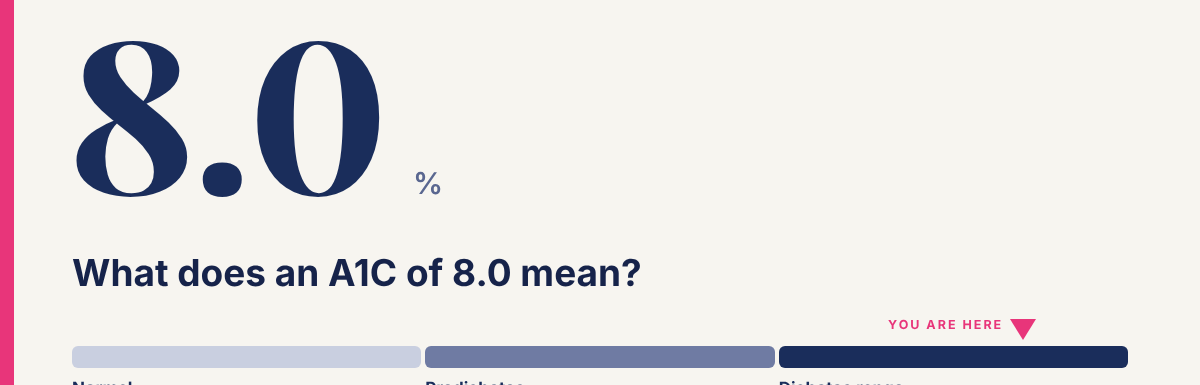
An A1C of 8.0% tends to arrive with a comment from the clinic along the lines of needs improvement. That is accurate for most adults, and it leaves out nearly everything you need to know. How high is 8.0 in terms of actual blood sugar? How urgent is it? Is it ever an acceptable number? And what normally happens at the next visit? This guide answers those questions plainly.
Quick answer: An A1C of 8.0% equals an estimated average glucose of about 183 mg/dL (10.2 mmol/L), or 64 mmol/mol. It is in the diabetes range and one full point above the goal used for many adults, which is below 7%. It is not an emergency level. For most adults it is a signal that the current plan needs to change. For some older adults and people with serious health conditions, a goal just under 8% is considered appropriate, which makes 8.0 the outer edge of acceptable. This article is educational and is not a substitute for your own clinician, especially on medication decisions.
Free tools: A1C chart with checker and high A1C: start here. Also see the A1C goal calculator and the A1C mmol/mol converter.
What average blood sugar 8.0 represents
The NGSP conversion is estimated average glucose in mg/dL = 28.7 x A1C – 46.7. For 8.0, that is 182.9, reported as 183 mg/dL.
| A1C (%) | A1C (mmol/mol) | Estimated average glucose (mg/dL) | Estimated average glucose (mmol/L) |
|---|---|---|---|
| 7.0 | 53 | 154 | 8.6 |
| 7.5 | 58 | 169 | 9.4 |
| 8.0 | 64 | 183 | 10.2 |
| 8.5 | 69 | 197 | 10.9 |
| 9.0 | 75 | 212 | 11.7 |
| 10.0 | 86 | 240 | 13.3 |
Each full point of A1C corresponds to about 29 mg/dL of average glucose. Moving from 8.0 to 7.0 therefore means lowering your around-the-clock average by roughly 29 mg/dL. That is a concrete target, and it is usually more reachable than the phrase one whole point makes it sound.
The 183 figure is an estimate. In the study behind the formula, people with an A1C of 8% had true average glucose values ranging from about 147 to 217 mg/dL. Use the A1C and average glucose calculator or the A1C to average glucose chart for other values. For the neighboring result, see what an A1C of 7.0 means.
What 8.0 looks like day to day
An average of 183 mg/dL means a meaningful part of each day is spent above 180. A common pattern at this level looks like this.
| Measure | Typical at an A1C near 8.0 | Usual goal for many adults |
|---|---|---|
| Fasting glucose on waking | About 140 to 175 mg/dL | 80 to 130 mg/dL |
| One to two hours after meals | Often 200 to 260 mg/dL | Below 180 mg/dL |
| CGM time in range (70 to 180 mg/dL) | Roughly half the day | More than 70% |
| CGM average glucose | About 183 mg/dL | About 154 mg/dL or lower |
These are typical values, and individuals differ. Around 180 mg/dL is also the level at which the kidneys begin to pass glucose into the urine in many people. That is why symptoms become more common at 8 than at 7: getting up at night to urinate, being thirstier than usual, tiredness after meals, and vision that blurs on and off. Plenty of people at 8.0 feel completely normal. Feeling fine is not evidence that the level is harmless, because the damage high glucose causes builds silently over years.
How serious is 8.0?
It helps to separate short-term danger from long-term risk.
Short term: an A1C of 8.0 is not an emergency. It does not by itself put you at risk of a diabetic crisis. Nothing needs to happen today other than making sure a visit is on the calendar.
Long term: risk rises with A1C in a smooth curve. In the UK Prospective Diabetes Study of people with type 2 diabetes, each one-point reduction in A1C was associated with about 37% fewer small-vessel complications of the eyes, kidneys, and nerves, about 21% fewer diabetes-related deaths, and about 14% fewer heart attacks. Those are associations across a large group, not a promise for one person. They do show why a clinician will want to act on 8.0 instead of watching it.
The same curve is also the encouraging part. You do not have to reach a perfect number to benefit. Going from 8.0 to 7.5 lowers risk. Going from 8.0 to 7.0 lowers it more. Every step counts, and the largest gains per point come from bringing down the higher values.
When 8.0 is above goal, and when it is acceptable
The American Diabetes Association glycemic goals guidance sets goals by the person, not by the disease.
| Who | Typical A1C goal | How 8.0 reads |
|---|---|---|
| Most nonpregnant adults with diabetes | Below 7% | One point above goal; the plan should change |
| Younger adults, recently diagnosed, decades of life ahead | Below 7%, sometimes below 6.5% | Clearly above goal; the years of exposure matter most here |
| Healthy older adults | About 7.0% to 7.5% | Somewhat above goal |
| Older adults with several chronic illnesses, mild to moderate cognitive impairment, or some dependence in daily activities | Below 8% | At the edge; often acceptable if stable and free of lows |
| Very complex health, end-stage illness, long-term care | Avoid symptoms and low blood sugar; A1C is secondary | May be entirely reasonable |
| History of severe low blood sugar or hypoglycemia unawareness | Often relaxed toward 8% | May be the safer place to be |
You may also see 8 used as a dividing line by health plans. Many quality programs count an A1C below 8% as controlled and an A1C above 9% as poorly controlled. Those are reporting categories for measuring clinics, not personal medical targets. Your goal is whatever you and your clinician agree on. See A1C goals by age.
Common reasons A1C reaches 8.0
- Undiagnosed until now. Type 2 diabetes develops slowly and can be present for years before a test picks it up.
- Natural progression. The pancreas tends to produce less insulin over time in type 2 diabetes. A plan that held A1C at 6.8 five years ago may not hold it today. That is the condition changing, not a personal failure.
- Doses missed or stopped. Side effects, cost, and complicated schedules are common reasons. All of them are fixable if your clinician knows.
- A plan that was never adjusted. It is well documented that treatment often stays the same for a year or more after A1C rises above goal. If nobody has revisited your plan, it is reasonable to ask.
- Other medicines. Steroids such as prednisone raise glucose substantially. Some antipsychotic medicines and certain other drugs can as well.
- Illness, infection, surgery, or major stress in the previous two to three months.
- Weight gain, less activity, or changes in eating, often after an injury, a job change, or a hard season of life.
- A different type of diabetes than assumed. Adults who were told they have type 2 but are lean, losing weight, and not responding to tablets are sometimes found to have a slow-onset autoimmune form.
If 8.0 is a new result
A first A1C of 8.0 is well inside the diabetes range, and normal lab variation cannot explain it away. The diagnosis is still formally confirmed with a second abnormal result unless you have classic symptoms with a very high glucose. A fasting glucose of 126 mg/dL or higher on the same report usually serves as that confirmation. See what a fasting blood sugar of 126 means and how the 6.5 threshold works.
After that, expect a baseline workup: a dilated eye exam, kidney tests in blood and urine, a foot exam, a lipid panel, blood pressure, and a referral to diabetes education. Because 8.0 is a point or more above the usual goal, clinicians commonly recommend starting medication at diagnosis alongside changes to eating and activity instead of trialing lifestyle changes alone. ADA guidance notes that starting two medicines together can be considered when A1C is 1.5 to 2 points above a person’s goal. Which medicines, and how many, is a decision for you and your prescriber. Read what to do in the first 30 days.
If you are on treatment and at 8.0
For most adults already on treatment, an 8.0 means the plan should be reviewed now, not at the visit after next. A useful review covers these points.
- Is the current medicine being taken as prescribed? If not, say why. Nausea from metformin, the cost of a newer drug, and fear of injections all have workarounds.
- What is the pattern? A week of fasting and after-meal readings, or two weeks of sensor data, shows whether the excess is overnight, after meals, or both.
- What has changed? New medicines, weight, sleep, activity, illness.
- What is the next step? Options include adjusting a dose, adding a medicine, switching to one with additional heart, kidney, or weight benefits, or starting or adjusting insulin. Guidelines advise against delaying this step when A1C is above goal.
- When is the recheck? About three months after a change.
For background on common medicines, see metformin in plain language and GLP-1 medications for type 2 diabetes. If cost or coverage of a sensor is the barrier to seeing your pattern, see CGM coverage for type 2 diabetes when you are not on insulin and Medicare CGM coverage.
Fasting or after meals: where the excess comes from
Research comparing glucose patterns across A1C levels has found a consistent shift. When A1C is close to 7, rises after meals account for most of the excess glucose. When A1C is above 10, high fasting and between-meal glucose account for most of it. Around 8, both contribute in roughly similar amounts.
The practical point is that at 8.0 you usually have two levers. Your waking number reflects what your liver released overnight and how well your baseline treatment is working. Your after-meal numbers reflect what and how much you ate, how active you were, and how your body handled the meal. Knowing which is further from goal tells you and your clinician where to concentrate.
| If this is highest | Often discussed |
|---|---|
| Waking glucose | Evening eating, sleep and sleep apnea, weight, medication dose and timing, basal insulin if used |
| After-meal glucose | Portions of starch and sugar, sweet drinks, order of foods, walking after meals, mealtime medicines |
| Both | A combination, usually including a medication change |
See high morning blood sugar and the dawn phenomenon, walking after meals, and the diabetes food guide.
How fast 8.0 can come down
A1C is weighted toward recent weeks. About half of the value reflects the last 30 days. If your true average glucose dropped today from 183 to 154 mg/dL and stayed there, a simplified model looks like this.
| When you test | Share of the change reflected | Approximate A1C |
|---|---|---|
| Before the change | 0% | 8.0% |
| After 1 month | About 50% | About 7.5% |
| After 2 months | About 75% | About 7.25% |
| After 3 to 4 months | Nearly all | About 7.0% |
Daily readings respond far sooner, within days of a medication change and within the same meal for food and activity changes. Use those to steer and the three-month A1C to confirm. See how quickly A1C can change.
Safety while your numbers improve
- Low blood sugar. If you take insulin or a sulfonylurea such as glipizide, glimepiride, or glyburide, eating less carbohydrate, losing weight, or exercising more can lower glucose enough to cause hypoglycemia. Tell your prescriber before making a significant change so doses can be adjusted. Know the symptoms: shakiness, sweating, hunger, a racing heart, confusion.
- Eyes. If you have not had a dilated eye exam in the past year, get one. When glucose improves substantially, clinicians like to know the starting condition of the retina. Vision can also blur temporarily as glucose levels shift, so it is usually best to wait until levels are steady before getting new glasses.
- Feet. Check them daily if you have reduced sensation.
- Do not stop or double medicines on your own in response to a single result.
When to call sooner
An A1C of 8.0 does not need urgent care. These situations do need prompt attention regardless of your A1C.
- Glucose readings that stay above 300 mg/dL
- High readings with vomiting, abdominal pain, rapid breathing, or confusion
- Moderate or large ketones, if you have been told to test for them
- Rapid unexplained weight loss with strong thirst and frequent urination
- A low reading below 54 mg/dL, or any low that required another person’s help
- A foot wound that is not healing, or sudden changes in vision
The other numbers to bring to the visit
Glucose is one of three numbers that drive long-term outcomes in diabetes. The other two are blood pressure and LDL cholesterol, and they respond well to treatment.
| Number | Usual goal with diabetes | Read more |
|---|---|---|
| Blood pressure | Below 130/80 mm Hg | Blood pressure of 130/80 and 140/90 |
| LDL cholesterol | Based on overall risk; lipid-lowering therapy is recommended for most adults aged 40 and older with diabetes | LDL of 130 and LDL of 160 |
| Kidney tests | Urine albumin-to-creatinine ratio below 30 mg/g, stable eGFR | How to read diabetes lab results |
Scenarios by situation
These are hypothetical illustrations, not case histories.
Age 48, new result of 8.0, fasting glucose 162, no prior diagnosis. Confirmed by two tests on one report. Expect a baseline workup and a conversation about starting medication now. At this age the goal is usually below 7.
Age 61, on metformin for six years, A1C drifted from 6.9 to 7.4 to 8.0. A steady climb on unchanged treatment points to progression. This is the standard moment to add a second medicine.
Age 83, heart failure and kidney disease, on basal insulin, A1C 8.0, no lows. For this person, 8.0 without hypoglycemia may be exactly where the care team wants it.
Age 55, A1C was 7.1, then three weeks of prednisone for a flare, now 8.0. Steroids are the likely explanation. The clinician may repeat the test in two to three months before changing long-term treatment.
Age 39, lean, losing weight without trying, A1C 8.0 despite two oral medicines. This picture should prompt a question about testing for an autoimmune form of diabetes.
Questions for your clinician
- What is my personal A1C goal, and how far is 8.0 from it?
- Is my excess mainly fasting, after meals, or both? How can we find out?
- What is the next change to my treatment, and what should I expect from it?
- Would a medicine with heart, kidney, or weight benefits make sense for me?
- If I change my eating or activity, which of my doses might need to come down?
- Could another medicine I take be raising my glucose?
- Am I due for eye, kidney, and foot checks?
- Can I be referred to diabetes education, and would a CGM help?
Bottom line by situation
| Situation | Bottom line |
|---|---|
| New result, never diagnosed | Diabetes range; confirm, get the workup, expect to discuss medication |
| On treatment, goal is below 7 | Above goal; ask for a plan change and a three-month recheck |
| Older adult with complex health, no lows | May be acceptable; confirm the goal with your clinician |
| Recent steroids or major illness | May be temporary; ask about a repeat test |
| Improving quickly on insulin or a sulfonylurea | Watch for lows; keep your prescriber informed |
| Readings above 300 or symptoms of a crisis | Seek care promptly |
Frequently asked questions
Is an A1C of 8.0 bad?
For most adults with diabetes it is about one point above the usual goal and a reason to adjust the plan. It is not an emergency, and for some older adults with complex health it can be an acceptable level.
What is the average blood sugar for an A1C of 8.0?
About 183 mg/dL, or 10.2 mmol/L, as an estimated average over the past two to three months.
What is 8.0% in mmol/mol?
About 64 mmol/mol.
Is an A1C of 8.0 dangerous?
It does not pose an immediate danger. Over years, an A1C at this level carries a higher risk of eye, kidney, and nerve complications than an A1C near 7, which is why treatment is usually adjusted.
Do I need insulin with an A1C of 8.0?
Not necessarily. Many people at 8.0 are managed with non-insulin medicines. Insulin is more often considered at much higher levels, with symptoms of high blood sugar, or in type 1 diabetes. Your prescriber decides this with you.
How long does it take to lower A1C from 8 to 7?
If average glucose falls by about 29 mg/dL and stays there, roughly half the change appears in a month and nearly all of it by three to four months.
Can an A1C of 8.0 be lowered without more medication?
Changes in eating, activity, weight, and sleep can lower A1C, and how much varies between people. At a point above goal, most guidelines recommend combining lifestyle changes with a medication review instead of relying on one alone.
Is 8.0 OK for an older person?
It can be. For older adults with multiple health conditions or a risk of falls and low blood sugar, a goal of below 8% is commonly used, and 8.0 without lows may be reasonable.
Will I have symptoms at 8.0?
Some people notice thirst, frequent urination, fatigue, or blurred vision. Many notice nothing, which does not mean the level is harmless.
What should my blood sugar readings be if my A1C is 8.0?
At 8.0, fasting readings are often 140 to 175 mg/dL and after-meal readings often exceed 200. Common goals are 80 to 130 before meals and below 180 after meals.
How often should A1C be checked at 8.0?
About every three months until you are at your goal, then at least twice a year.
Why is my A1C 8.0 when I take my medication?
Type 2 diabetes often progresses, so a treatment that worked before may no longer be enough. Other medicines, illness, and weight changes can also raise it. It is a reason to review the plan, not a sign you did something wrong.
Does one A1C of 8.0 mean I have complications?
No. Complications depend on how high glucose has been and for how long, along with blood pressure and other factors. Screening exams for eyes, kidneys, and feet show where you stand.
Is 8.0 worse than 7.9?
Not in any meaningful way. A tenth of a point is within normal test variation. Look at the trend across several tests.
About the author: Charles Kirkland is the founder of Metabolic Clarity Labs and author of The Journey Back. He is not a physician. This is general education, not a medically reviewed treatment plan.
Sources checked November 12, 2026: American Diabetes Association Standards of Care, NGSP, NIDDK, and the UK Prospective Diabetes Study. Do not start, stop, or change prescribed treatment based on this article.