
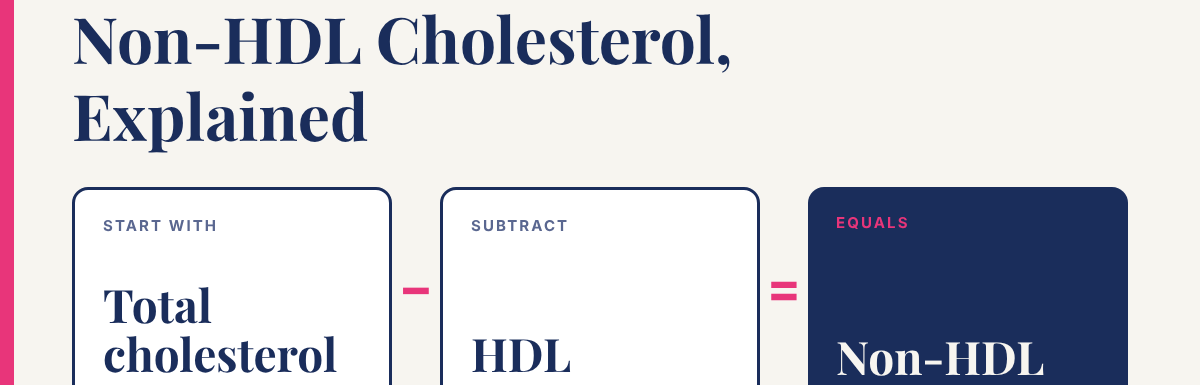
Non-HDL cholesterol is not printed on every lab report, yet it can be worked out from two numbers that are. It takes one subtraction, needs no fasting, and many clinicians consider it a better guide to risk than LDL alone, particularly when triglycerides are high.
Quick answer: Non-HDL cholesterol is your total cholesterol minus your HDL cholesterol. It captures all the cholesterol carried in particles that can build up in artery walls, not only LDL. A common rule of thumb is that your non-HDL goal sits 30 mg/dL above your LDL goal, and below 130 mg/dL is often used as a general target for adults without added risk. Your own target depends on your overall risk. This is education, not medical advice.
Free tools: Cholesterol levels chart with checker and LDL cholesterol calculator.
What non-HDL cholesterol is
Cholesterol travels in the blood inside several kinds of particles. HDL is the one generally associated with lower risk. All the others, LDL, VLDL, the remnants left as VLDL is broken down, and lipoprotein(a), can deposit cholesterol in artery walls. Non-HDL cholesterol is the cholesterol carried by all of those together.
An LDL number counts only one of them. When triglycerides are normal, LDL makes up most of non-HDL and the two tell a similar story. When triglycerides are high, more cholesterol is riding in VLDL and remnants, and LDL alone understates the total.
How to calculate it
Non-HDL cholesterol = total cholesterol – HDL cholesterol
| Example | Total | HDL | Math | Non-HDL |
|---|---|---|---|---|
| A | 180 | 55 | 180 – 55 | 125 mg/dL |
| B | 210 | 45 | 210 – 45 | 165 mg/dL |
| C | 240 | 38 | 240 – 38 | 202 mg/dL |
If your report uses mmol/L, the same subtraction applies. The complete cholesterol numbers calculator does this for you and adds remnant cholesterol and common ratios from the same panel.
Because neither total nor HDL cholesterol changes much after a meal, non-HDL can be calculated from a nonfasting sample. That is one of its practical advantages.
What the ranges mean
There is no single cutoff that applies to everyone. Targets are usually set from your LDL goal, with non-HDL 30 mg/dL higher.
| If your LDL goal is | Your non-HDL goal is about | Typically applies to |
|---|---|---|
| Below 100 mg/dL | Below 130 mg/dL | Many adults without established heart disease |
| Below 70 mg/dL | Below 100 mg/dL | People at high risk, including many with diabetes or known artery disease |
| Lower still | 30 mg/dL above the LDL goal | People at very high risk, as set by their clinician |
A non-HDL of 220 mg/dL or higher is the counterpart of an LDL of 190 mg/dL or higher and often points to an inherited cause. Ask your clinician which target applies to you.
Non-HDL vs LDL
| LDL cholesterol | Non-HDL cholesterol | |
|---|---|---|
| What it counts | Cholesterol in LDL particles | Cholesterol in all particles except HDL |
| How it is obtained | Usually calculated using triglycerides; sometimes measured directly | One subtraction from two measured values |
| Fasting needed | Sometimes, because the calculation depends on triglycerides | No |
| Reliable when triglycerides are high | Less so | Yes |
| Used in guidelines | Primary target | Secondary target and in risk assessment |
Most labs estimate LDL with a formula that subtracts HDL and a fraction of triglycerides from total cholesterol. When triglycerides are high, that estimate becomes less accurate, and above 400 mg/dL the traditional formula is not used at all. Non-HDL has no such weakness.
When it is most useful
- Triglycerides are raised. Common with insulin resistance, prediabetes, type 2 diabetes, and fatty liver.
- The test was not fasting.
- LDL looks fine but your risk does not. A normal LDL with high triglycerides and low HDL can hide a high non-HDL.
- You want one number to follow over time that reflects both LDL and triglyceride-related particles.
Here is how the same LDL can sit alongside very different non-HDL values:
| Person 1 | Person 2 | |
|---|---|---|
| Total cholesterol | 190 | 215 |
| HDL | 55 | 40 |
| Triglycerides | 100 | 250 |
| Calculated LDL (total – HDL – triglycerides / 5) | 190 – 55 – 20 = 115 | 215 – 40 – 50 = 125 |
| Non-HDL (total – HDL) | 135 | 175 |
The two LDL values are 10 points apart. The non-HDL values are 40 points apart. Person 2 is carrying far more cholesterol in triglyceride-rich particles, and LDL alone does not show it.
Related numbers: remnant cholesterol and ApoB
- Remnant cholesterol is non-HDL minus LDL. It estimates the cholesterol in VLDL and its remnants. In the table above it is 20 mg/dL for Person 1 and 50 mg/dL for Person 2. See what is remnant cholesterol.
- ApoB is a separate blood test that counts the particles themselves, since each carries one ApoB protein. Non-HDL estimates the same thing from a standard panel at no extra cost.
- Triglyceride to HDL ratio is a different kind of marker, used as a rough signal of insulin resistance. See the triglyceride to HDL ratio calculator.
What lowers non-HDL cholesterol
Non-HDL falls when either LDL or triglyceride-rich particles fall, so it responds to both kinds of change.
- Statins and other cholesterol medicines, within weeks.
- Less saturated fat and more soluble fiber, which lower LDL.
- Less sugar, refined starch, and alcohol, which lower triglycerides.
- Weight loss and regular activity, which help both.
- Better glucose control, which lowers triglycerides in people with diabetes.
Retest timing is covered in how quickly cholesterol can change and how quickly triglycerides can change. If you take insulin or a sulfonylurea, changes in eating can cause low blood sugar, so plan them with your prescriber.
Questions for your clinician
- What is my non-HDL cholesterol, and what should it be for my level of risk?
- Is my LDL calculated or measured directly?
- Given my triglycerides, which number should we follow?
- Would an ApoB test add anything?
- How often should my panel be repeated?
How to track it over time
Because non-HDL needs only two numbers that appear on every lipid panel, you can work it out for every past test you have. A simple table shows the trend more clearly than any single result.
| Test date | Total | HDL | Non-HDL | Triglycerides | Note |
|---|---|---|---|---|---|
| January | 228 | 41 | 187 | 240 | Baseline |
| April | 204 | 44 | 160 | 160 | Less alcohol and sugar, walking daily |
| October | 186 | 47 | 139 | 120 | Lost weight; weight now stable |
In this example non-HDL fell by 48 points across the year, from 187 to 139. Most of that came from fewer triglyceride-rich particles, which the triglyceride column confirms. LDL alone would have shown a smaller change and hidden most of the progress.
Tips for a fair comparison:
- Use the same lab when you can.
- Test when you are well and your weight is steady.
- Record what changed between tests.
- Look at the direction across three or more results, not the gap between two.
Scenarios by situation
These are hypothetical illustrations, not case histories.
LDL 105, triglycerides 280, HDL 36, total 197. Non-HDL is 197 – 36 = 161. The LDL looks close to fine, but non-HDL shows a large amount of cholesterol in triglyceride-rich particles. This is the situation non-HDL was designed to catch.
LDL 150, triglycerides 80, HDL 60, total 226. Non-HDL is 166, only 16 points above LDL. Here LDL tells nearly the whole story, and the issue is LDL itself. See high LDL with normal triglycerides.
Nonfasting test at a health fair: total 215, HDL 50. Non-HDL is 165 and is valid without fasting. It is a useful first screen that can be followed with a full panel.
Triglycerides 520; the lab did not report an LDL. The standard LDL formula is not used at this level. Non-HDL can still be calculated and followed while the triglycerides are addressed. Very high triglycerides need a clinician’s attention.
Type 2 diabetes, LDL at goal on a statin, non-HDL still 40 points above LDL. The remaining gap comes from triglyceride-rich particles. Glucose control, weight, alcohol, and sometimes additional medication are what the clinician looks at next.
Common mistakes
- Looking only at LDL when triglycerides are raised.
- Comparing your non-HDL with an LDL target. Non-HDL targets are about 30 points higher.
- Confusing non-HDL with the total-to-HDL ratio. One is a subtraction, the other a division.
- Assuming a normal total cholesterol means a normal non-HDL. A low HDL can hide a high non-HDL.
- Mixing units. Keep everything in mg/dL or everything in mmol/L.
- Treating one calculation as a diagnosis.
Bottom line by situation
| Situation | Bottom line |
|---|---|
| Triglycerides normal | LDL and non-HDL agree; either works |
| Triglycerides raised | Follow non-HDL as well as LDL |
| Nonfasting test | Non-HDL is still valid |
| LDL not reported | Use non-HDL |
| Non-HDL much higher than LDL | Work on what drives triglycerides |
| Non-HDL 220 or higher | See a clinician; may be inherited |
| Want a direct particle count | Ask about ApoB |
Frequently asked questions
What is a normal gap between non-HDL and LDL?
When triglycerides are normal, non-HDL is usually within about 30 mg/dL of LDL. A larger gap means more cholesterol is being carried in triglyceride-rich particles.
Why is non-HDL cholesterol not on my lab report?
Some labs print it and some do not. You can calculate it yourself by subtracting HDL from total cholesterol, both of which are always reported.
Can non-HDL cholesterol be too low?
Very low values are uncommon outside of treatment and are generally not a concern in people taking cholesterol-lowering medicine under supervision. Ask your clinician if yours is unusually low without explanation.
Does non-HDL include triglycerides?
Not directly. It measures cholesterol, not triglycerides. It does include the cholesterol inside triglyceride-rich particles, which is why it rises when triglycerides are high.
What is a good non-HDL cholesterol level?
It depends on your risk. A common approach sets the non-HDL goal 30 mg/dL above your LDL goal, so below 130 mg/dL for many adults and below 100 mg/dL for people at high risk. Ask your clinician for your target.
How do I calculate non-HDL cholesterol?
Subtract HDL cholesterol from total cholesterol. For example, a total of 210 and an HDL of 45 gives a non-HDL of 165 mg/dL.
Is non-HDL cholesterol the same as LDL?
No. LDL is one part of non-HDL. Non-HDL also includes cholesterol in VLDL, remnants, and lipoprotein(a), so it is always higher than LDL.
Is non-HDL better than LDL?
It is a broader measure and holds up better when triglycerides are high or the sample was not fasting. LDL remains the main treatment target in guidelines. Many clinicians look at both.
Do I need to fast for non-HDL cholesterol?
No. Total and HDL cholesterol change little after eating, so non-HDL can be calculated from a nonfasting test.
Why is my non-HDL high when my LDL is normal?
Usually because triglycerides are raised, which means more cholesterol is being carried in VLDL and remnant particles. That pattern is common with insulin resistance.
How quickly can non-HDL cholesterol change?
Within weeks. It responds to medication over about a month and to changes in eating, alcohol, and weight over several weeks.
What is the difference between non-HDL and ApoB?
Non-HDL measures the amount of cholesterol carried by risk-related particles. ApoB counts the particles. They usually agree, and non-HDL comes free with a standard panel.
About the author: Charles Kirkland is the founder of Metabolic Clarity Labs and author of The Journey Back. He is not a physician. This is general education, not a medically reviewed treatment plan.
Reviewed November 12, 2026. Do not start, stop, or change prescribed treatment based on this article.