
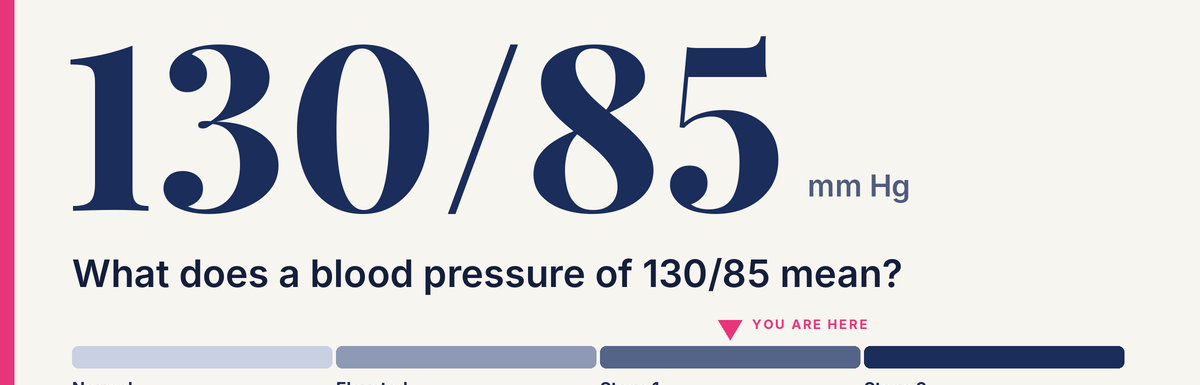
A blood pressure of 130/85 turns up in two different places. On a blood pressure chart it falls in stage 1 hypertension. In the definition of metabolic syndrome it is the exact line that decides whether blood pressure counts as one of the five criteria. If your reading is around 130/85, both meanings apply to you, and the second one is the reason this number deserves its own explanation.
Quick answer: A blood pressure of 130/85 mm Hg is stage 1 hypertension under US guidelines, because the systolic is at 130 and the diastolic is between 80 and 89. European guidelines call the same reading high-normal. It is also the threshold for the blood pressure criterion of metabolic syndrome: a systolic of 130 or higher, or a diastolic of 85 or higher, or being on blood pressure treatment. One reading is not a diagnosis. Confirm it with a week of home measurements, then look at your waist, triglycerides, HDL cholesterol, and fasting glucose to see whether it is part of a pattern. This is education, not medical advice.
Free tools: Blood pressure chart with checker and printable blood pressure log.
One reading, two meanings
| Framework | What 130/85 is | What it triggers |
|---|---|---|
| US blood pressure guideline | Stage 1 hypertension | Confirmation, a risk assessment, and lifestyle changes or medication depending on risk |
| European blood pressure guidelines | High-normal or elevated | Lifestyle advice, with treatment considered at high cardiovascular risk |
| Metabolic syndrome definition | The cut point for the blood pressure criterion | A check of the other four criteria |
Where 130/85 fits on the blood pressure chart
These are the categories in the American Heart Association and American College of Cardiology guideline, kept unchanged in the 2025 update.
| Category | Systolic (top number) | Diastolic (bottom number) | |
|---|---|---|---|
| Normal | Below 120 | and | Below 80 |
| Elevated | 120 to 129 | and | Below 80 |
| Stage 1 hypertension | 130 to 139 | or | 80 to 89 |
| Stage 2 hypertension | 140 or higher | or | 90 or higher |
At 130/85, the systolic is at the bottom of the stage 1 range and the diastolic is in the middle of it. The European Society of Hypertension uses a category called high-normal for 130 to 139 over 85 to 89, and 130/85 is its lowest reading. Under that system, hypertension begins at 140/90. The different names describe the same level of risk: above ideal, below the level where every guideline recommends medication.
130/80, 130/85, and 135/85: three lines that get confused
| Number | Where it comes from | What it is used for |
|---|---|---|
| 130/80 | US blood pressure guideline | Start of stage 1 hypertension, and the treatment goal (below 130/80) |
| 130/85 | Metabolic syndrome definition; also the start of high-normal in European guidelines | Deciding whether blood pressure counts as a metabolic syndrome criterion |
| 135/85 | Home blood pressure monitoring | The home average considered equivalent to 140/90 in a clinic |
| 140/90 | All major guidelines | Hypertension by every definition; stage 2 in the US |
The diastolic value of 85 appears in two of those rows for unrelated reasons, and that is the usual source of confusion. A home average of 135/85 is not a mildly raised reading. It corresponds to 140/90 in the office. A clinic reading of 130/85 is a stage 1 reading. See what 130/80 means and what 140/90 means.
130/85 and metabolic syndrome
Metabolic syndrome is a cluster of five measurements that tend to rise together and that, in combination, signal a higher risk of type 2 diabetes and cardiovascular disease. The National Heart, Lung, and Blood Institute describes the criteria. Meeting any three of the five defines the syndrome.
| Criterion | Cut point | Read more |
|---|---|---|
| Blood pressure | Systolic 130 or higher, or diastolic 85 or higher, or on treatment for high blood pressure | This page |
| Waist circumference | Over 40 inches (102 cm) in men, over 35 inches (88 cm) in women, with lower cut points for some ethnic groups | How to measure your waist |
| Triglycerides | 150 mg/dL or higher, or on treatment | Triglyceride levels explained |
| HDL cholesterol | Below 40 mg/dL in men, below 50 mg/dL in women, or on treatment | Low HDL explained |
| Fasting glucose | 100 mg/dL or higher, or on treatment | Fasting blood sugar of 100 to 110 |
Three details about the blood pressure criterion are worth knowing.
- Either number counts. A reading of 132/78 meets it on the systolic. A reading of 124/86 meets it on the diastolic.
- Treatment counts. If you take blood pressure medication and your reading is 118/74, the criterion is still met, because the definition includes people whose blood pressure is controlled by treatment.
- The line is older than the current blood pressure categories. It was set in 2001, when 130 to 139 over 85 to 89 was the category called high-normal. US blood pressure guidelines later moved their own line to 130/80, but the metabolic syndrome definition kept 130/85.
Why blood pressure travels with the other four
The five criteria are not a random list. They share underlying drivers, and insulin resistance with excess fat around the abdominal organs is thought to be central.
- Sodium retention. Insulin signals the kidneys to hold on to sodium. When insulin levels run high to overcome resistance, more sodium and water are retained, which raises pressure.
- Nervous system activation. Higher insulin levels and abdominal fat are associated with a more active sympathetic nervous system, which tightens blood vessels and raises heart rate.
- Stiffer, less responsive vessels. Insulin normally helps blood vessels relax. With resistance, that effect is blunted.
- Hormones from fat tissue. Abdominal fat produces substances that promote inflammation and activate the hormone system that regulates blood pressure.
- Sleep apnea. It is common with abdominal weight gain and raises both blood pressure and glucose.
This is why a blood pressure in the low 130s over mid 80s in a person with a growing waistline is often an early sign, appearing before glucose crosses any threshold. See blood pressure and insulin resistance, blood pressure and belly fat, and metabolic syndrome and sleep apnea.
Counting your criteria
You need four more measurements to know where you stand: waist circumference, and a fasting lipid panel and glucose from a blood test. Then count.
| Criteria met, including blood pressure | How to read it |
|---|---|
| 1 (blood pressure only) | A blood pressure question. Follow the blood pressure guidance. |
| 2 | Not metabolic syndrome, but one step away. Worth acting on now. |
| 3 | Meets the definition of metabolic syndrome. |
| 4 or 5 | Metabolic syndrome with a higher overall risk; a thorough plan is warranted. |
The metabolic syndrome calculator does the count for you, and the metabolic health numbers decoder explains each result. Related tools include the triglyceride-to-HDL ratio calculator and the waist-to-height ratio calculator.
What meeting three criteria means
About one in three US adults meets the definition, so it is common. In pooled studies, people with metabolic syndrome have roughly twice the risk of cardiovascular disease over the following five to ten years and about five times the risk of developing type 2 diabetes, compared with people who do not meet it.
Metabolic syndrome is best understood as a way of noticing a pattern. It is not a separate disease with its own medicine. Each component is managed according to its own guideline, and the combination tells you and your clinician that the root causes deserve attention, because one set of changes can improve all five numbers. See the guide to metabolic syndrome and why most people have no symptoms.
When the bottom number is the higher one
A reading such as 124/86 or 128/88, where the diastolic is out of range and the systolic is not, is called isolated diastolic hypertension. It is most common in adults under 50 and is associated with higher body weight, regular alcohol use, and sleep apnea. In younger adults the arteries are still elastic, so resistance in the small vessels shows up in the bottom number first.
Guidelines classify it by the higher category, so a diastolic of 85 with a normal systolic is stage 1. The long-term risk attached to isolated diastolic elevation at this level appears smaller than that of raised systolic pressure, but people with it are more likely to develop systolic hypertension later. It is a reason to work on contributing habits and keep measuring. See systolic vs diastolic blood pressure.
Confirming the reading
Stage 1 readings are especially sensitive to how they are taken, because errors of 5 to 10 points are common and the whole category is only 10 points wide.
- Rest seated for five minutes, back supported, feet flat, arm supported at heart level.
- Use a cuff that fits your arm, on bare skin.
- No caffeine, nicotine, or exercise for 30 minutes beforehand. Empty your bladder.
- Do not talk during the reading.
- Take two readings a minute apart, morning and evening, for seven days, and average them.
At this level, home and clinic readings correspond closely, so a home average of 130/85 can be read at face value. See how to take your blood pressure at home, how to calculate your average, choosing a validated monitor, and the blood pressure average calculator. If clinic and home readings disagree, see white coat and masked hypertension.
What guidelines recommend at this level
For confirmed stage 1 hypertension, the 2025 US guideline bases the next step on your overall cardiovascular risk and other conditions.
| Your situation | Recommendation |
|---|---|
| No diabetes, kidney disease, or cardiovascular disease, and 10-year risk below 7.5% | Lifestyle changes for three to six months; medication if the average remains 130/80 or higher |
| 10-year risk of 7.5% or higher | Lifestyle changes plus medication |
| Diabetes, chronic kidney disease, or existing cardiovascular disease | Lifestyle changes plus medication |
Metabolic syndrome is not a line in that table by name. Its components feed into the risk calculation, though, and a person who meets several of them is more likely to land above the 7.5% line. If your fasting glucose or A1C has reached the diabetes range, the recommendation changes. See what an A1C of 6.5 means.
Changes that move all five numbers
The advantage of seeing 130/85 as part of a cluster is that you do not need five separate plans.
| Change | Blood pressure | Waist | Triglycerides | HDL | Fasting glucose |
|---|---|---|---|---|---|
| Losing 5% to 10% of body weight | Lower | Lower | Lower | Slightly higher over time | Lower |
| Regular aerobic exercise | Lower | Lower | Lower | Slightly higher | Lower |
| Resistance training | Lower | Lower | Small effect | Small effect | Lower |
| DASH or Mediterranean-style eating | Lower | Lower with weight loss | Lower | Neutral to higher | Lower |
| Less sodium | Lower | No effect | No effect | No effect | No effect |
| Fewer sweet drinks and refined carbohydrates | Small effect | Lower | Lower | Neutral to higher | Lower |
| Less alcohol | Lower | Lower | Lower | Varies | Varies |
| Treating sleep apnea, sleeping seven hours or more | Lower | Indirect | Indirect | Indirect | Lower |
The table shows the usual direction of effect in studies. The size varies from person to person. Weight loss around the waist is the one change that reliably improves every column, which is why it sits at the center of most plans. For blood pressure specifically, average effects in trials are about 1 point of systolic pressure per kilogram lost, 5 to 8 points from regular aerobic exercise, and up to about 11 points from a DASH-style eating pattern. See the metabolic syndrome diet, diet for high blood pressure, a 7-day meal plan, and sodium and blood pressure.
How soon each number responds
| Number | Typical time to see a change | Read more |
|---|---|---|
| Blood pressure | One to four weeks for sodium and exercise; longer for weight loss | How quickly blood pressure can change |
| Triglycerides | Days to a few weeks | How quickly triglycerides can change |
| Fasting glucose | Days to weeks | How quickly fasting blood sugar can change |
| Waist | Weeks to months | Waist-to-height ratio chart |
| HDL cholesterol | Months, and the slowest to move | How quickly cholesterol can change |
Scenarios by situation
These are hypothetical illustrations, not case histories.
Age 41, home average 130/85, waist 34 inches, normal lipids and glucose. One criterion. This is a stage 1 blood pressure question in a low-risk person: lifestyle changes for three to six months and a recheck.
Age 49, 132/86, waist 43 inches, triglycerides 220, HDL 36, fasting glucose 97. Four criteria. Metabolic syndrome, with blood pressure as one visible part of it. The plan centers on weight around the waist, activity, and food pattern, with each number followed.
Age 55, on a blood pressure medicine, reading 122/76, fasting glucose 108, triglycerides 165. The blood pressure criterion is met through treatment, so this is three criteria even though the reading is normal.
Age 33, 124/88, drinks most evenings, snores. Isolated diastolic elevation with two likely contributors. Reducing alcohol and getting checked for sleep apnea are the first steps.
Age 60, clinic 130/85, home average 118/74. White coat effect. By home readings, blood pressure is normal and the criterion is not met.
Questions for your clinician
- Is 130/85 confirmed by my home readings?
- Can I have a fasting lipid panel and glucose, and can we measure my waist?
- How many metabolic syndrome criteria do I meet?
- What is my 10-year cardiovascular risk?
- Are you recommending lifestyle changes first, and when do we reassess?
- Should I be screened for sleep apnea or fatty liver?
- Which single change would do the most for my particular pattern?
Bottom line by situation
| Situation | Bottom line |
|---|---|
| One reading of 130/85 | Confirm at home before anything else |
| Confirmed 130/85, no other criteria | Stage 1; lifestyle changes and a recheck in three to six months if low risk |
| 130/85 plus one other criterion | One step from metabolic syndrome; act on the shared causes |
| 130/85 plus two or more other criteria | Metabolic syndrome; one plan aimed at waist, activity, and food |
| On blood pressure treatment with a normal reading | Still counts as the blood pressure criterion |
| Home average 135/85 | Equivalent to 140/90 in a clinic; see a clinician |
Frequently asked questions
Is a blood pressure of 130/85 high?
Under US guidelines it is stage 1 hypertension. European guidelines call it high-normal. It is above ideal and not dangerous in the short term.
Is 130/85 normal?
Not by current US categories, where normal is below 120/80.
Does 130/85 mean I have metabolic syndrome?
Not on its own. It meets one of five criteria. Metabolic syndrome requires three, so you need your waist measurement, triglycerides, HDL cholesterol, and fasting glucose to know.
Why does metabolic syndrome use 130/85 and not 130/80?
The definition was written in 2001, when 130 to 139 over 85 to 89 was the high-normal category. Blood pressure guidelines later changed, and the metabolic syndrome definition kept its original cut point.
Does it count if only my bottom number is 85?
Yes. A systolic of 130 or higher or a diastolic of 85 or higher meets the criterion.
Does it count if my blood pressure is normal on medication?
Yes. Being on treatment for high blood pressure meets the criterion regardless of the reading.
Do I need medication for 130/85?
Often not at first. Low-risk adults are advised to try lifestyle changes for three to six months. Medication is recommended sooner with diabetes, kidney disease, cardiovascular disease, or higher calculated risk.
Is a diastolic of 85 bad?
It is in the stage 1 range. On its own, with a normal systolic, it carries a modest increase in long-term risk and is a reason to address weight, alcohol, and sleep.
What is the difference between 130/85 and 135/85?
A clinic reading of 130/85 is stage 1. A home average of 135/85 is the equivalent of 140/90 in a clinic, which is stage 2.
Can 130/85 be lowered naturally?
Lifestyle measures lower blood pressure by several points each on average, including weight loss, regular exercise, less sodium, a DASH-style eating pattern, and less alcohol.
How common is metabolic syndrome?
About one in three US adults meets the definition.
What risk comes with metabolic syndrome?
In pooled studies, roughly double the risk of cardiovascular disease and about five times the risk of type 2 diabetes, compared with people who do not meet the definition.
Is 130/85 OK for someone over 60?
The categories are the same at every adult age. Risk at a given blood pressure is higher in older adults, though goals are individualized for those who are frail.
How do I check whether my 130/85 is accurate?
Take two readings each morning and evening for seven days with a validated upper-arm cuff, using correct technique, and average them.
About the author: Charles Kirkland is the founder of Metabolic Clarity Labs and author of The Journey Back. He is not a physician. This is general education, not a medically reviewed treatment plan.
Sources checked November 12, 2026: the 2025 AHA/ACC high blood pressure guideline, NHLBI, the European Society of Hypertension, and the 2009 joint statement on metabolic syndrome. Do not start, stop, or change prescribed treatment based on this article.