
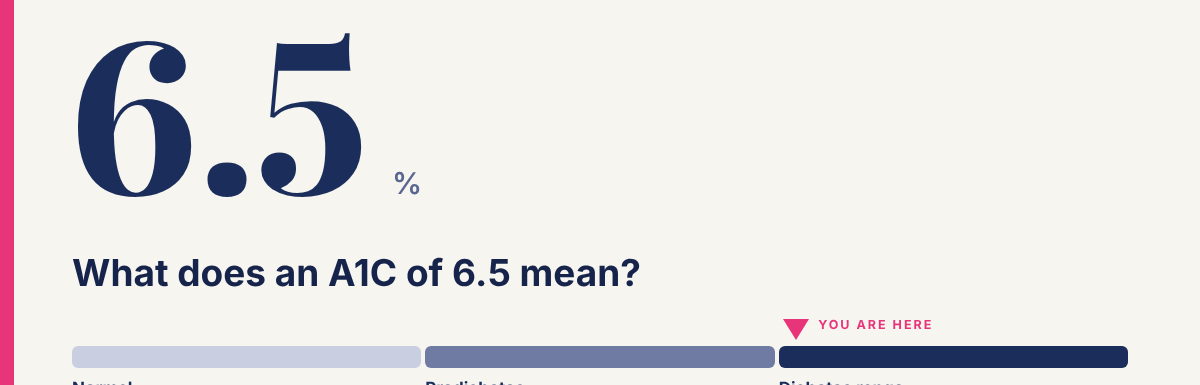
An A1C of 6.5% is the number where the label on a lab report changes from prediabetes to diabetes. If that is your result, you are probably trying to work out whether you have been diagnosed, how sure anyone can be from one test, and what is supposed to happen now. This guide walks through each of those in order.
Quick answer: An A1C of 6.5% is the lowest value in the diabetes range. It equals an estimated average glucose of about 140 mg/dL (7.8 mmol/L), or 48 mmol/mol in international units. One result at 6.5 is not automatically a diagnosis. Unless you have clear symptoms of high blood sugar, the standard is to confirm it with a second test. If you already have diabetes and your A1C is 6.5 on treatment, that is generally within the range many clinicians aim for. This is education, not medical advice.
Free tools: A1C chart with checker and high A1C: start here. Also see the A1C mmol/mol converter and the A1C goal calculator.
Where 6.5 fits
| A1C result | Usual category | Estimated average glucose |
|---|---|---|
| Below 5.7% | Normal range | Below about 117 mg/dL |
| 5.7% to 6.4% | Prediabetes range | About 117 to 137 mg/dL |
| 6.5% or higher | Diabetes range | About 140 mg/dL and above |
These categories come from the American Diabetes Association and are used by the NIDDK and the CDC. The World Health Organization uses the same 6.5% (48 mmol/mol) cut point. A value of 6.5 is the first step into the range, which is why it produces more confusion than a clearly higher number. For results on either side, see an A1C of 6.0 and an A1C of 7.0.
Why the line is drawn at 6.5
The threshold was not chosen because something switches on at 6.5. It was chosen because of the eyes. When an international expert committee reviewed the evidence in 2009, it looked at large population studies that paired A1C values with photographs of the retina. Diabetic retinopathy, the small-vessel eye damage that is specific to diabetes, was rare below about 6.5% and became steadily more common above it. The committee recommended 6.5% as the point where the condition should be named and treated.
Two things follow from that history. First, 6.5 is a reasonable line with real evidence behind it. Second, risk is a slope, not a cliff. Someone at 6.4 is not safe in a way that someone at 6.5 is not. The category matters for what it sets in motion: a confirmed diagnosis opens the door to eye screening, kidney testing, education programs, and insurance coverage for supplies and medicines.
What average blood sugar 6.5 represents
Using the NGSP formula, estimated average glucose in mg/dL = 28.7 x A1C – 46.7. For 6.5 that is 139.85, rounded to 140 mg/dL, or about 7.8 mmol/L.
| A1C (%) | A1C (mmol/mol) | Estimated average glucose (mg/dL) | Estimated average glucose (mmol/L) |
|---|---|---|---|
| 6.0 | 42 | 126 | 7.0 |
| 6.4 | 46 | 137 | 7.6 |
| 6.5 | 48 | 140 | 7.8 |
| 6.6 | 49 | 143 | 7.9 |
| 6.8 | 51 | 148 | 8.2 |
| 7.0 | 53 | 154 | 8.6 |
An average of 140 does not mean every reading is 140. A typical pattern at this level is a fasting glucose somewhere between 110 and 135 mg/dL with rises to 180 or above after larger meals. Some people have nearly normal fasting values and get to 140 through after-meal peaks alone. The average hides the shape. Use the A1C and average glucose calculator to convert other values.
One test is not a diagnosis: how confirmation works
This is the section most people need. The American Diabetes Association diagnostic criteria list four ways to reach the diabetes range.
| Test | Diabetes threshold | Notes |
|---|---|---|
| A1C | 6.5% or higher | Laboratory method that is NGSP certified |
| Fasting plasma glucose | 126 mg/dL or higher | At least 8 hours without calories |
| 2-hour oral glucose tolerance test | 200 mg/dL or higher | Two hours after a 75 g glucose drink |
| Random plasma glucose | 200 mg/dL or higher | Only with classic symptoms or a hyperglycemic crisis |
When a person has no clear symptoms, a diagnosis needs two abnormal results. They can be the same test repeated on a different day, or two different tests, even from the same blood draw. Here is how the common combinations play out.
| What you have | What it usually means |
|---|---|
| A1C 6.5 once, nothing else tested | Not yet confirmed. Expect a repeat A1C or a fasting glucose. |
| A1C 6.5 and fasting glucose 126 or higher from the same draw | Two tests above threshold. This confirms the diagnosis. |
| A1C 6.5, then a repeat A1C of 6.5 or higher | Confirmed. |
| A1C 6.5, then a repeat A1C of 6.3 | Not confirmed. Treated as high-risk prediabetes with close follow-up. |
| A1C 6.5, fasting glucose 112 | The tests disagree. The one above threshold is repeated, and the diagnosis rests on whether it stays above. |
| Random glucose over 200 with strong thirst, frequent urination, weight loss | Diagnosis can be made without a second test. |
If your results disagree, that is common near the threshold and is not a lab error. A1C and fasting glucose capture different parts of the day. See normal fasting glucose with a high A1C and the comparison of A1C, fasting glucose, and the glucose tolerance test.
Lab tests, clinic machines, and home kits
Where the number came from matters at 6.5 more than at any other value, because a tenth of a point decides the category.
- Laboratory A1C from a blood draw: the standard for diagnosis.
- Fingerstick machine in a clinic or pharmacy: fast and convenient for monitoring. The ADA advises that these devices be used for diagnosis only when they are cleared for that purpose and run in a certified laboratory setting. Many are not.
- Mail-in or at-home kits: useful for tracking a trend between visits. They should not be used to diagnose. See home A1C test kits.
- CGM estimates: a glucose management indicator from a sensor is an estimate of A1C from sensor readings. It is not a diagnostic test either.
If your 6.5 did not come from a lab draw, the next step is a lab draw.
6.4, 6.5, and 6.6: how sharp is the line?
Certified laboratory methods are permitted to vary from the reference standard by roughly 5 percent of the value. At 6.5, that is about three tenths of a point in either direction. Good laboratories are usually tighter than that, but a difference of one or two tenths between two draws is ordinary noise.
That is exactly why confirmation is required. A true A1C of 6.4 can report as 6.5 or 6.6 on a given day, and a true 6.6 can report as 6.4. Two results on the same side of the line are far more trustworthy than one.
Beyond random variation, some conditions push A1C away from the true average in a consistent direction.
| Can make A1C read higher than the true average | Can make A1C read lower than the true average |
|---|---|
| Iron deficiency, with or without anemia | Recent blood loss or blood donation |
| Vitamin B12 or folate deficiency anemia | Recent transfusion |
| Having had the spleen removed | Hemolytic anemia |
| Some hemoglobin variants, depending on the lab method | Late pregnancy, erythropoietin treatment, advanced kidney disease |
If one of these applies to you, the ADA guidance is to rely on plasma glucose tests for diagnosis instead. Why A1C can be wrong goes through each condition.
Symptoms, and when it is urgent
At 6.5, most people feel nothing unusual. Average glucose around 140 mg/dL is generally below the level where the kidneys begin spilling glucose into urine, which is what produces the classic thirst and frequent urination. Many people are diagnosed from routine blood work.
Symptoms become more likely as the number climbs: increased thirst, frequent urination, blurred vision, fatigue, slow-healing cuts, frequent infections, tingling in the feet, and weight loss without trying.
Seek urgent care for very high readings with vomiting, abdominal pain, deep or rapid breathing, fruity-smelling breath, confusion, or severe drowsiness. These can be signs of diabetic ketoacidosis or a hyperosmolar state, which are emergencies. They are unusual at an A1C of 6.5 but should never be waited out.
Which type of diabetes?
A1C tells you that average glucose is in the diabetes range. It does not tell you why. In adults, the large majority of new diagnoses are type 2. Clinicians consider other types when the picture does not fit: a lean adult with no family history, rapid onset over weeks, unintentional weight loss, a personal or family history of autoimmune disease, or glucose that does not respond to the usual first treatments. Type 1 diabetes can begin at any age, and a slower adult-onset form is sometimes mistaken for type 2 at first.
If any of that sounds familiar, ask whether autoantibody testing or a C-peptide level would be useful. Certain medicines, including long courses of steroids, and conditions affecting the pancreas can also raise glucose into this range.
If it is confirmed: the first visits
A new diagnosis comes with a baseline workup. The purpose is to find out where everything stands at the start, so that changes can be measured later.
| Check | Why it is done at diagnosis |
|---|---|
| Dilated eye exam | Type 2 diabetes can be present for years before diagnosis, so eyes are checked at the start |
| Urine albumin-to-creatinine ratio and eGFR | Early kidney changes show up in urine before symptoms |
| Foot exam | Baseline sensation and circulation |
| Lipid panel | Cardiovascular risk is managed alongside glucose |
| Blood pressure | The goal for most adults with diabetes is below 130/80 |
| Liver enzymes | Fatty liver is common with type 2 diabetes |
| Referral to diabetes self-management education | Structured education improves outcomes and is usually covered |
| Vaccine review | Several vaccines are specifically recommended with diabetes |
For a step-by-step plan, see what to do in the first 30 days after a type 2 diagnosis and how to read diabetes lab results. For the related numbers, see blood pressure of 130/80 and LDL of 130.
How treatment usually starts
Treatment decisions belong to you and your clinician, and they depend on far more than the A1C. In general terms, care at this level usually has three strands.
- Food, activity, sleep, and weight. These are part of every plan regardless of medication. Being diagnosed at 6.5 means the starting point is close to the goal, so these changes can have a visible effect.
- Medication. Metformin has long been the usual first medicine for type 2 diabetes. Current guidelines also direct clinicians to choose medicines with proven heart and kidney benefits for people who have cardiovascular disease, heart failure, or chronic kidney disease, and to consider weight when it is a major factor. Some people at 6.5 start a medicine immediately, and others agree on a defined trial of lifestyle changes first.
- Monitoring. A1C is typically rechecked about every three months until it is stable at goal, then at least twice a year.
See metformin in plain language, GLP-1 medications for type 2 diabetes, diet for type 2 diabetes, and the complete guide to type 2 diabetes.
Can the number come back down?
A1C at 6.5 can fall, and it often does once someone has a plan. Weight loss has the strongest evidence. In a UK primary care trial called DiRECT, adults with type 2 diabetes diagnosed within the previous six years followed a structured weight management program. After one year, about 46% had an A1C below 6.5% without diabetes medication, compared with 4% in usual care. Results tracked closely with the amount of weight lost and were smaller at two years as some weight returned.
An expert consensus group defines remission of type 2 diabetes as an A1C below 6.5% sustained for at least three months without glucose-lowering medication. That is a clinical term with a specific definition, and whether it applies is for your clinician to determine. It is not a guarantee, it does not happen for everyone, and it needs ongoing monitoring because glucose can rise again. A falling A1C is also never a reason to stop a prescribed medicine on your own.
For the timeline of change, see how quickly A1C can change and weight loss and type 2 diabetes.
If you already have diabetes and your A1C is 6.5
For someone with established diabetes, 6.5 means something different. The ADA describes an A1C goal below 7% as appropriate for many adults, and a tighter goal such as below 6.5% as reasonable for some people if it can be reached without significant low blood sugar or other burdens. An A1C of 6.5 on treatment is therefore at or better than goal for most adults.
The question to ask is how you got there. If you take insulin or a sulfonylurea, an A1C of 6.5 that includes frequent lows is not the same as a 6.5 with steady readings. For older adults and people with several health conditions, a goal this tight may carry more risk than benefit. See A1C goals by age.
Scenarios by situation
These are hypothetical illustrations, not case histories.
Routine physical, A1C 6.5, no symptoms, fasting glucose not checked. Unconfirmed. A repeat A1C or a fasting glucose within a few weeks settles it. In the meantime, nothing is lost by starting to walk after meals.
A1C 6.5 and fasting glucose 131 on the same report. Two tests above threshold. This meets the criteria, and the next step is the baseline workup.
A1C 6.5, known iron deficiency. Iron deficiency can raise A1C. A fasting glucose or a glucose tolerance test gives a cleaner answer.
A1C 6.2 last year, 6.5 now. Even if the repeat comes back at 6.4, the direction is clear. This is the high end of prediabetes and deserves the same seriousness.
Diagnosed two years ago at 8.1, now 6.5 on metformin. At goal for most adults. The plan is to maintain, keep up screening, and retest about twice a year.
Questions for your clinician
- Does this result need to be confirmed, and with which test?
- Was this a laboratory A1C or a fingerstick device?
- Could anemia, iron deficiency, kidney disease, or a hemoglobin variant be affecting my A1C?
- Does anything about my history suggest a type other than type 2?
- Which baseline checks do I need: eyes, kidneys, feet, lipids?
- What A1C goal makes sense for me?
- Are we starting a medicine now, or trying a defined period of lifestyle changes first? When do we reassess?
- Can you refer me to a diabetes education program?
Bottom line by situation
| Situation | Bottom line |
|---|---|
| One A1C of 6.5, no symptoms | In the diabetes range but not yet confirmed; get the second test |
| Two results at or above threshold | Confirmed; start the baseline workup and a plan |
| 6.5 followed by 6.3 or 6.4 | High-risk prediabetes; follow closely |
| 6.5 from a home kit or pharmacy device | Get a laboratory test |
| 6.5 with a condition affecting red blood cells | Use glucose-based testing |
| 6.5 on treatment for known diabetes | At goal for most adults; check that lows are not the price |
Frequently asked questions
Is an A1C of 6.5 diabetes?
It is the lowest value in the diabetes range. Without clear symptoms, a diagnosis requires a second abnormal result, either a repeat A1C or another test such as fasting glucose.
What is the average blood sugar for an A1C of 6.5?
About 140 mg/dL, or 7.8 mmol/L, as an estimated average over the previous two to three months.
What is 6.5% in mmol/mol?
About 48 mmol/mol, which is the international diagnostic threshold.
Is 6.5 type 2 diabetes?
A1C does not identify the type. Most adults diagnosed at this level have type 2, but clinicians consider type 1 and other causes when the history does not fit.
Can an A1C of 6.5 be wrong?
It can be off by a tenth or two from normal lab variation, and conditions such as iron deficiency or recent blood loss can shift it further. That is why a second test is required.
My A1C is 6.5 but my fasting glucose is normal. Which is right?
Both can be accurate, because they measure different things. The test above the threshold is usually repeated, and the diagnosis depends on whether it stays above.
Do I need medication at 6.5?
It depends on your overall health, other conditions, and preferences. Some people start metformin at diagnosis and others begin with a defined period of lifestyle changes. This is decided with your clinician.
Can an A1C of 6.5 come down without medication?
It can in some people, particularly with weight loss and regular activity. Results vary, and the decision about whether medication is needed belongs with your clinician.
Is 6.5 a good A1C for someone with diabetes?
For most adults on treatment it is at or better than the usual goal of below 7%. It is less clearly good if it comes with frequent low blood sugar, or in older adults with several health conditions.
What is the difference between 6.4 and 6.5?
The category changes from prediabetes to diabetes, but the health difference between the two is small. Both call for action and follow-up.
Will I have symptoms at 6.5?
Most people do not. Symptoms such as thirst and frequent urination become more likely at higher levels.
How soon should I retest?
A confirming test is usually done within days to weeks. After a plan is started, A1C is commonly rechecked in about three months.
Can a home A1C kit diagnose diabetes?
No. Home kits are for tracking. Diagnosis should be based on a laboratory test.
Does a diagnosis at 6.5 mean complications are coming?
No. Being found at the threshold means the condition was caught early. Keeping glucose, blood pressure, and cholesterol at goal and attending screening visits lowers the risk of complications substantially.
About the author: Charles Kirkland is the founder of Metabolic Clarity Labs and author of The Journey Back. He is not a physician. This is general education, not a medically reviewed treatment plan.
Sources checked November 12, 2026: NIDDK, CDC, NGSP, the American Diabetes Association Standards of Care, and the DiRECT trial. Do not start, stop, or change prescribed treatment based on this article.